
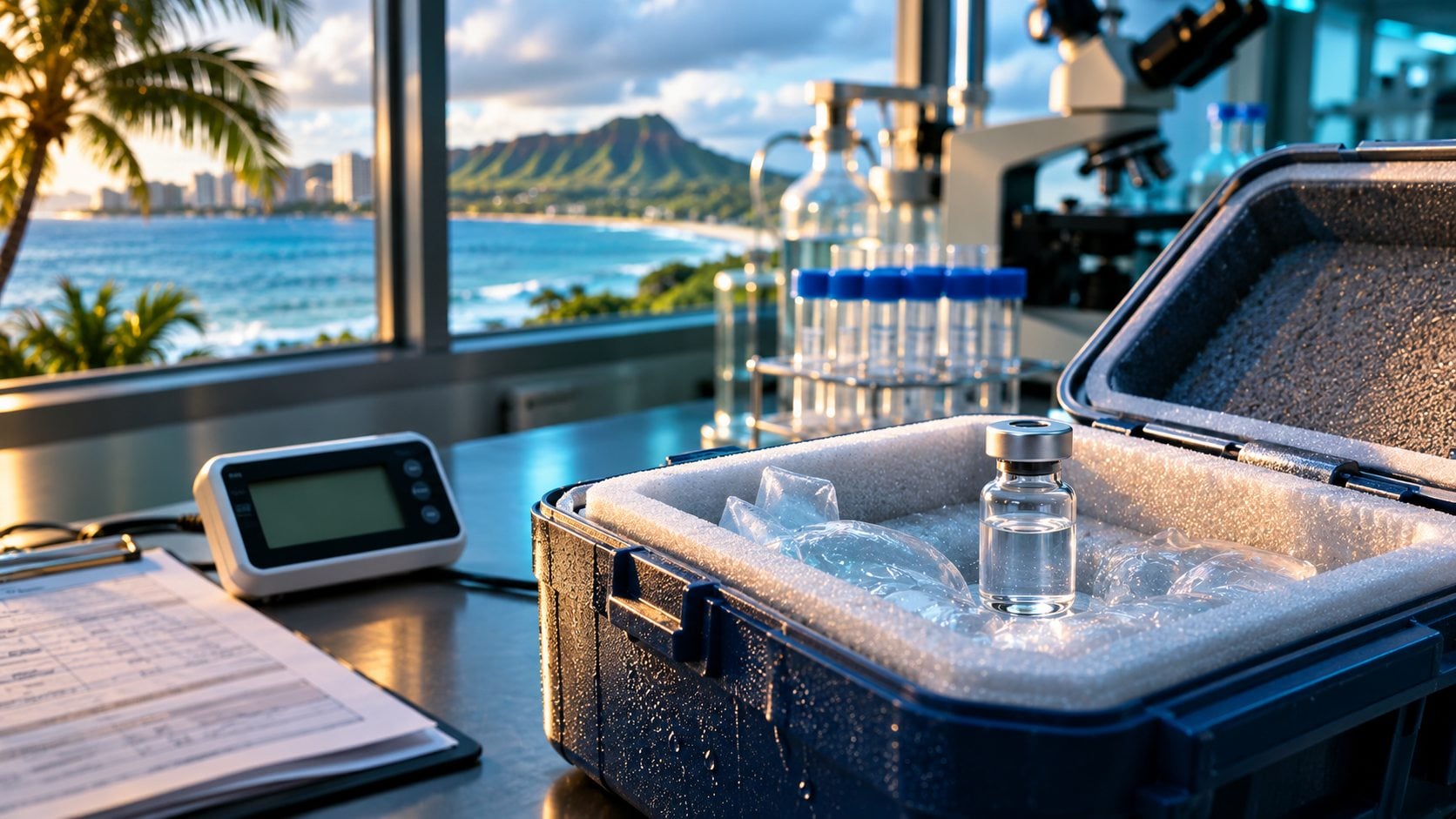


A research sample can leave a laboratory with a documented identity and a satisfactory analytical result, yet arrive at another facility with unanswered questions about its condition. Between those two points, it may have passed through warehouses, airport cargo facilities, delivery vehicles and temporary storage areas. Each transfer adds information that can matter to scientific interpretation, even when the package appears undamaged.
For peptide researchers, the problem is not simply the distance traveled. It is the absence of a complete record of what happened during that distance. A laboratory certificate may describe a sample when it was originally tested, but it cannot automatically establish that the material remained unchanged during subsequent transportation.
Hawaii provides a useful geographic example. Materials traveling to or between islands may involve air transportation, multiple handling stages and varying storage environments. None of these circumstances automatically damages a research sample. Their importance depends on the substance, packaging, exposure conditions and scientific questions being investigated.
Understanding those distinctions can help researchers separate actual evidence of material quality from assumptions based on a shipping label or an earlier laboratory report.
Why the Journey Begins Before a Package Is Shipped
The scientific history of a research material begins well before a carrier accepts the parcel. Its composition, preparation, packaging and initial analytical characterization all influence how later observations should be interpreted.
Peptides are molecules composed of amino acids connected through peptide bonds. They vary considerably in sequence, structure, chemical modifications and physical characteristics. As a result, the stability behavior of one peptide cannot automatically be applied to every other peptide.
Some compounds may undergo chemical changes under particular environmental conditions. Depending on their molecular characteristics, relevant mechanisms can include oxidation, hydrolysis, deamidation or other reactions. The conditions that make these changes significant must be established through evidence, not inferred from the general word “peptide.”
Likewise, the starting material’s physical form and surrounding components can influence its behavior. An analytical result obtained from one preparation cannot necessarily predict the behavior of a different preparation.
The first useful question is therefore not whether a package traveled far. It is whether the scientific record establishes the material’s original condition and provides a defensible basis for evaluating later changes.
The Temperature Record That a Delivery Confirmation Cannot Provide
A delivery confirmation establishes that a shipment reached a destination according to the carrier’s records. It does not ordinarily establish the complete temperature history of the contents.
A package might encounter several environments during transportation. These could include a controlled indoor facility, a vehicle exposed to outdoor conditions and a storage area with a different temperature profile. The duration of each exposure may matter as much as the highest or lowest temperature reached.
Temperature effects are substance-specific. Some chemical reactions proceed more rapidly at higher temperatures, but the degree of change depends on the relevant mechanism and material. It is not scientifically defensible to assume a universal degradation rate for research peptides.
The International Council for Harmonisation addresses temperature, humidity and time in its Q1A(R2) guidance, Stability Testing of New Drug Substances and Products. The guideline was finalized at Step 4 in February 2003 and adopted by the FDA in November 2003.
Although Q1A(R2) is intended for regulated drug development rather than every type of laboratory reagent, its central methodological principle is broadly informative: stability conclusions require evidence collected under defined conditions and over meaningful periods.
For a research shipment, an appropriate temperature record can help identify environmental exposure. However, the record alone does not prove that a chemical change occurred. That conclusion requires a relationship between the recorded conditions and suitable evidence about the material.
Why an Ocean Crossing Is a Scientific Documentation Problem
Hawaii’s geography makes the movement of materials across long distances particularly relevant. Research materials arriving from mainland locations may pass through more than one organization before reaching their intended destination.
Every change of custody introduces the possibility of a documentation gap. A handoff may be recorded accurately, incompletely or at a level of detail that does not answer the researcher’s scientific questions.
For example, knowing when a package departed and arrived may be insufficient to reconstruct what occurred between those events. Conversely, detailed transport records can be useful even when no problem is ultimately identified.
The scientific purpose of documenting transport is not to assume that carriers are unreliable. It is to establish a traceable history that can be reviewed when questions arise.
The World Health Organization’s 2011 guidance on storage and transport of time- and temperature-sensitive pharmaceutical products discusses systems for maintaining suitable distribution conditions. Its requirements apply to its defined pharmaceutical context, but the underlying concepts of risk assessment, monitoring and accountable handoffs can inform research-material management.
Those concepts should not be converted into claims that every peptide reagent requires pharmaceutical cold-chain handling. Appropriate conditions depend on the specific material and its demonstrated characteristics.
How Packaging Changes the Meaning of Environmental Exposure
Packaging is sometimes treated as a simple protective barrier. Scientifically, its performance is more specific. Different packaging materials and configurations can provide different degrees of protection against environmental influences and physical damage.
Moisture exposure may be relevant to some research materials, while light exposure, oxygen contact or physical movement may matter for others. A container that protects effectively against one concern may not address every possible source of change.
ICH Q1A(R2) recognizes that the container-closure system is relevant when evaluating the stability of regulated drug substances and products. This does not mean every research sample must use a pharmaceutical container. It means conclusions about environmental protection should be supported by evidence appropriate to the sample.
Visual inspection can reveal certain problems, such as obvious physical damage or unexpected changes in appearance. However, an unchanged appearance cannot establish chemical identity, unchanged composition or complete freedom from degradation.
A container may look intact while a measurement detects a chemical difference. Equally, a cosmetic packaging defect does not automatically establish that the material inside has changed. Each observation needs to be evaluated according to what it actually demonstrates.
Careful documentation helps distinguish these circumstances without turning ordinary shipping observations into unsupported scientific conclusions.
Why a Certificate of Analysis Has a Time Boundary
A certificate of analysis summarizes selected measurements associated with a material or batch. It may identify the test method, analytical result, reference information and testing date.
The date matters because analytical testing describes the material under the circumstances in which it was examined. A result obtained before transportation is not automatically equivalent to a measurement performed after the journey.
Suppose a sample was characterized before shipment and subsequently experienced an environmental condition that was not covered by available stability evidence. The earlier result may still be valid as a historical record. It simply may not resolve questions about the sample’s condition at the time of a later experiment.
This distinction is particularly important when researchers compare findings from different laboratories. An unexpected result might relate to experimental methods, sample history, analytical variability or an entirely different factor.
Rather than assuming that the original certificate was wrong, investigators should establish which questions the original test answered and which questions remain open.
That approach preserves the value of existing data while avoiding the mistaken assumption that one analytical result applies indefinitely under every possible condition.
Analytical Methods Must Be Appropriate for the Question
If researchers suspect a material has changed, they need analytical methods suitable for the characteristics under investigation. The choice of method depends on whether the question concerns chemical identity, the presence of additional components, relative composition or another defined property.
Chromatographic techniques can separate components within a sample under specified analytical conditions. Mass spectrometry may provide molecular information useful for identifying or characterizing substances.
Neither technique should be treated as universally sufficient. A method can produce a valid measurement while remaining unable to detect a particular change outside its intended analytical scope.
The FDA’s March 2024 final guidance, Q2(R2) Validation of Analytical Procedures, describes principles for demonstrating that analytical procedures are appropriate for their intended use.
Relevant characteristics include specificity or selectivity, precision, accuracy and other performance attributes chosen according to the purpose of the measurement.
For stability questions, the ability to distinguish the original substance from relevant changes can be particularly important. Yet the mere use of sophisticated equipment does not prove that a method has been suitably validated for a specific research question.
The scientific strength of a result depends on the method, its supporting evidence and the appropriateness of the conclusion drawn from it.
What Happens When Two Laboratories Report Different Results?
Conflicting laboratory results can generate uncertainty even when both teams followed established internal procedures. The discrepancy may arise because the laboratories tested different portions of material, used different analytical methods or examined samples with different histories.
Measurement uncertainty also matters. Every quantitative measurement has limitations, and small apparent differences may not represent meaningful changes unless they exceed the relevant analytical variability.
The first response to conflicting results should be a structured investigation rather than an immediate accusation of poor testing.
Researchers can compare the stated measurement objectives, sample identifiers, testing dates, analytical techniques and supporting records. They can also assess whether the results are genuinely comparable or answer different scientific questions.
For example, a method designed to evaluate one chemical characteristic may not detect a change that another method was designed to measure.
If the shipment history differs between samples, that distinction may provide a useful hypothesis. It should not be presented as the cause until evidence supports the explanation.
Scientific confidence improves when discrepancies are investigated transparently and competing explanations are considered.
The Difference Between Research Education and Verified Laboratory Performance
Educational information about peptide chemistry can help readers understand why identity, analytical results and sample histories deserve separate attention.
Resources such as Peptides Hawaii can be considered within the broader discussion of research-related information. However, any specific technical claim found on a commercial or educational website should be checked against suitable scientific evidence.
A website explaining temperature sensitivity does not thereby establish that its organization has conducted stability studies. Similarly, describing chromatography does not prove that a particular material was tested by that method.
Readers should distinguish between general scientific education, statements about an organization’s activities and documented results for specific materials.
Organizational information can provide context about responsibility for published material. The page containing information about Peptides Hawaii is a possible starting point for understanding the website’s background, although that information should not be treated as independent laboratory validation.
Maintaining these distinctions helps prevent scientific terminology from becoming an unsupported claim of testing, certification or product quality.
Why Scientific Records Need More Than a Tracking Number
A tracking number is useful for locating a shipment within a transportation system. A scientifically meaningful sample record must answer additional questions.
Researchers may need to establish which material was involved, when its relevant characteristics were measured, how it was identified and whether the available records refer to the same material used in the experiment.
Documentation quality depends on continuity. A collection of individual records may appear complete while still failing to establish the relationship between one event and the next.
A certificate associated with one batch does not necessarily describe another. A temperature record from one package does not automatically represent an accompanying package. Even accurate records can support misleading conclusions when they are connected to the wrong material.
Good traceability therefore concerns the relationships between records, not simply their existence.
The FDA’s December 2018 guidance on Data Integrity and Compliance With Drug CGMP addresses reliable and accurate data within the regulated manufacturing context. Its requirements should not be assumed to apply identically to all research websites or suppliers, but its emphasis on reliable supporting records illustrates why data integrity matters.
For scientific interpretation, incomplete documentation can create uncertainty even when the physical sample appears normal.
What Researchers Should Ask When Information Is Missing
Uncertainty does not always indicate a defective material. It may indicate that the available information is insufficient to support a particular conclusion.
When reviewing published information, readers can ask whether a statement is based on original measurements, peer-reviewed findings, a regulatory source or a general explanation.
They can also ask which observations support the conclusion and whether important limitations have been disclosed.
For organization-specific questions, a published contact route may help clarify what information is available. The Peptides Hawaii contact page provides a destination for inquiries directed to that website. Any response containing scientific claims should still be assessed against appropriate evidence.
These questions are especially useful when terminology such as purity, stability, traceability and analytical verification appears together. The terms describe different concepts and should not be used interchangeably.
Readers do not need to assume that missing records prove misconduct. They should also avoid treating unexplained gaps as evidence that every necessary check has been performed.
Why a Shipment’s History Can Change the Interpretation of an Experiment
Experimental findings are interpreted in relation to the material, methods and conditions involved. A research sample’s history can become an important variable when investigators attempt to explain an unexpected result.
A failed experiment does not automatically establish that transportation caused a problem. Differences in experimental design, biological models, analytical methods and ordinary measurement variability may provide alternative explanations.
Nevertheless, a documented material history allows investigators to evaluate possibilities that would otherwise remain hidden.
The lesson from stability science is not that every shipment requires the same conditions or that every environmental change causes degradation. It is that researchers should avoid making claims beyond the evidence available for a particular material.
Hawaii’s geographic separation provides a useful way to understand the importance of long-distance documentation, but the scientific principles apply equally to mainland routes, international research shipments and transfers between nearby facilities.
Ultimately, an arrival scan establishes delivery, an analytical report describes specified measurements and an experimental result addresses a separate scientific question. None automatically proves the others.
Reliable research depends on keeping those claims distinct and connecting them with appropriate evidence when the scientific question requires it.