



Think “full coverage” means you’re fully protected?
Not exactly. Progressive builds policies from three blocks—liability, collision, and comprehensive—and each choice changes what you pay now versus what the insurer covers later.
This post breaks down each tier, shows how deductibles and add-ons like roadside or gap insurance change the math, and points out the common trade-offs.
Read on to pick the coverage level that fits your car, your budget, and the real risks you want to avoid.
Overview of Progressive Auto Insurance Coverage Levels

Progressive stacks auto policies from three building blocks: liability (the legal floor in most states), collision (your car’s crash repairs), and comprehensive (theft, hail, vandalism). You can pick them in different combos, anything from bare minimum liability to a fully loaded plan with extras. Each choice shifts what you pay now versus what the insurer covers later.
“Minimum coverage” usually means your state’s required liability limits. Think 25/50/25: $25k bodily injury per person, $50k bodily injury total per accident, $25k property damage. That tier covers harm you cause to others. Your own repair bills? Entirely on you. “Full coverage” throws in collision and comprehensive, typically with a $250, $500, or $1,000 deductible. Depending on your car’s worth, your record, and where you live, full coverage can bump your premium anywhere from 20% to 60% over liability alone. Enhanced tiers add roadside help, rental backup, gap insurance, uninsured motorist protection—basically turning a basic policy into broader financial backup.
What you get at each Progressive tier:
- Minimum liability: Just your state’s required bodily injury and property damage. No help fixing your car. Cheapest premium, biggest personal risk.
- Standard full coverage: Liability plus collision and comprehensive, often with a $500 deductible. Protects your vehicle and others. Smart for any car worth more than a couple thousand or anything financed or leased.
- Mid-tier options: Liability plus either comprehensive or collision, not both. Used when one risk runs higher or budget’s tight.
- Enhanced/high-limit plans: Higher liability caps (100/300/100 or even 250/500/100), lower deductibles ($250), and multiple add-ons like roadside, rental, gap, and uninsured motorist. Priciest premium, widest safety net.
- Add-on customization: Any tier can get extras tacked on—medical payments, personal injury protection, glass coverage, accident forgiveness. Lets you tailor protection without jumping to the next full tier.
Minimum Liability Coverage at Progressive and What It Pays For

Liability’s the only part most states legally require. It covers injuries and property damage you cause when you’re at fault. Common minimums look like 25/50/25 (bodily injury per person / bodily injury per accident / property damage), 30/60/25, or 15/30/5 depending on your state. The first number caps what the policy pays one injured person, the second caps total payout for everyone hurt in a single crash, the third caps property damage.
Carry only minimum liability and your policy pays nothing toward fixing your own car, no matter who caused the wreck. It also won’t touch your medical bills unless you add separate medical payments or personal injury protection. When damage or injuries blow past your limits, you’re personally on the hook for the rest—through a settlement, lawsuit, or straight out of your savings.
| Limit Set | What It Covers |
|---|---|
| 25/50/25 | $25,000 max per injured person; $50,000 max per accident for all injuries; $25,000 max for property damage |
| 50/100/50 | $50,000 per person; $100,000 per accident; $50,000 property damage |
| 100/300/100 | $100,000 per person; $300,000 per accident; $100,000 property damage |
| 250/500/100 | $250,000 per person; $500,000 per accident; $100,000 property damage |
Big risk with minimum liability: lawsuits that tap into your home equity, wages, or retirement if you cause a bad crash and your limits evaporate. Injure someone seriously or total an expensive car and 25/50/25 can disappear fast, leaving you staring down six-figure claims.
Progressive Full Coverage: Collision and Comprehensive Explained

“Full coverage” is just shorthand for liability plus both collision and comprehensive. Protects your vehicle and everyone else’s. Collision pays to fix or replace your car after you crash into another vehicle or object like a guardrail, tree, fence. Comprehensive covers almost everything else: theft, fire, hail, flood, vandalism, hitting a deer, windshield cracks. Both need you to pick a deductible, the chunk you pay before the insurer steps in.
Collision Coverage Breakdown
Collision deductibles usually run $250 to $1,000. Your car takes $4,500 damage in a fender bender and you carry a $500 deductible? You write a check for $500, Progressive covers the other $4,000 to the shop. Raise that deductible to $1,000 and your monthly premium drops, but your share at claim time goes up. You’d pay $1,000, insurer covers $3,500 for the same $4,500 repair.
Formula’s simple: policy payout = repair cost minus deductible. If repairs fall below your deductible, insurer pays nothing and you handle it yourself. Collision also covers total losses. If your car’s declared totaled, Progressive pays actual cash value (market value after depreciation) minus your deductible.
Comprehensive Coverage Breakdown
Comprehensive uses the same deductible setup but applies to non-collision events. Stolen catalytic converter, windshield chip, storm damage, animal strike. Windshield replacement costs $400, you’ve got a $250 comprehensive deductible? You pay $250, Progressive pays $150. Some policies offer separate glass coverage with a lower or zero deductible for windshields, making small fixes easier on the wallet.
Full coverage makes sense when your car’s worth more than a few thousand bucks, especially if it’s financed or leased. Lenders and lessors almost always require collision and comprehensive to protect their stake. Even if you own it outright, both coverages shield you from big repair bills or total-loss scenarios that would otherwise drain your emergency fund.
Optional Add-Ons That Change Progressive Coverage Levels
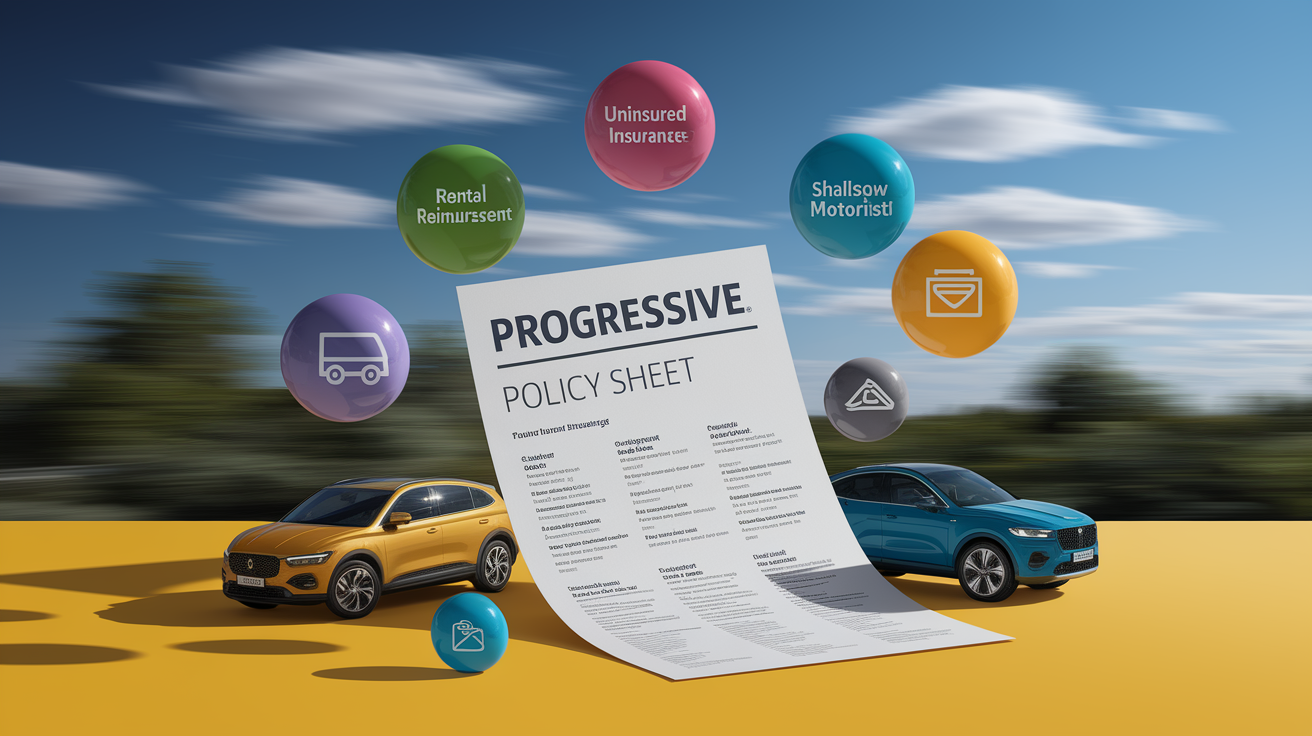
Add-ons (also called endorsements) let you expand a basic policy into custom protection. Progressive offers several that tackle specific risks or fill gaps left by standard liability, collision, and comprehensive.
-
Uninsured/Underinsured Motorist (UM/UIM): Covers your injuries, lost wages, sometimes vehicle damage when the at-fault driver has no insurance or limits too low to pay your bills. Smart to match or beat your own bodily injury limits. Cost swings widely by state, often under $50 to several hundred per year depending on location and chosen limits.
-
Personal Injury Protection (PIP) or Medical Payments (MedPay): Pays your medical bills and sometimes lost income no matter who caused the crash. Common limits include $1,000, $5,000, or $10,000. PIP’s mandatory in no-fault states; MedPay’s optional elsewhere. Usually runs a few bucks to around $20 monthly depending on the limit.
-
Roadside Assistance: Towing, jump starts, fuel delivery, lockout service, flat-tire changes. Typically $3 to $15 per month ($36 to $180 yearly). Handy if you drive an older car or don’t have a separate roadside membership.
-
Rental Reimbursement: Pays for a rental while your car’s being fixed after a covered claim. Common daily limits are $20 to $50, total caps around $600 to $1,500. Monthly cost usually $5 to $25. Worth it if you rely on your car for work or school and can’t afford even a few days without wheels.
-
Gap Insurance (Loan/Lease Payoff): Covers the gap between your car’s actual cash value and your remaining loan or lease balance if it’s totaled. Runs $10 to $30 monthly. Especially important in the first two to four years of a loan, when depreciation can leave you upside down.
-
Glass Coverage or Full Glass: Some Progressive policies offer windshield repair or replacement with reduced or zero deductible. Cost’s usually modest, under $10 monthly in many cases, and saves you from paying full comprehensive deductible for a cracked windshield.
Add-ons basically let you build an enhanced tier without locking into the highest pre-packaged level. Stack roadside, rental, gap, and UM/UIM on top of full coverage and you’ve turned a standard plan into serious financial backup, though each addition nudges your total premium higher. If you drive where uninsured drivers are common, carry a loan with negative equity, or depend on daily transportation, these extras often earn their keep in a single claim.
Coverage Level Cost Comparisons and Deductible Impacts

Premiums jump when you add collision, comprehensive, higher liability limits, or optional coverages. Full coverage (liability plus collision and comprehensive) commonly costs 20% to 60% more than minimum liability, depending on your car’s value, your age, record, and ZIP code. If minimum liability runs $600 yearly, tossing in collision and comprehensive with a $500 deductible might push annual premium to around $900 to $1,200.
Deductibles work like a direct cost lever. Raise your collision and comprehensive deductible from $500 to $1,000 and you can trim premium by roughly 10% to 25%, but you’ll pay an extra $500 out of pocket in any claim. Drop from $500 to $250 and your premium climbs but your immediate expense when something breaks falls. Optional add-ons like roadside and rental typically add less than $100 yearly combined. Gap insurance might tack on $120 to $360 annually depending on vehicle and lender.
| Change | Typical Cost Impact | Risk Trade-Off |
|---|---|---|
| Raise deductible $500 → $1,000 | Reduce premium ~10%–25% | Save monthly; pay $500 more per claim |
| Increase liability 25/50/25 → 100/300/100 | Increase premium moderately (varies widely by state and profile) | Protect assets; reduce lawsuit exposure |
| Add collision coverage | Increase premium significantly (depends on vehicle value) | Insurer pays most crash repair costs minus deductible |
| Add comprehensive coverage | Increase premium moderately (often less than collision) | Cover theft, weather, vandalism minus deductible |
| Add roadside + rental + gap | Add ~$200–$500/year combined (varies by vehicle and limits) | Gain towing, loaner car, loan‑balance protection |
Best cost-value balance usually involves carrying higher liability limits than your state minimum (100/300/100 protects most drivers’ assets), picking a deductible that matches your emergency savings (if you can handle $1,000 comfortably, grab the lower premium), and adding only extras you actually need. Dropping collision and comprehensive on a car worth less than $3,000 to $5,000 often makes sense if repair costs would approach the vehicle’s value anyway.
Real-World Examples Showing Progressive Coverage Levels in Action

Numbers make coverage differences real. These scenarios show how limits, deductibles, and add-ons play out when claims actually happen.
Liability-Only Example
You carry minimum 25/50/25 liability and cause a two-car crash. Other driver suffers a broken leg and soft-tissue injuries totaling $40,000 in medical bills and lost wages. Your policy covers $25,000 per person, sticking you personally with the remaining $15,000. Other driver’s lawyer files suit and you settle by agreeing to a payment plan that taps your savings and garnishes part of your paycheck for two years. If you’d carried 100/300/100 limits, the full $40,000 would’ve been covered by your insurer with no out-of-pocket exposure beyond your deductible (which doesn’t apply to liability claims, so you pay nothing directly in a covered liability claim; insurer pays the claimant up to your limit).
Full Coverage Collision Example
Your car gets rear-ended in stop-and-go traffic. Repair estimate comes back at $5,200. You carry full coverage with a $500 collision deductible. You pay the body shop $500; Progressive pays the remaining $4,700. If you’d chosen a $1,000 deductible to save $15 monthly on premiums, you’d pay $1,000 and insurer would cover $4,200. Over two years, higher deductible saves you $360 in premiums ($15/month times 24 months) but costs you an extra $500 in this single claim. Net outcome depends on your claim frequency.
Gap & UM/UIM Example
You financed a new SUV two years ago. Loan balance is still $28,000, but vehicle’s actual cash value after depreciation is only $22,000. Hailstorm totals the car. Your comprehensive coverage (with a $500 deductible) pays $21,500 ($22,000 ACV minus $500). Without gap insurance, you still owe the lender $6,500 out of pocket to close the loan. With gap coverage, Progressive pays that $6,500 difference and you walk away owing nothing.
Different scenario: uninsured driver runs a red light and T-bones your car, sending you to the hospital with $18,000 in medical bills and rehab costs. You carry uninsured motorist coverage with a $25,000 per-person limit. Your UM coverage pays the full $18,000 (subject to any applicable deductible and policy terms), sparing you from chasing an uninsured driver through small-claims court or eating the cost yourself.
How to Choose the Right Progressive Coverage Level

Start by checking your car’s current market value, your loan or lease status, your personal assets, and how much cash you keep for emergencies. These five steps guide you toward the tier and options that actually fit.
-
Check your vehicle’s age and value. Look up actual cash value using Kelly Blue Book or similar. If the car’s worth less than $3,000 to $5,000 and you own it outright, dropping collision and comprehensive might make sense. Repair costs after a moderate accident could approach or exceed the car’s value, and you’d only get that depreciated amount minus your deductible anyway.
-
Figure out loan or lease requirements. Lenders and lessors almost always mandate collision and comprehensive. If you’re financing or leasing, you’ll need full coverage. Add gap insurance if your loan balance tops the vehicle’s current value, which is common in the first two to four years.
-
Pick liability limits based on your assets. If you own a home, have decent retirement savings, or earn good income, carry at least 100/300/100 liability, preferably higher. Lower limits like 25/50/25 can vanish fast in a serious crash, exposing your bank accounts, home equity, and wages to lawsuits.
-
Match deductible to your emergency fund. If you keep $1,000 or more in accessible savings and rarely file claims, choose a $1,000 deductible to lower your premium. If an unexpected $1,000 hit would strain your budget, stick with $500 or even $250. You’ll pay more monthly but won’t scramble for cash after a fender bender.
-
Weigh add-ons for your situation. Add uninsured motorist coverage if your state has high rates of uninsured drivers. Include roadside help if you drive an older car or lack AAA. Carry rental reimbursement if you can’t afford to miss work while your car’s in the shop. Skip add-ons that duplicate coverage you already have elsewhere. For example, if your health insurance covers accident-related medical bills well, you may not need high PIP or MedPay limits.
New and teen drivers face higher premiums across all tiers due to inexperience and statistically higher accident rates. Keeping a teen on a parent’s policy with a modest, older vehicle and higher deductibles can control costs. Once the teen has a clean record for a few years, revisit liability limits and consider lowering deductibles. For any driver, life changes (buying a home, getting married, having a baby, switching jobs) are good moments to review coverage and adjust limits or add-ons to match new risks and assets.
Final Words
in the action, we covered Progressive’s three main tiers: minimum liability, full coverage (collision + comprehensive), and enhanced add-ons. We explained how deductibles and limits change what a claim pays and the typical price differences to expect.
Use the simple checklist to weigh vehicle value, loan status, deductible comfort, and extra protections. This wraps up progressive coverage levels explained and gives you a clear way to pick a fit-first plan. You’re set to compare options and choose coverage that matches your risk and budget.
FAQ
Q: What is a good coverage level?
A: A good coverage level balances protecting your assets and your budget; for most drivers that means at least 100/300/100 liability plus collision and comprehensive if your car is worth more than $5,000.
Q: What does $100 k /$ 300k /$ 100k mean?
A: The $100k/$300k/$100k numbers mean $100,000 bodily injury per person, $300,000 per accident, and $100,000 property damage, which are the limits insurers pay for others’ injuries and property when you’re at fault.
Q: What are the 4 types of insurance coverage?
A: The four main auto coverage types are liability, collision, comprehensive, and uninsured/underinsured motorist (or personal injury protection/medical payments), each covering different costs after an accident.
Q: What are the levels of car insurance Progressive?
A: Progressive’s coverage levels are minimum liability, standard or full coverage (adds collision and comprehensive), and enhanced tiers with optional add-ons like UM/UIM, roadside, rental reimbursement, and gap coverage.