



Think travel insurance won’t cover your pre-existing condition? Not true, but only if you meet strict rules.
Many policies exclude past illnesses, yet most major insurers offer a pre-existing condition waiver that can pay for emergency care, evacuation, or trip cancellation when your condition is stable and you buy the policy on time.
This article explains how waivers work, what look-back and stability windows to watch, common reasons claims get denied, and the best policies and providers to consider so you can travel with more confidence.
Understanding Coverage Options for Travelers With Pre‑Existing Medical Conditions

A pre-existing medical condition is basically any illness, injury, symptom, medical exam, treatment, or medication change that happened during an insurer’s look-back period before you buy your travel policy. That window usually runs 60 to 180 days, though some insurers stretch it to a full year. Here’s the thing: you don’t even need a formal diagnosis for something to count. If you saw a doctor, filled a new prescription, tweaked a dosage, or scheduled a medical test during that time frame, the insurer’s going to flag it as pre-existing. Within two months of buying your policy, you switched from one blood pressure pill to another. Even if the condition itself was stable for years, that medication change resets the clock.
The concept of “medically stable” drives how insurers decide whether to cover a pre-existing condition. Stable generally means your condition hasn’t required new or changed treatment, no medication adjustments, no new diagnostic tests or procedures, and no new symptoms for 60 to 90 days before you purchase the policy. If you had an MRI scheduled, started physical therapy, or increased your insulin dose within that stability window, the condition’s considered unstable. Insurers apply continuous treatment clauses to figure out whether any break or change in care signals worsening health. Dosage changes, even minor tweaks, usually disqualify you from meeting the stability requirement.
A pre-existing condition waiver removes the standard exclusion, letting the insurer cover emergency medical care, trip cancellation, or medical evacuation tied to that condition. To secure a waiver, you’ve got to meet three core requirements:
Buy the policy within the insurer’s purchase window, usually 14 to 21 days of making your first trip deposit. Insure the full nonrefundable trip cost. Partial coverage often disqualifies the waiver. Be medically stable for the required period, commonly 60 to 90 days before purchase. Have no medication or treatment changes during the stability window. Dosage adjustments count as changes. Be medically fit to travel when you buy the policy. Some insurers require a doctor’s note confirming you can safely travel. Disclose all conditions honestly on the application. Undisclosed conditions can void coverage at claim time.
Not all policies offer pre-existing condition waivers. Annual multi-trip plans rarely include this coverage. Waivers are almost exclusively available on single-trip comprehensive policies purchased for a specific journey. If you buy outside the waiver window or fail to meet the stability criteria, pre-existing related claims will be denied, and you’ll receive only the coverage that applies to new medical emergencies unrelated to your history.
How Insurers Evaluate Your Medical History

Insurers commonly review medical records tied to the look-back period, typically the 60 to 180 days before you purchase the policy. During claims assessment, underwriters request prescription histories, hospital records, physician notes, and test results to confirm whether the condition was stable and whether any new symptoms, medication changes, or scheduled procedures occurred. Some insurers perform this review at the point of application through health questionnaires and medical screening. Others rely on a “benefit of good faith” approach and postpone the detailed review until a claim’s filed. You assumed your hypertension was covered because you clicked ‘yes’ on the form. But when you filed a claim for a stroke, the insurer pulled your pharmacy records and found a dose increase two weeks before you bought the policy.
Changes in symptoms, medications, or diagnostic tests during the look-back period almost always trigger a pre-existing determination. If your doctor ordered a stress test, adjusted your thyroid medication, or referred you to a specialist within that window, the insurer will classify the related condition as unstable. Even benign changes like switching from a brand-name drug to a generic at the same dose can raise flags, because underwriters interpret any prescription modification as evidence of active management rather than stable control.
Insurers assess risk by cross-referencing your application answers with medical databases, pharmacy benefit managers, and records you submit at claim time. If the review uncovers undisclosed or unstable conditions, the claim may be denied in full, or the policy rescinded if the insurer determines you misrepresented your health status. The lesson? Assume your medical history will be scrutinized in detail if you file a claim involving a pre-existing condition. Buy coverage only after confirming you meet the exact stability and disclosure requirements in the policy terms.
How Travel Insurance Covers Pre‑Existing Medical Conditions

When a pre-existing condition waiver’s in place, comprehensive travel insurance typically covers emergency medical expenses incurred abroad. That includes inpatient hospital stays, outpatient urgent care, prescription medications, and diagnostic tests required to stabilize an acute flare of the condition. Emergency medical limits commonly range from $25,000 to $1,000,000, and you’ll want higher limits if you have cardiac disease, diabetes, or respiratory illness that could require intensive care or surgery overseas. Emergency medical evacuation and repatriation benefits, often capped between $50,000 and $500,000, pay to transport you to the nearest adequate medical facility or back home if local care isn’t sufficient. It’s a critical feature for travelers with complex or unstable health histories.
The waiver also extends to trip-cancellation and trip-interruption claims triggered by a covered medical reason related to the pre-existing condition. If your chronic kidney disease flares and your doctor advises you to cancel the trip, or if you’re hospitalized mid-trip and must return early, the insurer will reimburse prepaid, nonrefundable expenses up to the policy limit. Provided you met all waiver requirements at purchase. Some policies extend this protection to cover cancellations caused by a non-traveling immediate family member’s medical emergency, but coverage scope varies by plan and by whether that family member was also medically stable during the look-back period.
Without a waiver, pre-existing related claims are almost always excluded. If you suffer a heart attack abroad and your medical records show unstable angina or a medication change in the prior 90 days, the insurer will deny the emergency-care claim and refuse reimbursement for evacuation or trip interruption. The denial applies even if the policy covers other medical emergencies. Pre-existing exclusions are written broadly, and insurers interpret them strictly. The cost of overseas hospitalization and air-ambulance transport can easily exceed $100,000, so traveling without waiver-qualified coverage when you have a known condition is a significant financial gamble.
Qualifying for Travel Insurance Coverage When You Have a Pre‑Existing Condition

To qualify for a waiver, start by purchasing the policy within the insurer’s specified window after your first trip payment. Commonly 14 to 21 days, though the exact deadline varies by company and plan. The deposit date’s critical. If you placed a 50 percent down payment on a cruise and waited three weeks to buy insurance, you’ve likely missed the waiver window and locked in the exclusion. Ensure the policy’s coverage amount equals the total of all prepaid, nonrefundable trip costs, including flights, hotels, rental cars, tour packages, and event tickets. Insurers often condition the waiver on full-trip-cost coverage.
Meeting the medical-stability requirement means no changes in diagnosis, treatment, medications, or scheduled tests during the 60 to 90 day period before purchase. Some insurers also require you to be medically fit to travel at the time you buy the policy, and they may ask for a letter from your general practitioner or specialist confirming you can safely undertake the journey. If your condition worsened recently or if your doctor’s advised against travel, you won’t qualify, and the insurer may decline to issue the policy or exclude the condition from coverage even on a non-waiver basis.
Insurers may request the following documents during the application or claims process to verify eligibility:
Recent prescription history showing stable medication for at least 60 to 90 days. Physician statement or GP fitness-to-travel letter confirming medical stability. Specialist letter detailing your diagnosis, treatment plan, and current health status. Hospital discharge summaries or test results from the look-back period. Itemized list of all current medications and dosages.
Comparing Policies Offering Travel Insurance for Pre‑Existing Conditions

Well-known insurers that commonly offer pre-existing condition waivers include Allianz, AIG Travel Guard, Travelex, Seven Corners, IMG, Generali, Travel Insured International, and AXA Assistance. Each provider uses its own waiver terms, look-back periods, stability definitions, and purchase windows. A policy from one insurer may accept your medical history while another denies coverage or requires formal underwriting. Specialist brokers who focus on medical travel cover can help match your condition and trip details to the plan most likely to approve a waiver, especially if you’ve got multiple chronic illnesses or a recent hospitalization.
When comparing policies, focus on the length of the look-back period (60, 90, or 180 days), the waiver purchase window (typically 14 or 21 days from first deposit), the medical-stability requirement (60 to 90 days), and the maximum emergency medical and evacuation limits. Higher medical limits, $250,000 to $1,000,000, provide more protection if you require intensive care or air-ambulance transport. Lower-limit plans ($25,000 to $50,000) may leave you with significant out-of-pocket costs for serious illness or injury abroad.
| Insurer | Look-Back Period | Waiver Window | Max Medical Limit |
|---|---|---|---|
| Allianz | 60–180 days | 14–21 days | Up to $500,000 |
| AIG Travel Guard | 60–180 days | 14–21 days | Up to $1,000,000 |
| Seven Corners | 60–180 days | 14–21 days | Up to $500,000 |
| IMG/Patriot | 60–180 days | 14–21 days | Up to $1,000,000 |
| Generali | 60–180 days | 14–21 days | Up to $250,000 |
Condition‑Specific Travel Insurance Considerations
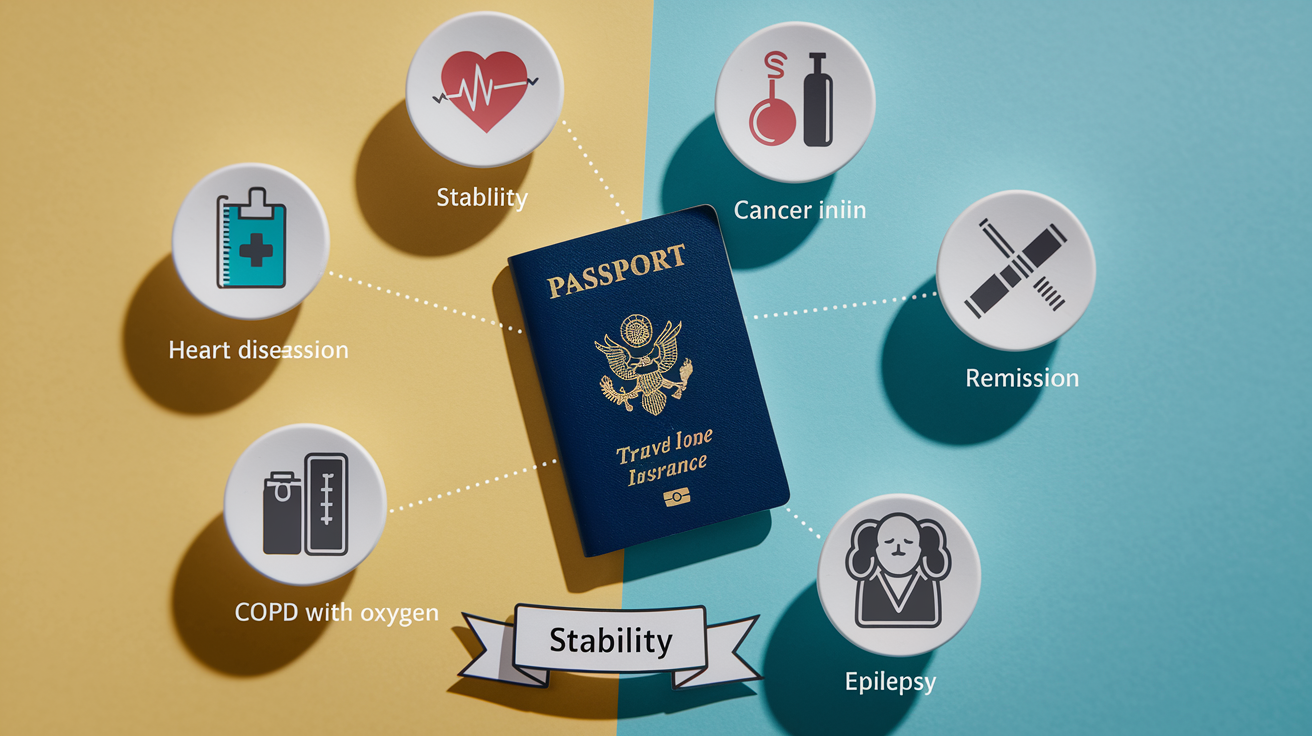
Chronic conditions carry different stability requirements and documentation standards, and insurers tailor their underwriting to the specific risks each illness presents. Understanding how your condition’s assessed will help you choose a policy that actually covers the scenarios you’re most likely to face.
Heart disease
Insurers commonly require 60 to 180 days of cardiac stability with no changes in medication, no new symptoms such as chest pain or shortness of breath, and no scheduled tests or procedures. If you had a recent angioplasty, stent placement, or medication adjustment, you likely won’t qualify for a waiver until the stability window passes. Confirm that emergency evacuation limits are at least $100,000, because cardiac events abroad often require air-ambulance transport to facilities with catheterization labs or cardiac surgery capabilities.
Diabetes
Insulin-treated diabetes requires proof of stable medication, stable blood-glucose control, and no recent hospitalizations for hypoglycemia or hyperglycemia during the 60 to 90 day look-back period. Carry documentation of your current insulin regimen, glucose-monitoring logs, and a letter from your endocrinologist confirming you’re medically fit to travel. Some policies explicitly cover diabetic supplies and emergency treatment for glucose emergencies. Others exclude coverage if the event’s linked to poor control or missed doses.
Cancer remission
Insurers typically require six to 12 months of documented remission with no active treatment, no recurrence, and no new symptoms before they’ll consider a waiver. If you’re still undergoing chemotherapy, radiation, immunotherapy, or regular scans to monitor for recurrence, the condition’s classified as active and will be excluded. Policies rarely cover travel undertaken for the purpose of obtaining cancer treatment abroad, even with a waiver in place.
COPD and asthma
Chronic obstructive pulmonary disease and moderate-to-severe asthma require stable medication, no recent exacerbations requiring emergency care or hospitalization, and no new respiratory symptoms for at least 60 to 90 days. Insurers often ask whether you use supplemental oxygen, whether you’ve had recent lung-function tests, and whether your pulmonologist has cleared you for air travel and high-altitude destinations. Ensure evacuation limits are sufficient, as COPD flares can require ventilator support and rapid transport to advanced pulmonary care.
Epilepsy
Stable epilepsy with no recent seizures and no medication changes during the look-back period may qualify for a waiver, but recent seizure activity, dosage adjustments, or new diagnostic workups will trigger an exclusion. Insurers typically request a letter from your neurologist confirming seizure-free status, current medication, and fitness to travel. If you have a breakthrough seizure abroad, the insurer will review whether the event was linked to noncompliance, medication changes, or an unstable baseline. Claims may be denied if the condition was deemed unstable at purchase.
Understanding Costs of Travel Insurance for Pre‑Existing Conditions

Travel insurance premiums are calculated as a percentage of your total trip cost, typically ranging from 4 to 10 percent depending on traveler age, trip duration, destination, and the coverage limits you select. A $5,000 trip might generate a base policy cost of $200 to $500, while a $2,000 weekend getaway could cost $80 to $200. Adding a pre-existing condition waiver usually increases the premium by an additional 0.5 to 3 percent of trip cost, translating to roughly $25 to $150 extra on a $5,000 trip or $10 to $60 on a $2,000 trip. The exact surcharge depends on your age, the number of conditions disclosed, and the insurer’s risk model.
Insurers calculate risk for pre-existing conditions by assessing the likelihood of claims related to emergency medical care, trip cancellation, and evacuation. Factors that drive higher premiums include advanced age, multiple chronic illnesses, recent hospitalizations, high-risk destinations with limited medical infrastructure, and trip durations longer than 30 days. The waiver itself typically carries no separate line-item fee if you meet all eligibility requirements, but insuring the full nonrefundable trip cost rather than partial coverage raises the overall premium because the policy limit is higher.
Key risk factors that influence cost:
Traveler age. Premiums rise sharply for travelers over 60 or 70. Number and severity of pre-existing conditions. Multiple conditions or high-risk diagnoses increase the surcharge. Trip cost. Higher trip values generate higher premiums, even at the same percentage. Destination medical costs. Travel to countries with expensive healthcare (United States, Switzerland, Japan) increases insurer risk and may raise rates.
Exclusions and Limitations of Travel Insurance Related to Pre‑Existing Conditions

Even when a pre-existing condition waiver’s in place, policies exclude coverage for conditions that were unstable during the look-back period, undisclosed conditions, and specific categories of illness or treatment. Pregnancy beyond 24 to 26 weeks is almost universally excluded from pre-existing coverage, and most plans don’t cover normal childbirth, pregnancy complications, or elective termination even if the pregnancy was disclosed. Mental-health conditions such as anxiety, depression, bipolar disorder, and substance-abuse diagnoses are often excluded from trip-cancellation and trip-interruption benefits, though some policies provide limited emergency psychiatric-care coverage if you’re hospitalized abroad.
Exclusions also apply to travel undertaken for the purpose of obtaining medical treatment, experimental or investigative procedures, cosmetic surgery, and injuries or illnesses resulting from high-risk activities such as extreme sports, scuba diving beyond certified depths, or motorized racing. Terminal illnesses diagnosed before purchase are typically excluded, as are conditions for which your doctor advised against travel. Alcohol or drug related medical events, Alzheimer’s disease, and injuries sustained while violating local laws are standard exclusions across most policies, regardless of whether you secured a waiver.
Insurers may also impose sub-limits or caps on specific benefits even when the waiver applies. For example, a policy with a $500,000 emergency medical limit might cap mental-health emergency care at $10,000 or limit coverage for diabetic supplies to $500 per trip. Some plans exclude coverage for trips exceeding a certain value, commonly $10,000, or impose stricter underwriting and higher premiums for high-value journeys. Always read the full policy wording to identify condition-specific exclusions, benefit caps, and situations in which the waiver doesn’t apply.
Claims Process for Travel Insurance Involving Pre‑Existing Conditions

When you file a claim involving a pre-existing condition, the insurer will conduct a detailed review of your medical records to confirm that the condition was stable during the look-back period and that you met all waiver requirements at the time of purchase. Expect the underwriting team to request your complete medical history for the 60 to 180 days before you bought the policy, including physician notes, hospital records, prescription histories, test results, and any referrals or specialist consultations. The insurer cross-references your application answers with these records. If discrepancies appear, such as an undisclosed medication change or a scheduled procedure you didn’t mention, the claim may be denied and the policy rescinded for material misrepresentation.
Required documents for pre-existing condition claims typically include:
Completed claim form with a detailed description of the medical event. Itemized medical bills from all providers (hospitals, physicians, pharmacies, ambulance services). Physician statements and discharge summaries explaining diagnosis, treatment, and prognosis. Medical records from the look-back period proving stability (medication lists, test dates, office-visit notes). Proof of trip payments and cancellation or interruption (receipts, invoices, cancellation notices). Prescription history showing no dosage or medication changes during the stability window.
Claims timelines vary by insurer, but most policies require you to notify the company within 20 to 30 days of a covered event and submit proof of loss (receipts, medical bills, and supporting documents) within 90 days. Final medical records, physician statements, and other evidence may be requested within 180 days of the event, and failure to meet these deadlines can result in partial or full claim denial. If the insurer determines that the condition was unstable or undisclosed, expect the claim to be rejected, leaving you responsible for all medical costs and nonrefundable trip expenses.
Practical Tips for Using Travel Insurance With Pre‑Existing Conditions

Buy your travel insurance immediately after making your first trip deposit to maximize your chances of qualifying for the pre-existing condition waiver. The 14 to 21 day purchase window starts ticking the moment you pay your initial deposit. Waiting even a few extra days can disqualify you if the insurer interprets the deposit date strictly. You booked the safari and put down $3,000 on Monday. By Friday afternoon, you should have a policy in hand, not a reminder on your calendar to ‘look into it next week.’
Practical steps to protect coverage and reduce claim denials:
Avoid medication or treatment changes during the look-back period. Even minor dosage adjustments can void waiver eligibility. Carry printed copies of your medication list, recent test results, and a fitness-to-travel letter from your doctor. These documents streamline claims and prove stability if questions arise. Confirm emergency evacuation limits match the risk of your condition. Cardiac, respiratory, or neurological illnesses should carry at least $100,000 in evacuation coverage. Pack extra medication and supplies in your carry-on luggage. Lost checked bags can leave you without essential treatment. Notify the insurer immediately if you need medical care abroad. Many policies require pre-authorization for non-emergency treatment and hospitalization. Disclose all conditions honestly on the application, even if you think they’re minor. Undisclosed issues discovered at claim time will void coverage. Keep receipts, medical bills, and physician notes organized during your trip. Claims move faster when documentation’s complete and legible.
Final Words
You now know what insurers mean by a pre-existing condition, including look-back periods, stability rules, and why medication or treatment changes matter.
You also saw how insurers review records, what benefits come with an approved waiver, common exclusions, pricing examples, and the claims steps to expect.
The practical checklist (buy within the waiver window, insure the full nonrefundable cost, avoid treatment changes, bring medical notes, compare look-back windows and limits) makes the choices clear.
Follow those steps and you’ll improve your chances of finding travel insurance for pre existing conditions that actually covers you when it counts.
FAQ
Q: Do any travel insurances cover pre-existing conditions?
A: Travel insurance can cover pre-existing conditions when insurers offer a waiver; you must buy within the waiver window (usually 14–21 days), insure the full nonrefundable trip cost, and be medically stable.
Q: Will travel insurance cover kidney stones?
A: Travel insurance will sometimes cover kidney stones if the attack is sudden and not tied to a pre-existing exclusion; check look-back rules, stability requirements, and whether a waiver or emergency care benefit applies.
Q: Can you get travel insurance with a preexisting condition?
A: You can get travel insurance with a preexisting condition, but eligibility depends on the insurer’s look-back period, stability rules, and whether you buy a timely waiver or provide requested medical documentation.
Q: Can you get travel insurance with pancreatitis?
A: You can get travel insurance with pancreatitis in many cases, but insurers often require a longer stability period, no recent flare-ups or medication changes, and may ask for medical records or a doctor’s letter.