



Think the cheapest health plan is always the best for a tight budget? Not usually.
Choosing the right low-cost coverage depends on your income, age, and how much care you expect to use.
This post breaks down the real trade-offs—Medicaid, subsidized marketplace plans, catastrophic plans, and short-term policies—so you can see typical monthly costs, what each actually covers, and when a low premium hides big bills.
Read on to learn which option fits your budget and what to check before you enroll.
Overview of the Most Affordable Coverage Options

When you’re shopping for health coverage on a tight budget, the lowest cost option isn’t always obvious. Medicaid usually wins on price. Most enrollees pay $0 premiums and have minimal copays. But it’s only available if your income falls below a certain threshold. For people who earn too much for Medicaid but still struggle with high premiums, ACA marketplace plans with subsidies often bring monthly costs down to $10, $50, or less. Catastrophic plans offer rock bottom premiums if you’re under 30 or qualify for a hardship exemption, but they come with deductibles that can exceed $9,000. Short term health plans advertise the cheapest monthly rates of all, sometimes under $100. But they routinely exclude preexisting conditions and services like maternity care or prescription drugs.
The best fit depends on your income, age, health status, and whether you’re willing to accept high out of pocket risk in exchange for lower monthly payments. If you have a chronic condition or expect to use medical services regularly, Medicaid or a subsidized Silver plan will save you far more over the year than a bare bones catastrophic or short term policy. If you’re young, healthy, and rarely visit a doctor, a catastrophic plan can protect you from financial disaster without draining your bank account every month.
Here’s how the most affordable options stack up:
Medicaid: $0 or very low monthly premiums. Available year round if your income is at or below roughly 138% of the federal poverty level in expansion states (about $20,120 for a single person in 2024). Coverage includes all essential health benefits with little to no cost sharing.
ACA marketplace plans with subsidies: Monthly premiums can drop to $10–$50 or less after premium tax credits, depending on your income, age, and location. Cost sharing reductions lower deductibles and copays for people earning 100%–250% of the poverty level who choose Silver plans.
Catastrophic plans: Monthly premiums often run $50–$150, but deductibles typically sit between $8,000 and $9,500. These cover three primary care visits before the deductible kicks in and protect you from very high costs if something serious happens.
Short term health plans: Premiums can be $50–$200/month, but coverage is minimal. Many plans exclude preexisting conditions, don’t cover maternity or mental health services, and cap benefits at amounts that won’t come close to covering a hospital stay.
Eligibility Rules for Low-Cost Health Coverage

Each affordable option has different gates. Medicaid eligibility depends on your state and income. States that expanded Medicaid let adults qualify if their household income is at or below 138% of the federal poverty level, which works out to about $20,120 for one person or roughly $41,400 for a family of three in 2024. Non expansion states set much stricter limits, often restricting Medicaid to pregnant people, children, elderly adults, and people with disabilities. CHIP covers children in families with incomes that are typically too high for Medicaid but still modest, often up to 200%–300% of the poverty level depending on the state.
ACA marketplace subsidies open up if your household income falls between 100% and 400% of the federal poverty level. Enhanced subsidy rules extended through 2025 mean some households above 400% can still get help if premiums would exceed 8.5% of their income. Catastrophic plans are available only to people under age 30 or anyone who qualifies for a hardship or affordability exemption (for example, if the cheapest available marketplace plan would cost more than 8% of your income). Short term plans and health sharing ministries generally don’t have income requirements, but they can deny you based on your health history or preexisting conditions.
To verify your eligibility and apply:
- Gather your most recent pay stubs, tax return, or benefit statements to document household income.
- Count everyone in your tax household (yourself, spouse if filing jointly, dependents you claim).
- Compare your annual household income to the current federal poverty level guidelines for your household size (available on the HHS website or your state’s marketplace site).
- If your income is at or below 138% of the poverty level and you live in an expansion state, apply for Medicaid directly through your state agency or the marketplace. Enrollment is year round.
- If your income is above Medicaid limits, use the marketplace application during open enrollment (typically early November through mid January) to check for premium tax credits and cost sharing reductions.
- For catastrophic plans, confirm your age or obtain a hardship exemption certificate before enrolling during the marketplace open enrollment period.
Cost Breakdown and What Each Option Covers
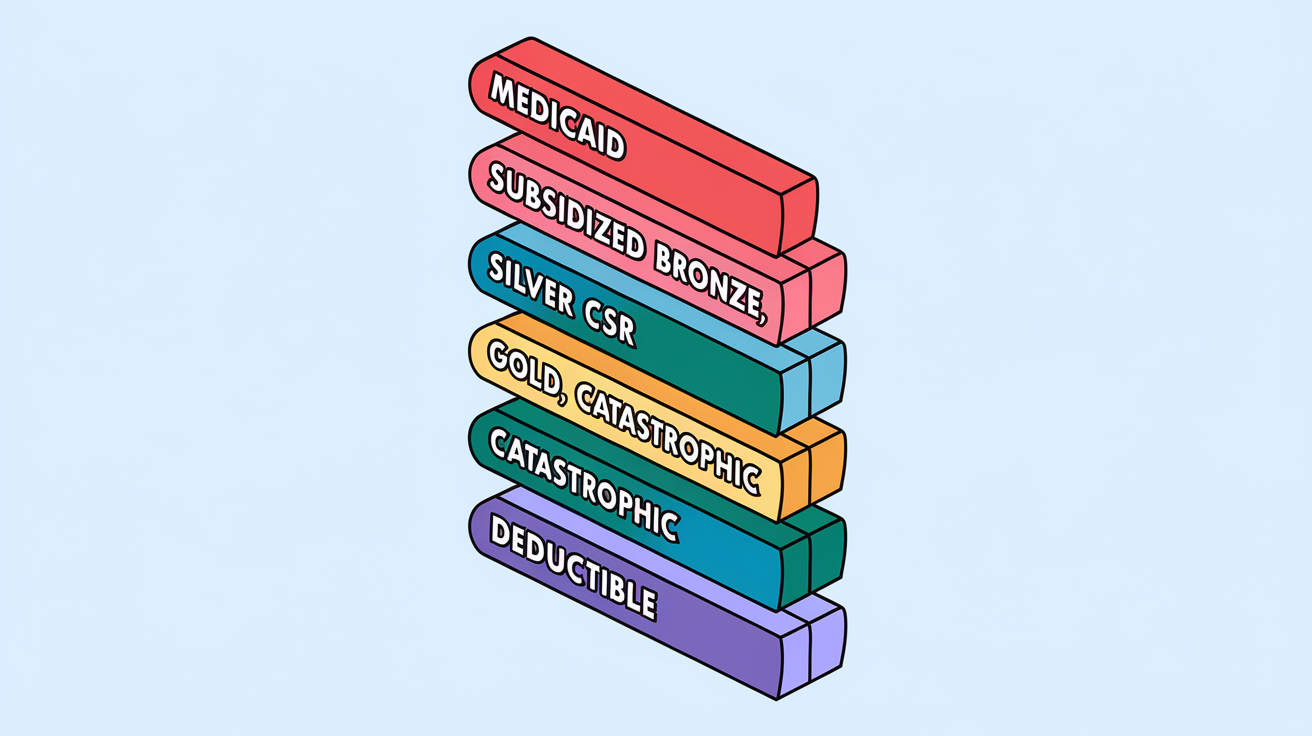
Medicaid typically charges $0 premiums for most enrollees, though a few states charge small monthly fees (often $5–$20) for certain adults above the poverty level. Copays are minimal, often $1–$4 for doctor visits and prescriptions, and out of pocket maximums are low or nonexistent. Coverage includes all ten essential health benefits: doctor visits, hospital care, emergency services, maternity and newborn care, mental health and substance use treatment, prescription drugs, lab tests, preventive services, pediatric services, and rehabilitative care.
After subsidies, ACA marketplace Bronze plans can cost under $50/month for households in the lower subsidy tiers, but deductibles often range from $4,000 to $7,000. Silver plans with cost sharing reductions bring deductibles down to $1,000–$3,000 for people earning 100%–200% of the poverty level, and premiums may still be very low or even $0 for the lowest income households. Gold and Platinum plans offer lower deductibles and copays. Sometimes $0 deductible on Platinum. But monthly premiums are higher unless subsidies bring them down.
Catastrophic plans have the lowest sticker premiums (often $50–$150/month for young adults) but very high deductibles, typically $8,000–$9,500. You pay the full cost of most care until you hit that deductible, though the plan does cover three primary care visits per year and all preventive services before the deductible. After the deductible, the plan pays for essential health benefits. Short term plans may advertise premiums as low as $50–$100/month, but they routinely exclude maternity, mental health, prescription drug coverage, and preexisting conditions. They often cap total benefits at $1 million or less, far below what a serious illness can cost.
| Plan Type | Typical Monthly Cost | Deductible Range | Key Coverage Features |
|---|---|---|---|
| Medicaid | $0 (or $5–$20 in some states) | $0 or minimal | All essential health benefits; low or no copays; year round enrollment |
| ACA Marketplace (with subsidies) | $0–$200+ (varies by income, age, location) | $0–$7,000+ (Silver CSR plans: $1,000–$3,000) | All essential health benefits; guaranteed issue; premium and cost sharing subsidies available |
| Catastrophic Plans | $50–$150 | $8,000–$9,500 | Three free primary care visits; preventive services; coverage after deductible; under 30 or hardship only |
| Short Term Plans | $50–$200 | $1,000–$10,000+ | Limited benefits; may exclude preexisting conditions, maternity, mental health, Rx; not ACA compliant |
How to Check Subsidy Eligibility and Estimate Costs

The marketplace calculates your subsidy based on your modified adjusted gross income (MAGI), household size, your age, and the cost of the benchmark Silver plan in your ZIP code. MAGI is usually very close to your adjusted gross income from your tax return. It includes wages, self employment income, interest, dividends, and some other income, minus certain deductions. The marketplace compares your MAGI to the federal poverty level for your household size, then caps the amount you’re expected to pay for the second lowest cost Silver plan at a percentage of your income. If the benchmark plan costs more than that cap, you get a premium tax credit to cover the difference.
You’ll need to provide Social Security numbers or document numbers for everyone applying, proof of income (recent pay stubs, last year’s tax return, or self employment records), and proof of your current address. If your income fluctuates or you’re self employed, estimate your annual income as accurately as you can. Underestimating can mean you owe money back at tax time, and overestimating leaves subsidy dollars on the table.
To check eligibility and estimate your monthly cost:
- Go to HealthCare.gov (or your state’s marketplace website if your state runs its own exchange).
- Start a new application and enter your ZIP code, household size, ages of everyone applying, and estimated annual household income.
- The site will show you whether you appear eligible for Medicaid, CHIP, or marketplace subsidies based on the income you entered.
- Review the list of available plans and look for the “estimated monthly premium” next to each plan. This is the amount after your premium tax credit is applied.
- Click into individual plans to see the deductible, out of pocket maximum, copays, and coinsurance, then estimate your total annual cost by multiplying the monthly premium by 12 and adding your expected out of pocket spending (deductible, copays, prescriptions).
- If you’re in the 100%–250% poverty level range, check whether Silver plans show a “cost sharing reduction” label. These plans lower your deductible and copays, often saving you hundreds or thousands of dollars if you use medical services during the year.
Where and How to Compare Plans for the Best Price

The federal marketplace and state exchanges organize plans by metal level (Bronze, Silver, Gold, Platinum, and Catastrophic) so you can quickly see how premiums and deductibles trade off. Plans within the same metal level cover roughly the same percentage of total costs on average (Bronze covers about 60%, Silver 70%, Gold 80%, Platinum 90%), but individual plans vary on network size, drug formularies, and specific copays. Filter results by your expected medical usage. If you take regular prescriptions or see specialists often, a Gold or Silver plan with cost sharing reductions usually costs less over the year than a Bronze plan, even though the monthly premium is higher.
Watch out for plans that look cheap on the surface but exclude your doctors, charge high copays for the drugs you take, or have narrow networks that make it hard to find in network care. Before you enroll, use the plan’s provider directory tool to confirm your current doctors and any specialists participate in the network, and check the drug formulary to see which tier your prescriptions fall into and what the copay will be. A plan with a $30 lower monthly premium isn’t a bargain if it costs you an extra $100/month in prescriptions or forces you to switch to an out of network provider and pay thousands more out of pocket.
We broke down the cheapest coverage types: Medicaid, ACA-subsidized plans, catastrophic plans, and short-term alternatives, who they help, and where savings are biggest.
You got clear eligibility rules, a side-by-side cost comparison with typical premiums and deductibles, and simple steps to check subsidy eligibility.
Use the comparison tips to estimate costs and choose affordable health care coverage options that actually protect you. Check eligibility, read benefit limits, and watch deductibles to avoid surprises. A few small checks now can mean real savings and less stress later.
FAQ
Q: What is the best health insurance that’s affordable?
A: The best affordable health insurance depends on your income, household size, and needs. Medicaid is free or very low cost for eligible people; ACA marketplace plans with subsidies often give the lowest premiums.
Q: Is migraine covered under health insurance?
A: Migraine care is typically covered by health insurance for doctor visits, specialist care, imaging, and many prescriptions. Coverage varies—check your plan’s formulary, prior authorization rules, and limits on specialty migraine drugs.
Q: What health insurance covers Zepbound?
A: Coverage for Zepbound depends on your plan and the treatment purpose. Many commercial insurers cover it for FDA‑approved diabetes use; coverage for weight‑loss is often limited and may need prior authorization or step therapy.
Q: Is cataract surgery covered by care health insurance?
A: Cataract surgery is generally covered when it’s medically necessary. Coverage depends on your policy, waiting periods, and whether premium intraocular lens upgrades or refractive add‑ons are excluded or billed separately.