


Is liability-only insurance really enough, or could skipping full coverage cost you thousands after a wreck?
Basic auto insurance (liability-only) pays for injuries and property damage you cause to others, but not for repairs to your own car, theft, or most medical bills.
Full coverage adds collision and comprehensive protection so your vehicle is covered after crashes, theft, or weather damage.
Deciding between basic auto insurance vs full coverage comes down to your car’s value, whether it’s financed, and how much you could pay out of pocket.
We’ll show how to decide.
Clear Comparison of Basic Auto Insurance vs Full Coverage

Basic auto insurance (what most people call liability-only coverage) pays for bodily injury and property damage you cause to others in an accident. It won’t cover repairs to your own vehicle, theft, vandalism, or most medical costs you rack up. Full coverage auto insurance adds protection for your own car by tossing in collision and comprehensive coverage on top of liability, along with optional extras like uninsured motorist protection and medical payments.
The cost gap between the two is significant. Liability-only policies typically run $600 to $1,200 per year nationally, while full coverage policies average $1,200 to $2,000 per year. That difference (often $400 to $1,000 annually) buys repair and replacement protection for your vehicle. But whether that trade-off makes sense depends on your car’s value, your loan status, and your ability to cover repair costs out of pocket.
Here’s the basic comparison at a glance:
| Coverage Type | Summary of Protection |
|---|---|
| Liability-Only (Basic) | Covers injuries and property damage you cause to others; does not cover your vehicle or your medical costs in most cases. |
| Full Coverage | Covers injuries/damage to others plus repairs/replacement of your vehicle from collisions, theft, vandalism, weather, and other non-collision perils. |
Defining Basic Auto Insurance and Its Coverage Scope

Basic auto insurance centers on liability. Bodily injury liability pays others’ medical expenses, lost wages, and legal fees when you’re at fault in an accident. Property damage liability covers damage to their vehicles, homes, fences, and other property. Most states require these two components at minimum. Common formats include 25/50/25 (up to $25,000 per person injured, $50,000 total per accident for injuries, $25,000 for property damage) and 15/30/5 in states with lower thresholds.
The problem with state minimums? They often fall far short in severe accidents. A multi-car pileup or a single serious injury can easily exceed $50,000 in medical costs, leaving you personally liable for the difference if you carry only minimum limits. That’s why many drivers choose higher liability limits even when sticking with basic coverage.
What basic auto insurance doesn’t cover:
- Damage to your own vehicle from a collision
- Theft or vandalism of your car
- Hitting an animal (deer, elk, dog)
- Weather-related damage (hail, flood, falling trees)
- Broken glass, fire, or other comprehensive perils
Full Coverage Auto Insurance Components Explained
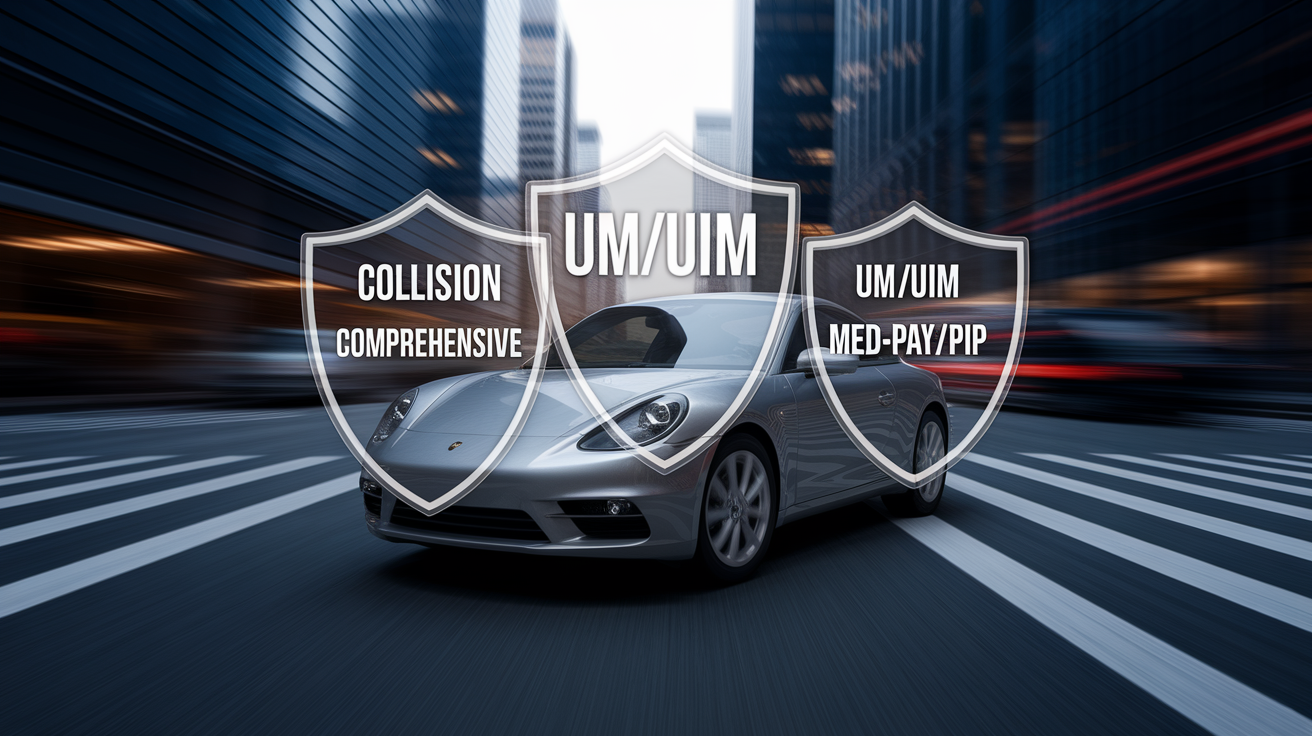
Full coverage auto insurance isn’t a single product. It’s shorthand for a package that includes liability plus physical damage protection for your vehicle and often several optional coverages. Insurers bundle these to protect both you and other drivers, and lenders typically require most of them when you finance or lease a car. The average annual cost for a full coverage policy sits around $1,200 to $2,000, depending on your vehicle, driving record, and location.
Collision Coverage
Collision coverage pays to repair or replace your vehicle after a crash with another car or a stationary object like a guardrail, pole, or building. It applies whether you caused the accident or not, minus your chosen deductible. If you back into a parked car or roll through a stop sign and hit another vehicle, collision covers your repair bill. What it doesn’t cover: mechanical failure, wear and tear, engine breakdown, or damage from potholes unless the pothole directly caused a collision.
Comprehensive Coverage
Comprehensive coverage handles non-collision losses. This includes theft, vandalism, broken glass (windshields, side windows), fire, flood, hail, falling objects, and hitting an animal. If your car is stolen from a parking lot or a deer jumps into your path on a rural highway, comprehensive pays the repair or replacement cost minus your deductible. It doesn’t cover damage from collisions with vehicles or objects. That’s collision’s job.
UM/UIM and Med-Pay/PIP
Uninsured motorist (UM) and underinsured motorist (UIM) coverage step in when the other driver lacks insurance or carries limits too low to cover your injuries or property damage. This coverage is especially important in states with high rates of uninsured drivers. Medical payments coverage (med-pay) or personal injury protection (PIP) pay your immediate medical costs, lost wages, and sometimes child care or funeral expenses after an accident, regardless of fault. PIP is required in no-fault states like Florida, Michigan, and New Jersey. Med-pay is optional in most other states but often inexpensive.
Common Add-ons
Rental reimbursement covers the cost of a rental car while yours is being repaired after a covered claim, typically $30 to $50 per day for a set number of days. Roadside assistance pays for towing, jump starts, tire changes, and lockout service. Gap insurance is essential if you finance or lease a new car. It pays the difference between your vehicle’s actual cash value (what the insurer settles for after a total loss) and your remaining loan balance, protecting you from owing money on a totaled car.
Cost Differences Between Basic Auto Insurance and Full Coverage

Nationally, liability-only coverage averages $600 to $1,200 per year. Full coverage runs $1,200 to $2,000 per year. That spread reflects the added expense of collision and comprehensive coverage, which protect higher value or financed vehicles. Younger drivers, those with recent claims, and owners of new cars often see the largest premium gaps, sometimes doubling or tripling the cost when moving from basic to full coverage.
Vehicle characteristics drive much of the difference. Newer cars and models with expensive parts cost more to insure for collision and comprehensive because repair bills are higher. Older cars with low market values generate smaller collision/comprehensive premiums, but the gap between liability-only and full coverage remains meaningful. Location matters too. Urban areas with high theft rates, frequent hail, or congested roads push comprehensive and collision premiums higher.
Deductibles directly affect your premium and out-of-pocket costs. Choosing a $1,000 deductible instead of $500 typically reduces your annual premium by 15 to 30 percent, saving perhaps $200 to $400 per year. But you’ll pay an extra $500 out of pocket when you file a claim. For example, a driver with a $1,500 annual full coverage premium at a $500 deductible might drop to $1,200 per year by switching to a $1,000 deductible, saving $300 annually but accepting higher immediate costs after an accident.
Four major factors magnify or shrink the cost gap:
- Driving record: tickets, at-fault accidents, and DUIs raise both liability and physical damage premiums.
- Location: ZIP codes with high claim frequency or vehicle theft increase comprehensive and collision costs.
- Annual mileage: more miles driven raise collision risk and premiums.
- Vehicle make and model: luxury, performance, and high theft vehicles cost more to insure across all coverage types.
Factors That Influence Choosing Basic Auto Insurance vs Full Coverage

Vehicle value sits at the center of the decision. Full coverage makes sense when your car is worth more than about $10,000 because the potential repair or replacement payout justifies the premium. Below $3,000 to $5,000, the annual cost of collision and comprehensive often approaches or exceeds the vehicle’s market value, making liability-only a more rational choice unless you can’t afford to replace the car after a total loss.
Financing and leasing rules remove the choice. Lenders and leasing companies require collision and comprehensive coverage until you pay off the loan or return the leased vehicle. This protects their financial interest in the car. If you drop required coverage, the lender can force-place expensive insurance on your behalf and bill you, or repossess the vehicle for breach of contract.
Personal financial risk tolerance and emergency savings also matter. If you’ve got $10,000 set aside and drive a car worth $5,000, you can self-insure and absorb the loss after a theft or total loss accident. If losing that car would leave you stranded with no funds to replace it, full coverage offers peace of mind even on a lower value vehicle.
When comparing quotes and deciding on coverage level, prioritize these six factors:
- Current vehicle market value (check Kelley Blue Book or similar tools)
- Loan or lease requirements (mandatory collision and comprehensive if financed)
- Emergency savings available to cover repair or replacement costs
- Local theft rates and accident frequency in your ZIP code
- Daily commute length and total annual mileage
- Driving history and likelihood of filing a claim
Practical Scenarios Comparing Basic Auto Insurance vs Full Coverage
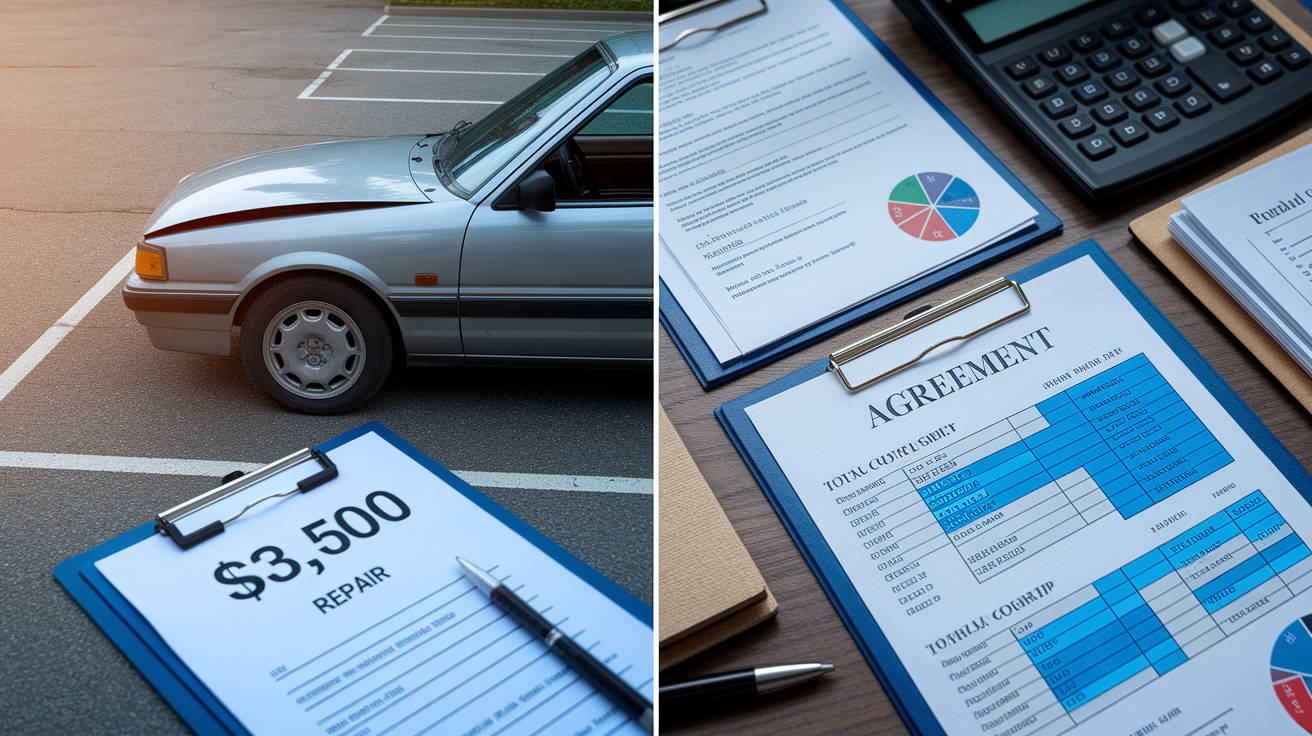
Real-world examples show how the math shifts based on vehicle value, deductibles, and annual premiums. Comparing costs and outcomes helps clarify when full coverage pays off and when it becomes an unnecessary expense.
Scenario: Older Vehicle
You own a 2010 compact car with a current market value of $4,000. A collision repair estimate comes in at $3,500. If you carry full coverage with a $1,000 deductible, the insurer pays $2,500 and you pay $1,000. If you carry liability-only, you pay the full $3,500 out of pocket. The annual cost difference between full coverage and liability-only is $700 for your profile. Over three years, you’d spend $2,100 extra on full coverage. If you avoid accidents during that period, you’ve paid $2,100 for protection you didn’t use. If you total the car, the insurer pays $3,000 (market value minus $1,000 deductible), which is less than the $2,100 in extra premiums over three years. This suggests liability-only may be the better bet for this vehicle.
Scenario: New or Financed Car
You finance a new sedan for $25,000. The lender requires collision and comprehensive until the loan is paid off. In this case, full coverage is mandatory, not optional. Beyond the legal requirement, it also protects your financial position. If the car is totaled in year one, the insurer pays the actual cash value (perhaps $22,000 after immediate depreciation), and gap insurance covers the remaining loan balance. Without full coverage, you’d owe $25,000 on a totaled car with no payout to offset the debt.
Scenario: Break-Even Calculation
Your car is worth $8,000 today. Full coverage costs you $1,400 per year. Liability-only costs $700 per year. The annual difference is $700. Your collision deductible is $1,000. If you keep the car for four more years and never file a claim, you’ll spend $2,800 extra on full coverage. If you total the car in year two, the insurer pays roughly $7,000 (assuming depreciation to about $8,000 minus $1,000 deductible). Compare $2,800 spent over four years to a $7,000 payout. The coverage pays off if you file a claim early, but loses value if you go claim-free and the vehicle continues to depreciate.
Pros and Cons of Basic Auto Insurance and Full Coverage
Liability-only coverage saves money (often several hundred dollars per year) and meets state legal requirements in most cases. The downside is significant financial exposure. You pay for all damage to your vehicle, theft, vandalism, and weather losses out of pocket. If your car is totaled or stolen, you absorb the entire replacement cost.
Full coverage protects your vehicle repair and replacement costs, satisfies lender requirements, and covers a wide range of perils beyond collisions. The trade-off is higher annual premiums, sometimes 50 to 100 percent more than liability-only. For low value vehicles, those extra premiums can exceed the likely insurance payout, making full coverage economically inefficient.
Key trade-offs at a glance:
- Liability-only pros: lower premiums, meets minimum legal requirements, simple coverage structure.
- Liability-only cons: no vehicle protection, high out-of-pocket risk after accidents, theft, or weather damage.
- Full coverage pros: protects repair and replacement costs, required by lenders, covers collision and non-collision perils.
- Full coverage cons: higher annual cost, may exceed vehicle value on older cars, requires choosing and paying deductibles.
State Minimum Requirements and Legal Considerations

Every state sets minimum liability limits, but those minimums vary widely. Common formats include 25/50/25 (California, Texas) and 15/30/5 (some Southeastern states). The first number is bodily injury liability per person, the second is total bodily injury per accident, and the third is property damage per accident. A few states require personal injury protection (PIP) or uninsured motorist coverage on top of liability.
State minimums often prove insufficient in serious accidents. A single hospitalization can exceed $50,000, and totaling a newer vehicle easily surpasses $25,000 in property damage. Drivers with assets to protect (homes, savings, retirement accounts) should carry liability limits well above state minimums to avoid personal financial exposure in a lawsuit.
| State Example | Common Minimums | Additional Required Coverages |
|---|---|---|
| California | 15/30/5 | None (UM optional but recommended) |
| Florida | 10/20/10 PD only | PIP ($10,000 medical/lost wages) |
| New York | 25/50/10 | UM/UIM, PIP ($50,000 basic) |
Check your state’s department of motor vehicles or insurance regulator website to confirm current requirements and understand whether PIP, med-pay, or UM/UIM coverage is mandatory or optional in your area.
Checklist for Comparing Basic Auto Insurance vs Full Coverage Quotes
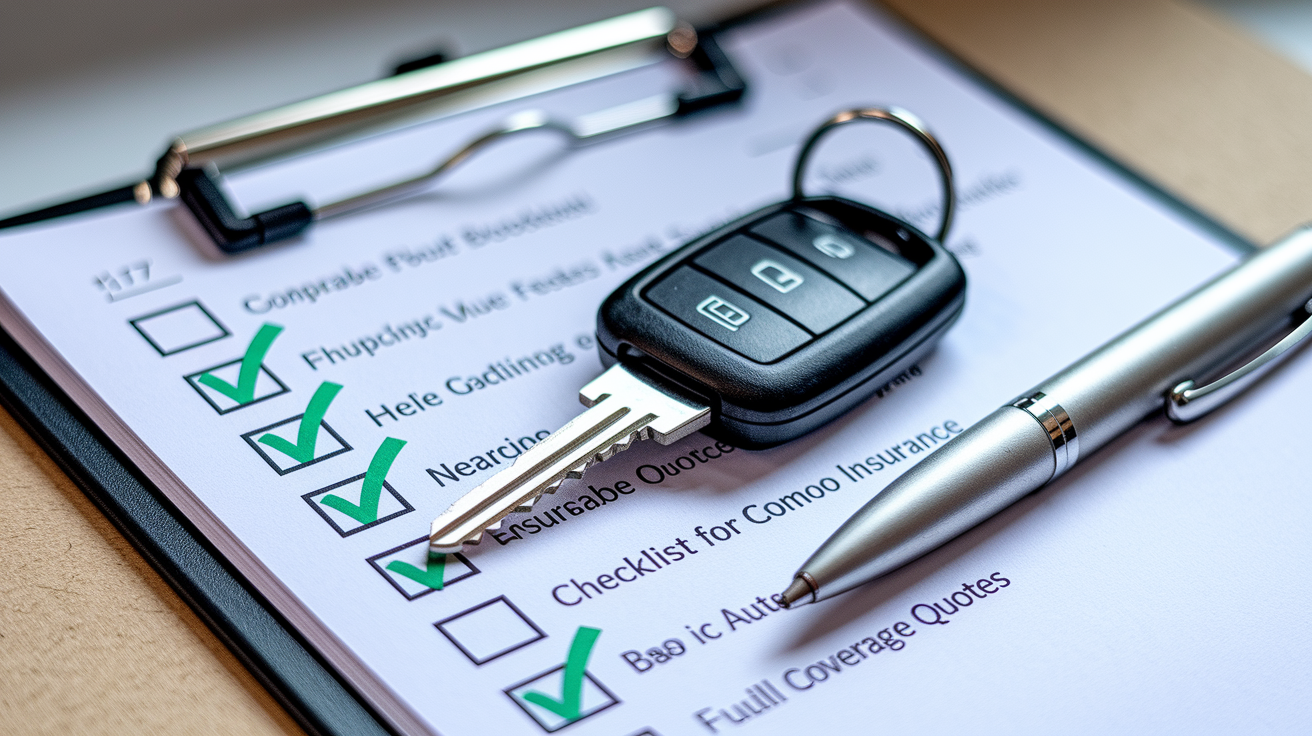
Shopping for auto insurance requires comparing identical policy structures to see the true cost difference between liability-only and full coverage. Mismatched limits, deductibles, or add-ons can distort the comparison and lead to poor decisions.
Follow these steps when requesting quotes:
- Verify that liability limits match across all quotes (e.g., 100/300/100 or your preferred limits).
- Request quotes for both $500 and $1,000 deductibles on collision and comprehensive to see premium savings.
- Confirm state-required coverages (PIP, UM/UIM, med-pay) are included consistently.
- Check lender or lease contract requirements if your vehicle is financed.
- Add optional coverages (rental reimbursement, roadside assistance, gap insurance) one at a time to see individual costs.
- Compare the annual premium difference to your vehicle’s current market value to assess value.
- Re-evaluate coverage annually as your vehicle depreciates and your financial situation changes.
Final Words
Deciding between liability-only and full coverage puts you back in the driver’s seat. This post walked through what liability pays, what full coverage adds, national premium ranges, real scenarios, and a simple checklist to compare quotes.
Liability-only covers others’ injuries and property but not your repairs. Full coverage protects your vehicle but costs more—national averages are roughly $600–$1,200 for liability-only and $1,200–$2,000 for full coverage.
Use the break-even examples and checklist to weigh risks and cost. basic auto insurance vs full coverage is a personal choice—make it with facts, not guesses, and you’ll land on a plan that fits.
FAQ
Q: What is the difference between basic and full coverage insurance?
A: The difference between basic and full coverage insurance is that basic (liability-only) pays for others’ injuries and property damage, while full coverage also helps repair or replace your own vehicle, at a higher cost.
Q: What are the disadvantages of full coverage?
A: The disadvantages of full coverage are higher premiums, larger total insurance costs, and often poor value for older cars; you still pay a deductible after a claim, though lenders may require it for financed vehicles.
Q: Is $3,000 a year for car insurance normal?
A: A $3,000 a year car insurance premium is high compared to national averages for full coverage, but it can be normal for high-risk drivers, luxury cars, or high limits; compare quotes and adjust coverage to lower it.
Q: Is it better to have a $500 deductible or $1000?
A: Choosing a $500 versus $1,000 deductible depends on your savings and claim frequency; a $1,000 deductible usually lowers premiums by 15 to 30 percent but requires more out-of-pocket after a claim.