



Think saving is just wishful thinking?
A savings goal calculator turns that guesswork into a clear plan by telling you exactly how much to set aside each week, bi-weekly, or month to hit a target by a deadline.
It accounts for your starting balance, timeline, and expected interest so you can see if your plan actually fits your paycheck.
In this post we’ll explain how the calculator works, what inputs matter, and how to use the results to budget, test scenarios, and track progress.
Clear Overview of How a Savings Goal Calculator Works

A savings goal calculator figures out how much you need to put away each week, bi-weekly, or month to hit a specific dollar amount by a deadline you pick. You’d use one when you’re planning an emergency fund, a vacation, a car purchase, a down payment, or any future expense that needs steady saving over time.
The point is to turn “I should probably save for something” into an actual plan. Instead of “I need to save for a new car eventually,” the calculator tells you “save $350 a month for three years and you’ll have $12,000.” That kind of clarity helps you budget with real numbers, stay accountable, and track where you’re at. It also shows you if your timeline makes sense given what you earn and spend, so you can tweak the goal or the deadline before you even start.
Basically, the tool takes your target amount, your timeframe, and optional stuff like starting balance and expected interest, then spits out a clear monthly or weekly savings target. You know exactly how much to move into savings each pay period to stay on track.
Key Inputs in a Savings Goal Calculator Explained

Getting your inputs right matters. If you’re off on your timeline or you overestimate the interest your account will earn, your monthly amount will be too low and you won’t hit your goal. Most calculators ask for six core pieces of info to give you something you can trust.
Contribution frequency and compounding frequency both change how fast your balance grows. Weekly contributions put money to work faster than monthly deposits, and daily compounding earns a bit more interest than monthly compounding. Even tiny differences in frequency can cut weeks or months off your timeline or lower your required deposit by a few bucks per period.
The six most common inputs:
- Goal amount – The total dollar target you want to reach. Could be $10,000 for an emergency fund or $5,000 for a vacation.
- Timeframe – How long you’ve got to save, entered as months or years. Common examples are 12 months, 24 months, or 3 years.
- Starting balance – The amount you’ve already saved toward this goal. Enter “0” if you’re starting from scratch.
- Expected annual rate or APY – The interest rate your savings account or certificate of deposit will pay. Usually somewhere between 0% and 5% for typical bank savings products.
- Contribution frequency – How often you plan to deposit money. Weekly, bi-weekly, or monthly are the standard options.
- Compounding schedule – How often the bank calculates and adds interest to your balance. Typically daily or monthly, and it affects total interest earned.
Savings Goal Calculator Outputs and What They Tell You

The main output is your required periodic contribution. That’s the dollar amount you need to save each week, bi-week, or month to hit your target on schedule. If the calculator says you need to save $412 per month, that number already accounts for your starting balance, your timeframe, and the interest you expect to earn.
The tool also shows the difference between your total contributions and your final balance. Total contributions is the sum of all the deposits you make from your own pocket. The final balance is higher because it includes interest earned over time. Understanding this gap helps you see the real benefit of choosing a high-yield savings account over a standard checking account that pays nothing.
Projections help you plan ahead and adjust before you commit. If the required monthly amount is more than you can afford, extend your timeline by a few months or lower your goal a bit. If the amount fits comfortably in your budget, you might bump up your monthly deposit and reach the goal faster, or you might put that extra capacity toward a second savings target.
Formula Behind Savings Goal Calculators (Beginner-Friendly)

The calculator uses a future-value formula that accounts for both your regular deposits and the compound interest those deposits will earn. The math combines two parts: the growth of your starting balance and the growth of a series of equal contributions. When you’ve got a non-zero interest rate and you’re making monthly deposits, the formula looks messy, but the idea is simple. Each deposit grows for a different amount of time, and the calculator adds up all those individual future values to reach your target.
When the interest rate is zero, the formula gets way simpler. Your required monthly deposit is just your goal amount divided by the number of months. Need $6,000 in 12 months and your account earns no interest? You save $6,000 ÷ 12 = $500 per month.
| Formula Component | Meaning |
|---|---|
| FV | Future value, the total dollar amount you want to reach by your target date |
| PV | Present value, the amount you already have saved at the start (your starting balance) |
| r | Periodic interest rate, your annual rate divided by the number of compounding periods per year (for monthly compounding, divide APY by 12) |
Practical Example: How a Savings Goal Calculator Finds Your Monthly Amount
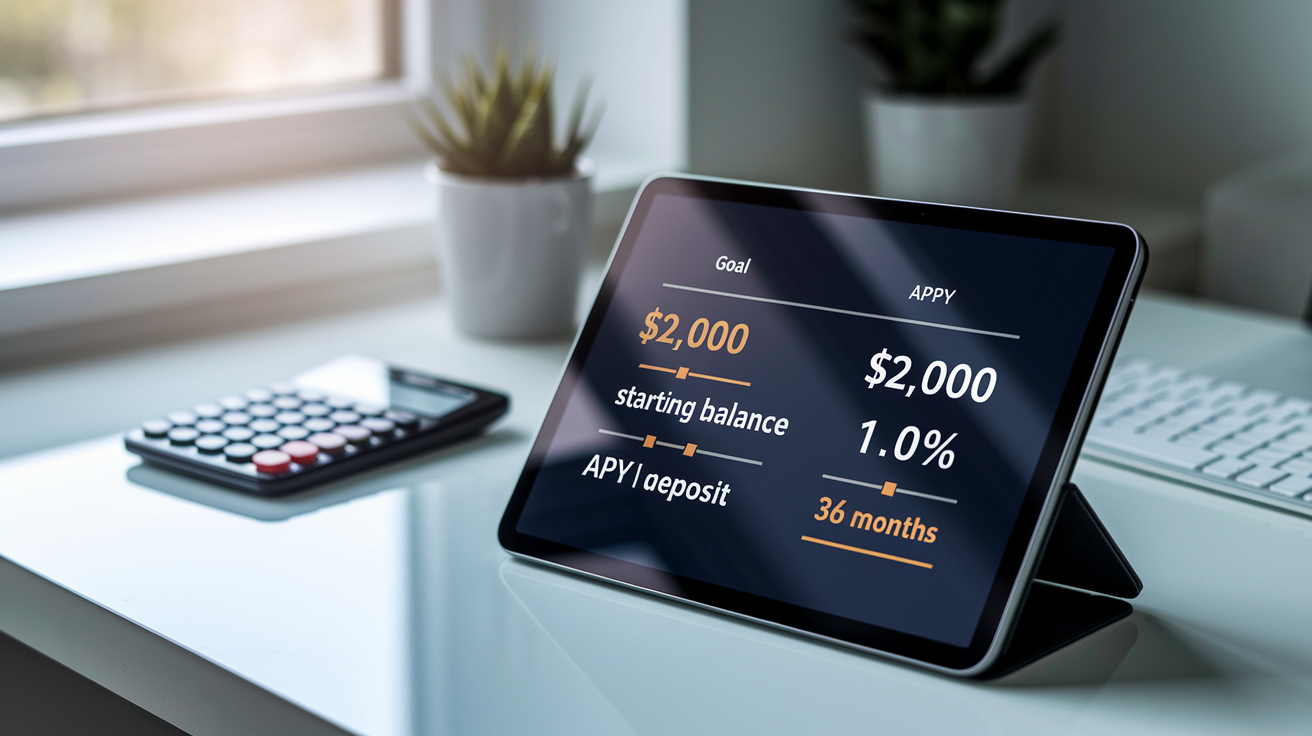
Walking through a real example makes the numbers feel less abstract. Say your goal is to save $12,000 for a used car in three years. You already have $2,000 set aside, and your high-yield savings account pays 1.0% APY compounded monthly.
First, the calculator projects how much your $2,000 starting balance will grow in 36 months at 1% annual interest. That comes to about $2,060.91. Subtract that from your $12,000 goal and you’re left with $9,939.09 that has to come from monthly deposits and the interest those deposits earn. Applying the annuity formula with a monthly interest rate of roughly 0.0008333 (1% divided by 12), the required monthly deposit works out to around $272.12 per month. Stick to that plan and you’ll hit $12,000 in exactly three years.
Small changes to the interest rate or the timeline have real effects. If the APY were 3.65% instead of 1%, your required monthly deposit would drop to around $263 because more of the goal is covered by interest. Shorten the timeline to two years instead of three and your monthly amount would jump to over $400 because you’ve got less time for interest to pile up.
The four steps to run any savings goal calculation:
- Enter your total goal amount and your current starting balance.
- Enter your target deadline in months or years.
- Add the expected annual interest rate (APY) and choose the compounding frequency.
- Review the required monthly deposit and adjust your inputs if the amount doesn’t fit your budget.
Benefits of Using a Savings Goal Calculator for Planning

A goal calculator turns vague intentions into a concrete monthly action. Instead of guessing how much to save, you know the exact number and can fit it into your budget from the start. This clarity cuts down on decision fatigue every payday because the answer’s already decided.
The tool also lets you test scenarios before you commit. You can try different timelines, contribution frequencies, or interest rates to see how each choice changes your monthly requirement. This flexibility helps you find a plan that fits both your financial capacity and your urgency. Progress tracking becomes straightforward because you’ve got a clear target and a schedule to compare against actual deposits.
Key benefits:
- Clarity – Converts a vague savings wish into a specific dollar-per-month target you can budget around.
- Automation support – Knowing the exact monthly amount makes it simple to set up automatic transfers from checking to savings.
- Scenario testing – Adjust timeframe, interest rate, or starting balance to explore different saving strategies before choosing one.
- Improved accuracy – Takes compound interest into account so your plan reflects real growth, not just addition.
- Progress tracking – Gives you a baseline to compare your actual balance against the projected schedule and catch shortfalls early.
Common Use Cases for Savings Goal Calculators

Emergency funds are one of the most common applications. Financial advisors usually recommend saving three to six months of essential expenses in a liquid account. If your monthly expenses are $3,000 and you want a six-month cushion, your goal is $18,000. A calculator shows you how to reach that amount over two or three years with manageable monthly contributions, and it accounts for the modest interest you’ll earn in a high-yield savings account.
Down payment planning is another high-impact use case. If you’re aiming to buy a home in five years and need $30,000 for a down payment, the calculator breaks that large sum into a monthly target. Knowing you need to save $450 per month (assuming a small interest rate) helps you decide whether to adjust your timeline, increase your income, or cut other expenses to make room in your budget.
Other practical scenarios:
- Vacation savings – Planning for a $3,000 trip in 12 months. The calculator shows whether $250 per month is enough or if you need to save a bit more.
- Car purchase – Saving $8,000 over two years for a reliable used vehicle. The tool factors in a 1% or 2% APY from a savings account.
- Wedding expenses – Setting aside $15,000 over 18 months. The calculator reveals the required bi-weekly or monthly deposit.
- Education costs – Building a fund for tuition, books, or certification programs over a set period before enrollment.
- Appliance or home repair fund – Creating a sinking fund for a new refrigerator, roof repair, or HVAC replacement within a year or two.
- Holiday or gift budget – Saving $1,200 throughout the year so December spending doesn’t rely on credit cards.
Comparing a Savings Goal Calculator to Other Financial Tools

Retirement calculators focus on decades-long timelines and income replacement in your 60s or 70s. They work with variables like employer matches, tax-advantaged growth, Social Security estimates, and inflation adjustments. A savings goal calculator is built for shorter horizons and concrete dollar targets, not lifetime income projections.
Investment calculators assume variable returns from stocks, bonds, or mutual funds and often include volatility or risk adjustments. They help you model portfolio growth over time, but they don’t guarantee a specific end balance because market performance fluctuates. Savings goal calculators use fixed or near-fixed interest rates from bank accounts and certificates of deposit, so the results are predictable as long as the rate doesn’t change.
When choosing the right tool, match the calculator to your goal’s timeline and risk profile. Use a savings goal calculator for any target you want to hit with certainty within ten years or less, especially if the money needs to be liquid and safe. Use an investment calculator if you’re willing to accept market risk for potentially higher returns over a longer period.
Four common alternatives and when to use them:
- Retirement calculator – Best for goals 20+ years out. Focuses on replacing income in retirement and includes employer contributions, tax advantages, and Social Security.
- Investment calculator – Good for medium to long-term goals where you invest in stocks or funds and accept year-to-year volatility for higher average returns.
- CD calculator – Useful when you lock funds into a certificate of deposit with a fixed term and fixed rate (example: a 12-month CD at 4.00% APY). Shows guaranteed interest with no flexibility to withdraw early without penalty.
- Sinking fund calculator – Designed for single, specific purchases like a new roof or annual insurance premium. Often simpler with no compound interest, just division of cost by number of periods.
Tips for Reaching the Monthly Savings Target Your Calculator Recommends

Automation is the simplest way to stick to your plan. Set up a recurring transfer from your checking account to your savings account on the same day you get your paycheck. When the money moves before you see it, you’re less tempted to spend it. Most banks and payroll systems let you split direct deposits, so a portion goes straight into savings without any manual action.
Budgeting makes sure the monthly target fits into your overall financial picture. List your fixed expenses like rent, utilities, and loan payments. Estimate variable costs like groceries, gas, and entertainment. Confirm that your required savings amount leaves enough for essentials and a small buffer. If the number’s too tight, adjust your timeline or goal rather than setting yourself up to fail.
A high-yield savings account maximizes the interest part of your plan. Even a difference between 0.5% and 3.5% APY can save you months of contributions on a multi-year goal. Check that the account has no monthly fees and no minimum balance requirements. Confirm that your deposits stay below any maximum balance limits the bank imposes.
Practical steps to stay on track:
- Automate transfers – Schedule recurring moves from checking to savings on payday so you never forget a contribution.
- Build savings into your budget – Treat your monthly target as a fixed expense, just like rent or a loan payment.
- Choose a high-yield savings account – A 3% or 4% APY earns real interest over time compared to a 0.01% standard savings rate.
- Track progress monthly – Compare your actual balance to the calculator’s projected schedule and adjust contributions if you fall behind.
- Adjust contributions after raises or windfalls – When you get a raise, bonus, or tax refund, bump up your monthly deposit or make a one-time lump-sum addition to speed up your timeline.
- Celebrate milestones – Reward yourself in small, budget-friendly ways when you hit 25%, 50%, or 75% of your goal to keep motivation up.
- Cut discretionary expenses temporarily – Find one or two non-essential costs like subscriptions, dining out, or impulse purchases and redirect that money to your savings target for a few months.
Understanding Assumptions and Limitations in Savings Goal Calculators

Most calculators assume your interest rate stays constant throughout the entire savings period. Banks can change APY anytime, especially on variable-rate savings accounts. A rate that starts at 3.65% might drop to 2% if the central bank lowers benchmark rates. Your actual end balance could be lower than projected, and your required monthly deposit might need to go up mid-plan to make up the difference.
The tool also assumes you make every deposit on schedule and never withdraw money early. Skip a month or pull funds out for an emergency and your timeline stretches or your final balance falls short. The calculation doesn’t account for life changes, irregular income, or unexpected expenses, so treat the output as a best-case scenario that takes discipline to hit.
Five key assumptions and limitations to keep in mind:
- Constant rate assumption – The calculator uses one APY for the entire period, but actual rates move around. Check your account terms to see if the rate is fixed or variable.
- No-withdrawal assumption – Results depend on leaving all principal and interest untouched until the goal date. Early withdrawals break the compounding chain.
- Rounding – Many calculators round results to the nearest dollar, which can create small discrepancies over long timelines or large balances.
- Inflation omission – The tool doesn’t adjust your goal for inflation, so if you’re saving for something years away, the real purchasing power of your target amount may be less than you expect.
- Potential tax influence – Interest earned on savings is typically taxable income. The calculator shows gross interest, not the after-tax amount you actually keep.
Final Words
Plug in your goal, timeline, and a realistic rate, and the calculator gives a clear monthly target you can act on. We walked through what these tools do, the key inputs and outputs, the simple math, examples, use cases, and practical tips.
Remember assumptions like steady interest or no withdrawals. Check and tweak numbers, automate transfers if you can, and revisit the plan after life changes.
If you’re asking what is a savings goal calculator, it’s a quick planner that turns a target into steps—use it and watch progress build.
FAQ
Q: What is an example of a savings goal and how much should my savings goal be?
A: An example of a savings goal is building an emergency fund equal to 3–6 months of expenses. How much it should be depends on your monthly costs, timeline, and priorities—choose an amount you can fund consistently.
Q: What is the 3 3 3 rule for savings?
A: The 3 3 3 rule for savings is a simple guideline to keep three months’ worth of living expenses as an emergency fund, giving you a basic short-term safety net.
Q: How much do I have to save a month to save $10,000 in a year?
A: To save $10,000 in a year you need to save about $833.33 per month before interest; with modest interest you’ll need slightly less, so plan to set aside about $834 monthly.