



Think all car insurance is the same? Think again.
For first-time buyers, starter insurance really boils down to three clear choices based on your car, lender rules, and budget.
Choose liability-only for older paid-off cars, a balanced plan for mid-value vehicles, or full coverage when you finance or lease.
This guide cuts through the jargon, shows typical yearly costs, and gives quick checks, like what to ask insurers and when it’s worth raising your deductible, so you can pick a setup that protects your wallet without leaving you exposed.
Core Starter Insurance Options for First-Time Buyers
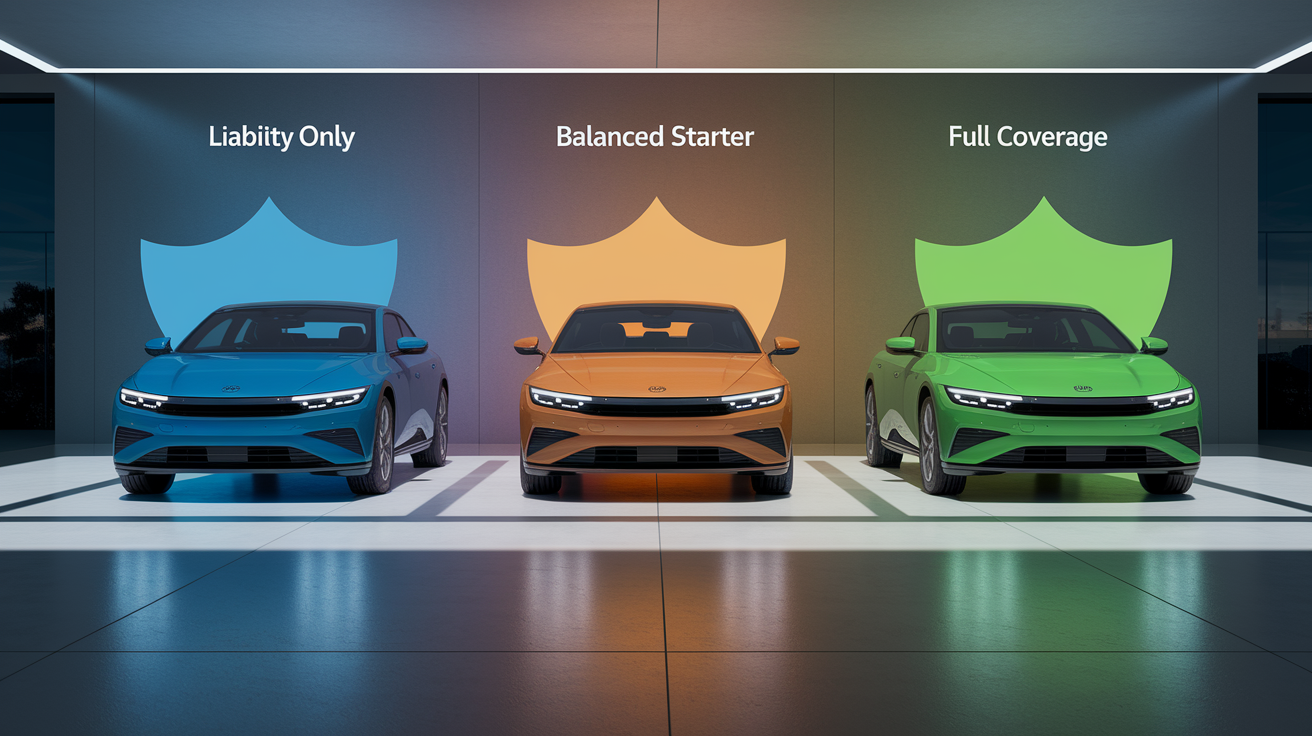
Most first-time insurance buyers feel overwhelmed by options, but starter insurance breaks down into three simple tiers based on your vehicle and budget. If you own an older car that’s paid off and worth less than $5,000, a liability-only starter makes sense. Covers only damage you cause to others while keeping your annual cost between $400 and $1,200 in affordable states. For daily commuters with newer vehicles financed through a loan or lease, full coverage (liability plus collision and comprehensive) is required by lenders and costs roughly $1,200 to $4,500 annually depending on age and location. Between those two sits the balanced starter: liability plus collision with a higher deductible, offering protection for your car without the full premium burden. Typically lands between $1,200 and $3,000 per year.
Your age plays a major role in cost. Young drivers under 25 often pay $2,500 to $5,000+ annually because insurers price in inexperience. Adult first-time buyers over 30 with clean records see much lower premiums, often $900 to $1,800 per year for the same coverage. Raising your deductible from $500 to $1,000 can cut your premium by roughly 10 to 25 percent, but only do that if you can afford the higher out-of-pocket cost in a claim. “I’ll save $200 a year” sounds good until you’re stuck paying an extra $500 after an accident.
Many first-time buyers find success starting with a nationally recognized carrier offering strong telematics programs or a regional insurer with competitive base rates in their state. Military households should check eligibility-restricted options that can save 30 to 50 percent compared to general-market plans. The key is matching coverage to how you use the car and what you can realistically afford.
Top recommended starter policy setups for beginners:
Liability-only for older vehicles: State-required minimums or recommended 100/300/100 limits. Cheapest option if your car’s value doesn’t justify collision/comprehensive premiums.
Balanced starter for moderate-value cars: Liability 100/300, collision with $1,000 deductible, skip comprehensive if theft/weather risk is low. Good middle ground on cost.
Full coverage for financed/leased vehicles: Liability 100/300, collision and comprehensive both with $500 deductibles, plus rental reimbursement. Required by lenders and protects your investment.
Student/young-driver bundle: Liability 100/300, collision/comprehensive $500 deductible, telematics enrollment, good-student discount applied. Targets maximum available discounts to offset age penalties.
Low-mileage occasional driver plan: Liability 50/100, comprehensive-only or usage-based program with per-mile pricing. Ideal if you drive under 7,500 miles annually and park in a safe area.
Understanding Starter Insurance Coverage Types for New Buyers

Liability coverage is the foundation. It pays for damage you cause to other people and their property in an at-fault accident, and nearly every state legally requires it before you can register a vehicle. Liability splits into two parts: bodily injury (covering medical bills, lost wages, and legal costs if you injure someone) and property damage (covering repairs to another person’s car, fence, or building). State minimums often follow a numeric format like 25/50/25, meaning $25,000 bodily injury per person, $50,000 total bodily injury per accident, and $25,000 property damage per accident. That sounds like a lot until you realize a single serious injury can generate $100,000+ in medical costs, leaving you personally responsible for the shortfall if you carry only minimums.
Collision coverage pays to repair or replace your own vehicle after an accident, regardless of who was at fault. Rear-end someone or get rear-ended, collision handles your car. Comprehensive coverage protects your car from non-collision events: theft, vandalism, hail, flood, hitting a deer, falling tree branches. Lenders require both collision and comprehensive if you finance or lease a vehicle because they hold the title and need to protect their asset. If your car is older and paid off, you’ll decide whether the annual cost of these coverages (often $400 to $1,200 combined) justifies the payout you’d receive after a total loss minus your deductible. Sometimes it doesn’t, especially if your car’s market value hovers near $3,000 or less.
Uninsured and underinsured motorist coverage (UM/UIM) steps in when the at-fault driver has no insurance or not enough to cover your injuries and vehicle damage. Roughly one in eight drivers operates without insurance, so UM/UIM acts as a safety net. It’s your own policy covering what the other driver should have paid. Medical payments coverage (MedPay) or personal injury protection (PIP) pays your and your passengers’ medical bills after an accident, regardless of fault, and some states require PIP by law while others make it optional. Think of MedPay as your health insurance backup. It covers ambulance rides, emergency room visits, and follow-up care up to your chosen limit, often $1,000 to $10,000.
| Coverage Type | What It Protects | Typical Limits |
|---|---|---|
| Liability (Bodily Injury & Property Damage) | Injuries and property you damage in an at-fault accident | 25/50/25 state minimum; recommended 100/300/100 |
| Collision | Your vehicle repairs after a crash, regardless of fault | Actual cash value minus deductible ($250–$1,000) |
| Comprehensive | Your vehicle from theft, weather, vandalism, animals | Actual cash value minus deductible ($250–$1,000) |
| Uninsured/Underinsured Motorist (UM/UIM) | Your injuries and damage when other driver lacks coverage | Match liability limits; often 100/300 |
Cost Breakdown of Starter Insurance for First-Time Buyers

Age dominates pricing more than any other single factor. Insurers treat drivers under 25 as high-risk because crash data shows inexperience leads to more claims. Teen drivers ages 16 to 17 typically face annual premiums between $4,000 and $8,000, sometimes reaching $10,000+ in expensive metro areas or if they drive a high-performance car. Young adults ages 22 to 30 see that penalty shrink but still pay roughly $1,200 to $3,000 per year, which is 50 to 300 percent higher than a comparable 40-year-old driver with the same coverage. Once you hit 30 and maintain a clean record, premiums often drop into the $800 to $1,800 range for solid starter coverage.
Your ZIP code matters almost as much as your birthday. Moving from a rural county to a dense city can raise your premium by 15 to 60 percent because urban areas generate more claims. Higher theft rates, more traffic density, more frequent accidents. Driving record acts as a multiplier: each at-fault accident or moving violation in the past three years can increase your rate by 20 to 50 percent per incident, and serious violations like DUI can double or triple your cost or make you uninsurable with standard carriers. Vehicle type also adjusts your premium. High-theft models (certain Honda and Toyota sedans top theft lists annually) or luxury/sports cars can add 10 to 40 percent to collision and comprehensive costs compared to a modest family sedan.
Deductible choices directly trade upfront savings for future out-of-pocket risk. Choosing a $1,000 deductible instead of $500 typically reduces your premium by 10 to 25 percent annually, saving you maybe $150 to $400 per year, but costs you an extra $500 when you file a claim. “I saved $200 this year but now I owe $1,000 instead of $500 to fix my car” is the math you’re agreeing to. Credit score (where legally allowed) can shift premiums by 5 to 20 percent because insurers link poor credit to higher claim frequency, and gender sometimes plays a small role in pricing, though several states have banned gender-based rating.
The biggest cost drivers with measurable impact:
Age under 25: Raises premiums by 50 to 300 percent compared to drivers over 30 with identical coverage and clean records.
Urban ZIP code versus rural: Adds 15 to 60 percent due to higher theft, vandalism, and accident frequency in metro areas.
At-fault accidents or tickets: Each incident increases rates by 20 to 50 percent for three to five years after the event date.
High-theft or luxury vehicle: Boosts collision and comprehensive premiums by 10 to 40 percent compared to low-risk sedan models.
Low credit score (where used): Can increase premiums by 5 to 20 percent. Improving credit over time reduces this penalty.
Deductible choice: Lowering deductible from $1,000 to $250 raises annual premium by roughly 10 to 25 percent but reduces your claim out-of-pocket by $750.
Comparing the Best Starter Insurance Companies for First-Time Buyers

Choosing a starter insurance company means balancing three priorities: competitive pricing for your profile, discounts that actually apply to first-time buyers, and customer service that won’t leave you stuck on hold when you need to file a claim. Large national carriers often offer the broadest discount menus and robust online quoting tools, making it easy to bind coverage in under 20 minutes. Regional insurers can beat national pricing by 10 to 30 percent in their home states but may lack the mobile app features or 24/7 claims support that tech-savvy buyers expect. Military-focused carriers deliver the lowest premiums for eligible households, sometimes 30 to 50 percent below the general market, but restrict membership to active duty, veterans, and their families.
Customer service ratings typically range from 3.5 to 4.5 out of 5 on aggregated review platforms, with higher scores correlating to faster claims processing and better communication during stressful moments. “My car was totaled and they had a check in six days” versus “I called four times and never got a callback.” Look for insurers with strong telematics or usage-based programs if you’re a cautious driver, because these can unlock 5 to 30 percent savings within your first six months by monitoring braking, speed, and mileage. Bundling home or renters insurance with auto typically saves 10 to 25 percent, and some carriers offer higher discounts for homeowners bundles than renters bundles. Roughly $66 more annually for home+auto versus renters+auto.
| Insurer | Annual Cost Range | Key Discount | Best For |
|---|---|---|---|
| Company A | $1,100–$2,200 | Multi-policy bundling (10–25%) | Buyers with renters/homeowners insurance to bundle; strong local agent network |
| Company B | $900–$1,900 | Telematics safe-driver (5–30%) | Tech-comfortable drivers willing to install app; fast online quoting |
| Company C | $800–$1,800 | Regional competitive base rates | Residents in specific states where this carrier dominates market share |
| Company D | $600–$1,400 | Military family discount (10%+) | Active duty, veterans, and dependents only; highest service ratings for eligible members |
| Company E | $1,000–$2,200 | Good-student academic (10–25%) | Students under 25 with GPA 3.0+; strong campus presence and scholarship tie-ins |
Availability varies significantly by state. Some of the lowest-cost carriers operate in only 10 to 20 states, while national brands write policies in all 50 but may not be price-competitive everywhere. Always get at least three to five quotes even if one carrier advertises heavily in your area, because underwriting differences can produce 20 to 60 percent price variance for identical coverage. A company that’s cheapest for a 19-year-old student in Ohio might be the most expensive option for a 32-year-old commuter in Texas.
Choosing the Right Starter Insurance Policy as a New Buyer

Matching coverage to your actual risk and assets prevents both overpaying and dangerous under-insurance. Start by asking whether you finance or lease your vehicle. If yes, full coverage (liability, collision, comprehensive) is non-negotiable because the lender requires it in the loan contract. If you own the car outright, calculate your vehicle’s current market value and compare that to the annual cost of collision and comprehensive. When your car is worth $3,000 and collision+comprehensive costs $800 per year with a $500 deductible, you’re paying nearly a third of the car’s value annually to protect an asset that would only net you $2,500 after the deductible in a total loss.
Deductible selection hinges on how much cash you can access in an emergency. Choosing a $250 deductible means lower financial shock if you crash tomorrow, but you’ll pay 10 to 25 percent higher premiums every year to buy that peace of mind. “I’m paying an extra $300 annually to avoid a $250 difference in a claim” is backwards math. Most first-time buyers land on $500 as the practical middle ground: low enough that an unexpected fender-bender doesn’t drain savings, high enough to keep premiums manageable. If you have $2,000 sitting in an emergency fund, consider the $1,000 deductible and pocket the annual savings.
Liability limits deserve more thought than most new buyers give them. State minimums like 25/50/25 leave you personally liable for the difference if you cause a serious accident. Rear-ending a luxury SUV with three injured passengers can generate $150,000 in medical bills and property damage, and you’d owe $100,000 out-of-pocket with minimum coverage. Stepping up to 100/300/100 liability typically adds $200 to $600 annually but shields your assets and future wages from lawsuits. Match your uninsured/underinsured motorist coverage to your liability limits because roughly one in eight drivers carries no insurance, and you want the same protection if they hit you.
Key decision factors for selecting starter coverage:
Vehicle loan or lease: Full coverage (liability + collision + comprehensive) required. Choose $500 deductible as baseline if budget allows.
Car value under $4,000: Skip collision and comprehensive or carry comprehensive-only if theft/weather risk is high in your area. Liability-only with high limits saves money.
Emergency savings balance: Match deductible to available cash. If you have $1,500 saved, $1,000 deductible makes sense. If you have $300, stick with $250 or $500.
Asset protection: Raise liability limits to 100/300/100 or higher if you own a home, have significant savings, or earn income that could be garnished in a lawsuit.
Ways to Reduce Starter Insurance Premiums for First-Time Buyers

Discounts can cut your final premium by 20 to 50 percent if you stack them correctly, but you have to ask because insurers rarely volunteer every discount you qualify for. Good-student discounts reward academic performance with 10 to 25 percent savings, typically requiring a 3.0 GPA or higher and proof via transcript every six to twelve months, and they’re available to drivers under 25 still in high school or college. Multi-policy bundling (combining auto with renters or homeowners insurance) unlocks 10 to 25 percent off both policies, and bundling with homeowners insurance saves roughly $66 more per year than bundling with renters because the home policy represents a larger premium base.
Multi-car discounts kick in when you insure two or more vehicles on the same policy, saving 5 to 15 percent per car. Parents adding a teen driver should always explore keeping the teen on the family policy rather than buying a separate policy, because the savings often exceed $1,000 annually. Safe-driver or accident-free discounts grow over time, reaching 15 to 30 percent after you maintain a clean record for three to five years, and defensive driving courses deliver 5 to 15 percent savings in most states if you complete an approved program (typically $20 to $50 and four to eight hours of online or classroom instruction). Signing up for automatic payments or paperless billing can shave another 2 to 8 percent off your premium with almost no effort.
Top discounts and typical savings for first-time buyers:
Good student (GPA 3.0+): 10 to 25 percent for drivers under 25. Proof required every 6 to 12 months.
Multi-policy bundling (renters or homeowners + auto): 10 to 25 percent on both policies. Homeowners bundles save $66 more annually than renters bundles on average.
Multi-car on same policy: 5 to 15 percent per vehicle. Keeping teen drivers on parents’ policy maximizes this discount.
Safe-driver or claims-free record: 15 to 30 percent after 3 to 5 years of no at-fault accidents or violations.
Telematics or usage-based insurance programs: 5 to 30 percent based on monitored driving behavior (braking, speed, mileage, time of day).
Defensive driving course completion: 5 to 15 percent. Course costs $20 to $50 and takes 4 to 8 hours. Discount applies for 1 to 3 years depending on state.
Automatic payments or paperless billing: 2 to 8 percent. Often combined into a single “account convenience” discount.
Low-mileage or pay-per-mile programs: 5 to 25 percent if you drive under 7,500 miles annually. Per-mile pricing can save even more for very occasional drivers.
Telematics and usage-based insurance programs track your driving through a mobile app or plug-in device, measuring hard braking, rapid acceleration, speed relative to posted limits, mileage, and time of day (late-night driving scores worse than daytime). If you drive cautiously and avoid rush hour, you can earn 5 to 30 percent savings within the first six months. “I installed the app, drove like my grandma was in the passenger seat for three months, and my rate dropped 22 percent” is a common result. The trade-off is privacy: the insurer sees when, where, and how you drive, and risky patterns (frequent hard braking, speeding, driving at 2 a.m.) can increase your rate or disqualify you from the discount. Most programs offer a small upfront discount just for enrolling, so even moderate drivers come out ahead.
Common First-Time Insurance Buyer Mistakes and How to Avoid Them

Buying only state-minimum liability might keep you legal, but it leaves you financially exposed in any serious accident. Minimum limits like 25/50/10 max out at $50,000 for injuries in a crash, and a single ambulance ride plus emergency room visit for one injured person can hit $30,000 before any surgery or rehab. If you cause an accident that racks up $120,000 in medical bills and lost wages, you’re personally responsible for the $70,000 overage, which can lead to wage garnishment and liens against your property. Stepping up to 100/300/100 liability costs an extra $200 to $600 per year but shields your assets and future income from lawsuits. “I saved $400 annually on premiums and lost my savings account to a court judgment” is a brutal lesson.
Skipping collision coverage on a financed or leased vehicle violates your loan contract and leaves you stuck paying off a car you can’t drive after a total-loss accident. Lenders and leasing companies require full coverage (liability plus collision and comprehensive) because they hold the title and need to protect their collateral. If you drop collision to save money and then total the car, you still owe the full loan balance but have no vehicle and no insurance payout to cover it. Choosing a deductible that’s too low raises your annual premium by 10 to 25 percent without providing real value unless you file multiple claims per year, and filing frequent small claims can trigger rate increases that cost more than the deductible savings. Paying an extra $300 annually for a $250 deductible instead of $500 means you’d need to file a claim every year just to break even.
Most damaging mistakes first-time buyers make:
Buying state-minimum liability only: Exposes you to tens or hundreds of thousands in personal liability. Upgrade to 100/300/100 ($200 to $600 annual increase) to protect assets.
Skipping collision on financed/leased cars: Violates lender requirements and leaves you paying off a totaled vehicle with no insurance payout. Full coverage is mandatory when you owe money on the car.
Choosing too-low deductibles: Raising deductible from $250 to $500 saves roughly 10 to 25% annually ($200 to $500 per year). Only stick with $250 if you file claims frequently (most drivers file once every 10+ years).
Missing available discounts: Forgetting to ask about good-student, telematics, or bundling discounts forfeits 10 to 30 percent in savings. Always request a full discount audit during quoting.
Comparing fewer than three carriers: Underwriting differences produce 20 to 60 percent price variance for identical coverage. Limiting yourself to one or two quotes often means overpaying by $300+ annually.
Not listing all household drivers: Failing to disclose household members or regular drivers can void claims and trigger policy cancellation. Insurers require you to list anyone with access to your vehicle even if they “rarely drive it.”
Step-by-Step Application Guide for Your First Insurance Policy

Applying for your first insurance policy takes 30 to 90 minutes from start to finish if you have all required documents ready. Start by gathering your driver’s license, vehicle identification number (VIN, found on the dashboard or driver’s-side door jamb), vehicle registration, the last four digits of your Social Security number, current odometer reading, and proof of prior insurance if you’ve been covered under someone else’s policy. That prior coverage history can unlock loyalty discounts or preferred rates even as a first-time buyer. If you’re a student, grab your most recent transcript or report card to prove your GPA for good-student discounts, and keep certificates from any defensive driving or driver education courses handy because those often translate to 5 to 15 percent savings.
Follow these steps to complete your application and bind coverage:
-
Gather required documents (10 to 30 minutes): Driver’s license, vehicle VIN and registration, Social Security number (or last four digits), date of birth, current odometer reading, and proof of good-student status or defensive-driving completion if applicable.
-
Request quotes from three to five insurers (15 to 60 minutes total): Use online quoting tools or call agents directly. Provide identical coverage specs (same liability limits, deductibles, add-ons) to ensure apples-to-apples comparison. Each quote takes 5 to 20 minutes.
-
Choose coverage levels and deductible (10 to 20 minutes): Confirm liability limits (recommended 100/300/100), select collision and comprehensive deductibles ($500 typical starter), add uninsured motorist coverage equal to liability limits, and review optional add-ons (rental reimbursement, roadside assistance).
-
Verify and apply all eligible discounts (5 to 10 minutes): Explicitly ask about good-student, multi-policy, multi-car, telematics, defensive-driving, and auto-pay discounts. Insurers won’t always apply them without prompting.
-
Provide payment information and bind the policy (5 to 10 minutes): Most insurers accept credit/debit cards or electronic bank transfers (ACH). Coverage typically begins immediately after payment is processed, and you’ll receive a digital insurance ID card via email within minutes.
-
Download and store your insurance ID card (2 to 5 minutes): Save the PDF to your phone and email it to yourself as backup. Most states accept digital proof of insurance during traffic stops, and you’ll need it to register the vehicle.
Coverage becomes active the moment your payment clears, which is usually immediate for electronic payments. No waiting period, no delayed effective date unless you specifically request coverage to start on a future date. Your insurance ID card arrives via email within minutes to hours, and most insurers also mail a physical card that reaches you in three to seven business days. Always keep both digital and physical copies accessible because you’ll need to show proof of insurance during vehicle registration, traffic stops, and any accident scene.
Final Words
You ran through the core starter options: liability-only for old cars, balanced starter plans for daily commuters, and full coverage when a lender requires it. You also saw realistic cost ranges, key coverage types, sample insurers, savings tactics, common mistakes, and a short application checklist.
Match limits to your risk, pick a deductible that lowers premiums without breaking the bank, hunt discounts, and compare several quotes.
These steps make it easier to choose the best starter insurance for first time buyers. You’re on the right track.
FAQ
Q: What’s the best insurance for first time buyers?
A: The best insurance for first-time buyers is a policy that fits the car and your risk: liability-only for older cars, a balanced starter plan for daily drivers, and full coverage if the car is financed; aim for 100/300/100.
Q: Who has the cheapest insurance for first time drivers?
A: The cheapest insurance for first-time drivers often comes from regional carriers or insurers offering telematics and good-student discounts; compare 3–5 quotes and consider usage-based programs to lower rates quickly.
Q: Is $200 a month expensive for car insurance?
A: A $200 monthly car insurance payment is reasonable for many first-time buyers; it equals $2,400 yearly and can be low or high depending on your age, vehicle, coverage level, and ZIP code.