



Buying travel insurance the day before a hurricane won’t save you.
Travel insurance is a reimbursement plan: you pay costs up front, keep receipts, then file to get paid back up to your policy limits for covered events.
Timing, covered reasons, and exclusions decide whether a claim succeeds.
This post explains when coverage starts, what common benefits really cover (cancellation, medical, evacuation, baggage), and the clear steps to file a successful claim so you know what to expect.
Clear Breakdown of How Travel Insurance Works in Real-Life Situations

Travel insurance works on a reimbursement model. You pay upfront for eligible expenses, then submit documentation to get paid back up to your policy limits. Purchase timing is critical. You’ve got to buy the policy before the event you want coverage for happens. If a hurricane’s already approaching your destination, a newly purchased policy won’t cover that storm.
Coverage activates on specific timelines depending on the benefit. For comprehensive plans, the policy typically becomes effective the day after purchase. Trip cancellation benefits often start immediately upon purchase, meaning if you buy today and need to cancel tomorrow for a covered reason, you’re eligible. On-trip benefits (emergency medical, evacuation, baggage coverage) begin when you start your trip on the departure date stated in your policy.
Most insurers offer a 10 to 15 day refund window. If you change your mind or cancel your trip before the policy’s effective date, you can request a full refund of your premium within that window. After that period, premiums are generally non-refundable unless you cancel the entire trip before departure and meet specific criteria, such as purchasing a single-trip medical policy that allows cancellation before travel.
Here’s the basic flow from purchase to payout:
Purchase the policy within required windows (often 14 to 21 days of your initial trip deposit to qualify for waivers and add-ons).
Coverage activates on the policy’s effective date. Cancellation coverage may start immediately, on-trip benefits begin when you depart.
An event occurs that’s listed as a covered reason (illness, injury, weather, carrier cancellation).
You pay costs upfront and collect documentation. Receipts, medical bills, airline statements, police reports.
File your claim within the policy’s window (commonly 20 to 90 days for initial filing, sometimes up to 180 to 365 days for final documentation), and the insurer reviews and reimburses approved claims typically within 30 to 60 days.
Core Travel Insurance Coverage Types Explained
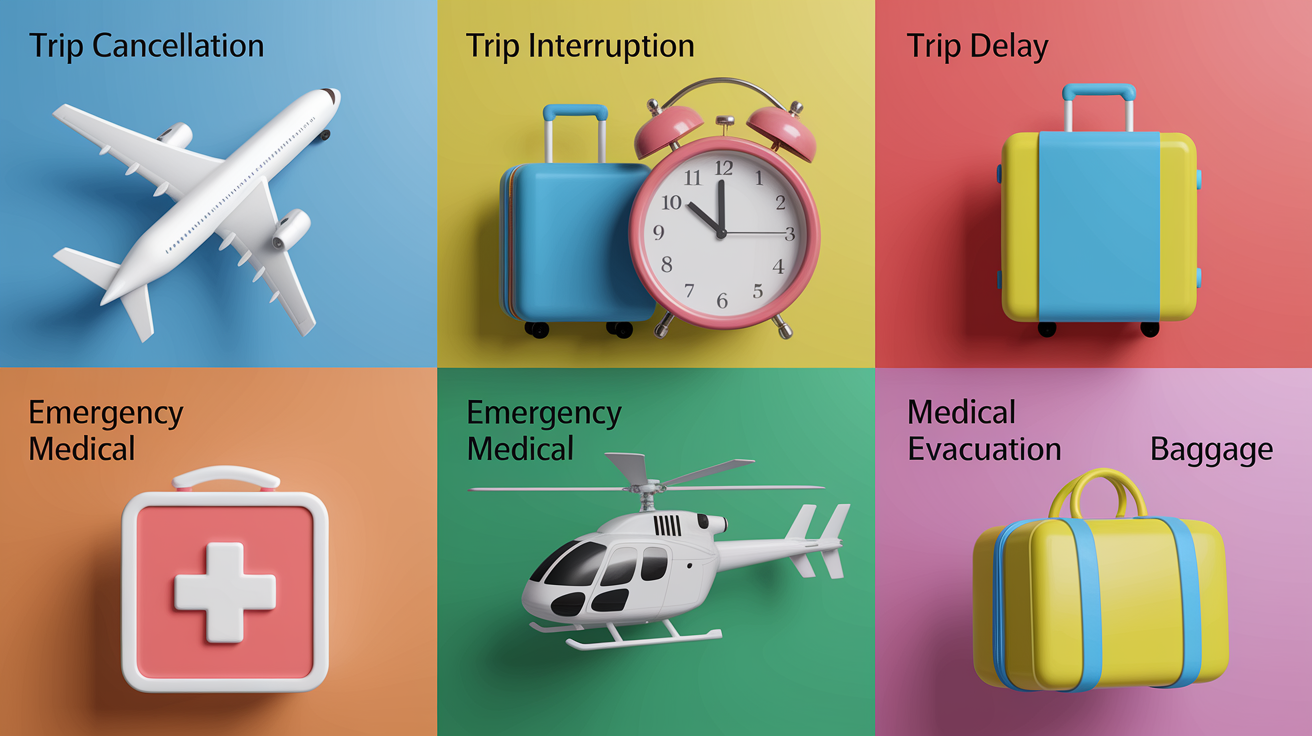
Comprehensive travel insurance bundles several protections into one plan. Trip cancellation reimburses you for prepaid, non-refundable trip costs if you cancel for a covered reason before departure. Common limits equal 100% of your insured trip cost (the total amount you prepaid and declared when you bought the policy).
Trip interruption pays for the unused portion of your trip plus extra expenses to return home early if a covered event forces you to cut your trip short. Typical limits range from 100% to 150% of your trip cost, or a fixed dollar amount stated in your policy. Emergency medical coverage pays for hospital visits, doctor fees, and prescriptions incurred abroad. Limits typically range from $10,000 on basic plans to $1,000,000 on premium plans. Common mid-range limits fall between $50,000 and $250,000.
Medical evacuation and repatriation coverage pays to transport you to the nearest adequate medical facility or back home if local care isn’t sufficient. Evacuation limits often sit around $100,000, with some plans offering $250,000 or higher. Baggage loss or damage reimburses you for lost, stolen, or damaged belongings. Total baggage limits typically range from $1,000 to $3,000, with per-item caps often between $100 and $2,000. Baggage delay coverage reimburses you for emergency purchases (toiletries, clothes) if your luggage is delayed beyond a specified number of hours, commonly 12 to 24 hours. Reimbursements for baggage delay typically range from $100 to $500.
| Coverage Type | Purpose | Typical Limit Range |
|---|---|---|
| Trip Cancellation | Reimburses prepaid, non-refundable trip costs if you cancel for a covered reason | Up to 100% of insured trip cost |
| Trip Interruption | Pays for unused trip portion plus return travel if you must cut the trip short | 100%–150% of trip cost or stated dollar cap |
| Emergency Medical | Covers medical expenses incurred abroad for injury or sudden illness | $10,000–$1,000,000 (common $50,000–$250,000) |
| Medical Evacuation | Pays to transport you to adequate care or home | $100,000–$250,000 |
How Trip Cancellation, Interruption, and Delay Benefits Work

Trip cancellation kicks in when a covered event prevents you from starting your trip. Covered reasons typically include sudden illness or injury to you or a traveling companion, death of an immediate family member, a named hurricane making your destination uninhabitable, or the airline or tour operator canceling your entire trip. You file documentation (medical records, death certificate, official carrier cancellation notice) and the insurer reimburses your prepaid, non-refundable costs up to your policy limit.
Trip interruption applies when you’ve already started traveling and need to return home early or skip a portion of your itinerary. Common triggers include a medical emergency requiring hospitalization, a family emergency at home, or a natural disaster that makes your destination inaccessible. Interruption coverage pays for the unused prepaid portion of your trip plus the cost of a last-minute ticket home, often up to 100% to 150% of your trip cost. Trip delay benefits reimburse meals, lodging, and local transportation if your carrier delays departure or arrival beyond a set number of hours (commonly 6 to 24 hours depending on the policy). Keep receipts and the airline’s delay confirmation to support your claim.
Common covered reasons include:
Sudden illness or injury requiring hospitalization before or during the trip.
Death of an immediate family member (parent, sibling, child, spouse).
Named hurricane, flood, or earthquake making your destination uninhabitable.
Airline or cruise line canceling your entire trip.
Jury duty or subpoena you can’t reschedule.
Understanding Emergency Medical and Medical Evacuation Coverage Abroad

Emergency medical coverage pays for treatment you receive abroad if you’re injured or suddenly become ill during your trip. Many standard health insurance plans offer limited or zero coverage outside your home country, so travel insurance fills that gap. Hospitals in some countries require upfront payment or proof of coverage before admitting you. When you call your insurer’s 24-hour assistance line, they can often arrange direct billing with the hospital, or you’ll pay out of pocket and file for reimbursement later with itemized bills and medical records.
Medical evacuation coverage becomes critical when local facilities can’t provide the care you need. If you’re in a remote area or a country without adequate medical infrastructure, the insurer arranges and pays for air ambulance transport to the nearest suitable hospital or back home. A typical medical evacuation can cost $45,000 or more, so policies with $100,000 to $250,000 evacuation limits are common. Repatriation of remains is also included in most evacuation benefits, covering the cost to return your body home in the event of death abroad.
Key points about medical and evacuation claims:
Call the insurer’s emergency assistance number immediately. They coordinate care and authorize evacuation.
Keep all itemized medical bills, prescriptions, hospital admission records, and doctor’s notes.
Reimbursement timelines typically run 30 to 60 days after you submit complete documentation and the claim is approved.
What Travel Insurance Doesn’t Cover and Common Exclusions

Pre-existing medical conditions are almost always excluded unless you purchase a pre-existing condition waiver. A pre-existing condition is typically defined as any injury, illness, or medical condition for which you received treatment, took medication, or experienced symptoms during a “look-back” period before buying the policy. Common look-back windows range from 60 to 180 days. To qualify for the waiver, most policies require you to buy the insurance within 14 to 21 days of making your initial trip deposit and to insure the full prepaid, non-refundable cost of your trip.
High-risk activities (skydiving, scuba diving deeper than specified limits, mountaineering, rock climbing, bungee jumping) are usually excluded unless you purchase an adventure sports or hazardous activities add-on. Injuries or illness caused by intoxication or illegal acts are never covered. Events that were known, foreseeable, or already occurring at the time you purchased the policy are excluded. If a hurricane is forecast and a travel advisory is issued before you buy your plan, claims related to that storm may be denied.
Pandemic and epidemic exclusions vary widely by insurer and policy. Some plans cover trip cancellation if you test positive for COVID-19 before departure and can’t travel, while others exclude pandemics entirely or require a separate endorsement. Always read the policy’s exclusions section to confirm what is and isn’t covered.
Common exclusions include:
Pre-existing medical conditions without a waiver or outside the stability period.
Injuries from extreme sports or hazardous activities unless specifically added.
Claims arising from intoxication, drug use, or illegal activities.
Events that were known or announced before you purchased the policy.
War, civil unrest, terrorism in some policies, or nuclear incidents.
Pandemics or epidemics unless explicitly covered by the policy or an endorsement.
Optional Add-Ons Like CFAR, Adventure Sports, and Pre-Existing Condition Waivers

Cancel For Any Reason (CFAR) is an optional upgrade that allows you to cancel your trip for reasons not listed in the standard covered-reasons list. Cold feet, work schedule changes, or simply changing your mind. CFAR typically reimburses 50% to 75% of your prepaid, non-refundable trip costs and must be purchased within a specific window, often 14 to 21 days of your initial trip deposit. CFAR adds roughly 40% to 75% to your base premium, making it a significant cost increase.
Adventure sports or hazardous activities coverage expands the standard exclusions to include activities like scuba diving, skiing, snowboarding, surfing, or trekking at high altitudes. Without this add-on, injuries sustained during these activities are denied. Pre-existing condition waivers allow coverage for medical conditions you had before buying the policy, but only if you meet strict purchase timing and trip cost requirements. Buy within 14 to 21 days of deposit, insure the full prepaid amount, and have a stable condition during the policy’s look-back period, commonly 60 to 180 days.
Key optional upgrades:
CFAR: Reimburses 50% to 75% of trip cost for any reason. Costs an extra 40% to 75% of base premium. Must be purchased within 14 to 21 days of initial deposit.
Adventure sports rider: Covers injuries from high-risk activities. Pricing varies by sport and trip duration.
Pre-existing condition waiver: Requires timely purchase within 14 to 21 days, full trip cost insured, and stable condition during look-back period (60 to 180 days).
When Travel Insurance Becomes Effective and Why Timing Matters

Your policy’s effective date is the date coverage begins. For comprehensive plans, this is typically the day after you purchase the policy. Trip cancellation benefits may start on the purchase date or the effective date depending on the insurer, so review your policy documents carefully. On-trip benefits (emergency medical, evacuation, baggage loss) begin on the trip start date you declared when buying the policy, usually the day you leave home.
Some benefits include waiting periods of 24 to 72 hours before they activate. For example, a medical coverage waiting period means if you fall ill within the first 48 hours of your trip, that claim might be excluded. Refund windows allow you to cancel the policy and receive a full premium refund if you do so within 10 to 15 days of purchase and before the policy’s effective date or trip departure.
Timing also determines eligibility for waivers and add-ons. Pre-existing condition waivers and CFAR options require purchase within 14 to 21 days of your initial trip deposit. Miss that window, and those protections disappear. If you book a trip six months in advance but wait four months to buy insurance, you’ve lost access to CFAR and the pre-existing waiver, even if you’re willing to pay extra.
How timing affects your coverage:
Purchase within 14 to 21 days of initial trip deposit to qualify for pre-existing condition waivers and CFAR add-ons.
Check the policy effective date to know when trip cancellation benefits start and when the refund window closes.
Confirm waiting periods for specific benefits. Medical, baggage, or other coverages may not activate until 24 to 72 hours after the policy becomes effective.
Step-By-Step Travel Insurance Claims Process

Filing a claim starts the moment a covered event occurs. For emergencies (sudden illness, injury, evacuation), call the insurer’s 24-hour assistance line immediately. The assistance team can arrange medical care, coordinate with hospitals, and authorize evacuation. Note the claim number and any instructions the representative provides.
Gather documentation as the event unfolds. Collect itemized receipts for all expenses you’re claiming, including medical bills, prescription invoices, airline or hotel receipts, taxi fares, and meals during delays. For trip cancellations or interruptions, save booking confirmations, proof of payment (credit card statements, canceled checks), and official notices from carriers or tour operators. If baggage is lost or stolen, file a report with the airline (Property Irregularity Report) or local police immediately and keep copies. For medical claims, obtain hospital discharge summaries, doctor’s notes, and any diagnostic test results.
Complete the claim form provided by your insurer. Most offer online portals or paper forms. Attach all supporting documents and submit within the policy’s filing window, commonly 20 to 90 days for initial filing. Some policies allow up to 180 to 365 days for final documentation if you’re still receiving treatment or waiting for final bills. The insurer reviews your claim and may request additional documents or clarification. Once approved, reimbursement is issued within 30 to 60 days, sometimes extending to 90 days for complex claims.
Filing steps in detail:
Call the insurer immediately if the event is a medical emergency or evacuation. Note your policy number and claim reference.
Collect all receipts and documentation as soon as possible. Itemized bills, booking confirmations, proof of payment, carrier notices, police reports.
Notify the insurer of the loss or cancellation within the policy’s required window (often 24 to 72 hours for emergencies, up to 20 to 30 days for other events).
Complete and submit the claim form with all attachments within the initial filing deadline (commonly 20 to 90 days).
Respond to requests for additional documentation or clarification promptly to avoid delays.
Receive reimbursement up to policy limits, less any deductible, typically within 30 to 60 days of claim approval.
Understanding Travel Insurance Costs and What Affects Your Premium

Comprehensive travel insurance premiums generally equal 4% to 10% of your total trip cost. In 2025, the average cost for a comprehensive policy was $402, while the average medical-only policy cost $82. For a $5,000 trip, expect to pay roughly $200 to $500 for full coverage including cancellation, medical, evacuation, and baggage protection. Medical-only plans are significantly cheaper because they exclude trip cancellation and interruption benefits.
Adding CFAR can increase your premium by 40% to 75% of the base cost. If your base premium is $300, CFAR might add $120 to $225, bringing your total to $420 to $525. Trip length, traveler age, destination, and coverage limits all influence price. Older travelers pay more because medical risk increases with age. Trips to countries with high medical costs or political instability carry higher premiums. Higher coverage limits for medical or evacuation also raise the price.
Deductibles lower premiums. Many comprehensive plans offer $0 deductibles for trip cancellation and interruption, but baggage or medical claims may carry a $25 to $250 deductible. Choosing a higher deductible reduces your upfront premium but increases your out-of-pocket cost if you file a claim.
| Factor | Effect on Price |
|---|---|
| Trip cost | Higher trip cost = higher premium (4%–10% of total trip cost) |
| Traveler age | Older travelers pay more due to increased medical risk |
| Destination | Countries with high medical costs or political instability increase premiums |
| Coverage limits and add-ons | Higher medical/evacuation limits and CFAR add-ons significantly raise cost |
Choosing the Right Travel Insurance Plan

Start by comparing policies side-by-side for coverage limits, exclusions, and optional benefits. Look at emergency medical limits. If you’re traveling internationally, prioritize plans with at least $50,000 in medical coverage and $100,000 in evacuation coverage. For expensive trips, confirm that trip cancellation and interruption limits match your total prepaid, non-refundable costs. Read the covered reasons list carefully to ensure the policy protects against events most relevant to your trip (weather, illness, carrier issues).
Evaluate the insurer’s emergency assistance services. A 24-hour, multilingual assistance line can coordinate care, arrange hospital admissions, and authorize evacuations in real time. Check reviews and complaints to gauge claim approval rates and customer service responsiveness. Insurers with low claim approval rates or slow reimbursement timelines can leave you waiting months for payment.
Confirm purchase windows and waiver eligibility. If you want CFAR or a pre-existing condition waiver, verify that you’re buying within the required 14 to 21 days of your initial trip deposit. Review exclusions for high-risk activities, pandemics, and known events to avoid surprises when filing a claim. Compare premiums from multiple providers. Prices for identical coverage limits can vary by 20% to 50% depending on the insurer.
Policy selection checklist:
Verify coverage limits for trip cancellation, medical, and evacuation match your trip cost and health risk.
Confirm covered reasons align with likely risks (weather, illness, carrier cancellation).
Check whether CFAR, pre-existing waivers, or adventure sports riders are available and required.
Review the insurer’s 24-hour assistance services and multilingual support.
Read customer reviews for claim approval rates and reimbursement speed.
Compare premiums and deductibles across at least three providers to find the optimal price and coverage balance.
Final Words
You walked through buying a plan, when coverage starts, typical dollar limits, and the reimbursement model. You also saw how exclusions, optional add-ons, and timing rules affect what gets paid.
When a problem happens, call assistance right away, keep receipts, and file your claim quickly. Those steps speed reimbursement and reduce surprises.
If you’re still wondering how does travel insurance work, remember it’s mainly a reimbursement system with clear effective dates and timelines—so the right policy makes travel feel safer.
FAQ
Q: Does travel insurance actually pay out?
A: Travel insurance does pay out when a covered event happens and you follow the policy steps: buy on time, notify the insurer, submit proof. Expect exclusions and typical reimbursement in 30–60 days.
Q: Is norovirus covered by travel insurance?
A: Norovirus is covered if your policy includes illness benefits and you document it with a medical visit. It can trigger cancellation, interruption, or emergency medical claims, subject to limits and exclusions.
Q: Is it worth it to get travel insurance?
A: Travel insurance is worth it when you have significant nonrefundable costs, limited medical access abroad, or higher health risk; expect comprehensive plans to cost about 4%–10% of trip price.
Q: What is not covered by travel insurance?
A: Travel insurance typically excludes pre-existing conditions without a waiver, hazardous sports, intoxication, illegal acts, known or foreseeable events, and some pandemics. Stability windows often run 60–180 days, so check details.