



Think insurance is a waste of money for a tiny startup?
Skipping starter business insurance can wipe out months of work after one mistake, accident, or lawsuit.
This post cuts through the jargon and shows the essential protections every new entrepreneur should consider: general liability, property, workers’ comp, professional liability, and business interruption.
It explains what each covers, typical costs, and the key questions to ask when you shop.
If you want to protect your cash, your team, and your ability to keep running after something goes wrong, start here.
What Business Insurance Is and Why Startups Need It

Business insurance is a set of policies built to protect your company from financial losses when accidents, lawsuits, property damage, employee injuries, or other unexpected events hit. Instead of eating the full cost of a legal claim or replacing stolen equipment out of your own pocket, insurance shifts that risk to a carrier. You pay a regular premium, and they cover the loss. Policies vary in what they protect, but they all exist for the same reason: keep your business alive when things go sideways.
Startups are more vulnerable than established companies. You’re running on tight margins, limited cash, and untested processes. One lawsuit from a customer injury, a fire that wipes out inventory, or a professional mistake that costs a client money can end everything you’ve built. Early-stage companies also lack the track record and systems that reduce risk over time. Mistakes happen more often, and insurers price that in.
Before you get into specific policies, understand three foundational categories: liability insurance (covers lawsuits and claims from third parties), property insurance (protects physical assets like equipment and inventory), and statutory coverage like workers’ comp (legally required in most states once you hire employees). These form the backbone of any starter insurance program. Most other policies are either add-ons or industry variations of these core protections.
Core Coverage Types Every Startup Should Consider

Getting familiar with the major policy types helps you spot gaps in your protection and avoid buying coverage you don’t actually need. Each policy addresses a distinct set of risks. Most businesses need more than one to stay fully protected.
The five most common types of coverage for startups:
General Liability Insurance covers third-party bodily injury, property damage, and advertising injury (like slander or copyright infringement). Example: A customer slips on a wet floor in your office and breaks a wrist, then sues for medical costs and lost wages. General liability pays the legal defense and any settlement or judgment up to your policy limit, typically $1,000,000 per occurrence.
Professional Liability Insurance (Errors & Omissions) protects you from mistakes, negligence, or failure to deliver services as promised. Example: A consultant gives bad financial advice that leads to a client losing $50,000, and the client sues. Professional liability handles the legal costs and payout if you’re found liable.
Commercial Property Insurance covers buildings, equipment, inventory, furniture, and other physical business assets from perils like fire, theft, vandalism, and certain natural disasters. Example: A fire destroys your leased retail space and $30,000 worth of inventory. Property insurance reimburses you for the inventory loss and may cover temporary relocation costs while repairs happen.
Workers’ Compensation Insurance pays for medical expenses, lost wages, and rehabilitation when an employee is injured or becomes ill on the job. Example: A warehouse worker injures their back lifting boxes and requires surgery. Workers’ comp covers the medical bills, a portion of their salary during recovery, and protects you from most employee lawsuits related to the injury. This coverage is mandatory in nearly all U.S. states once you hire your first employee.
Business Interruption Insurance replaces lost income and covers ongoing expenses when your business is forced to suspend operations due to a covered property loss, like a fire or storm damage. Example: A tornado damages your manufacturing facility, and you’re closed for two months. Business interruption pays your rent, payroll, and lost profits during the shutdown, based on your historical income records.
Which policies you actually need depends on your industry, physical footprint, number of employees, and the types of services or products you provide. Most startups begin with general liability and add property, professional liability, or workers’ comp as operations mature and regulatory or contractual obligations show up.
Typical Insurance Costs for New Businesses

Knowing what you’ll pay for startup insurance helps you budget accurately and avoid sticker shock when you request your first quotes. Costs vary widely based on industry risk, revenue, payroll, location, and claims history. But national averages provide useful benchmarks for early planning.
General liability insurance for a small, low-risk startup often runs $40 to $80 per month ($480 to $960 annually). Professional liability (errors and omissions) typically costs $50 to $100 per month for service businesses with modest revenue. Workers’ compensation premiums are calculated as a percentage of payroll. Expect anywhere from 0.75% to 3% of total wages depending on your industry classification. A bundled Business Owner’s Policy (BOP), which combines general liability and commercial property coverage, typically costs $300 to $1,500 per year and can save 10% to 20% compared to buying the same coverages separately.
| Coverage Type | Typical Monthly Cost | Cost Factors |
|---|---|---|
| General Liability | $40–$80 | Industry risk, revenue, number of customers, location |
| Professional Liability | $50–$100 | Service type, revenue, claims history, coverage limits |
| Workers’ Compensation | 0.75%–3% of payroll | Industry class code, payroll size, state rates, safety record |
Higher-risk industries like construction or food service see steeper premiums. Office-based consulting firms or software startups often qualify for the lower end of these ranges. Deductibles also influence price. Choosing a $1,000 deductible instead of $500 can lower your annual premium by 10% to 15%, but you’ll pay more out of pocket if you file a claim.
Industry‑Specific Insurance Requirements

Different industries carry different risks, and insurance needs shift accordingly. A tech consultant faces professional liability exposure but minimal property risk. A bakery worries about equipment breakdown and food spoilage but rarely needs errors and omissions coverage. Understanding your industry’s unique vulnerabilities ensures you’re not underinsured in critical areas or overpaying for policies you’ll never use.
Startup insurance requirements often align with the operational risks and regulatory environment of your field. High-contact industries like retail and food service prioritize general liability and property coverage. Knowledge workers focus on professional liability and cyber protection. Physical trades demand robust workers’ compensation and contractor policies.
Four common industry profiles and the coverage they typically require:
Construction and Contracting needs contractor general liability, mandatory on most job sites, with typical limits of $1,000,000 per occurrence. You’ll also need commercial auto for work vehicles, inland marine insurance for tools and equipment, and workers’ compensation as soon as you hire employees. Many contracts require surety bonds ranging from $5,000 to $100,000+ depending on project size. Exclusions on standard policies often leave pollution, faulty workmanship, or underground work uncovered, so specialized contractor policies are essential.
Retail Stores need property insurance covering inventory, fixtures, and leasehold improvements. General liability protects against customer slip-and-fall claims and product liability issues. If you sell perishable goods, consider spoilage coverage. Crime insurance (employee theft or external robbery) and business interruption insurance help protect revenue during forced closures. Landlords typically require at least $1,000,000 in general liability and proof of property coverage before signing a lease.
Consultants and Professional Services rely on professional liability (E&O) as the cornerstone policy, with limits commonly set at $1,000,000. General liability is still useful if you meet clients in person or rent office space. Cyber liability has become essential if you handle sensitive client data or store information in the cloud. If you hire subcontractors or form a partnership, consider adding business owner’s liability coverage or an umbrella policy to boost aggregate limits.
Food Service and Restaurants need general liability, commercial property (including equipment breakdown and spoilage), and liquor liability (if you serve alcohol). Most lease agreements and health permits require these. Workers’ compensation is required once you employ kitchen or front-of-house staff. Consider employment practices liability insurance (EPLI) as you grow your team, since restaurant turnover and labor disputes are common.
Even within these categories, your specific operations may demand additional endorsements or stand-alone policies. A food truck needs commercial auto and mobile equipment coverage. A brick-and-mortar café does not. Always compare your day-to-day activities against standard policy language to spot gaps before a claim reveals them.
How to Choose the Right Policies for Your Startup

Selecting the right insurance mix starts with an honest assessment of your operational risk. Walk through a typical day in your business and identify every moment where something could go wrong. A customer visits your space, an employee handles equipment, you give advice, you store client data, you transport products. Each touchpoint represents a potential claim, and each claim type maps to a specific coverage. Revenue and employee count matter too, because higher sales and larger teams increase your exposure to lawsuits, injuries, and mistakes.
Matching coverage to business size and industry prevents both over-insurance and dangerous gaps. A solo freelance writer working from home needs far less than a retail shop with foot traffic and inventory. Start with the minimum required by law (usually workers’ comp if you have employees) and any coverage demanded by your landlord, lender, or clients (often general liability at $1,000,000 per occurrence). Then add policies that address your biggest financial risks. If you carry $50,000 in equipment, property insurance is essential. If your advice could cost a client money, professional liability is non-negotiable.
New business owners commonly make three mistakes: buying only general liability and assuming it covers everything (it doesn’t cover professional errors, cyber breaches, or employee injuries), choosing the lowest limits to save money (leaving catastrophic claims uninsured), and skipping annual reviews (resulting in outdated limits that no longer match your asset values or revenue). Avoid these pitfalls by treating insurance as a living system that evolves with your business, not a one-time purchase you forget about until renewal.
Step‑by‑Step Guide to Purchasing Business Insurance
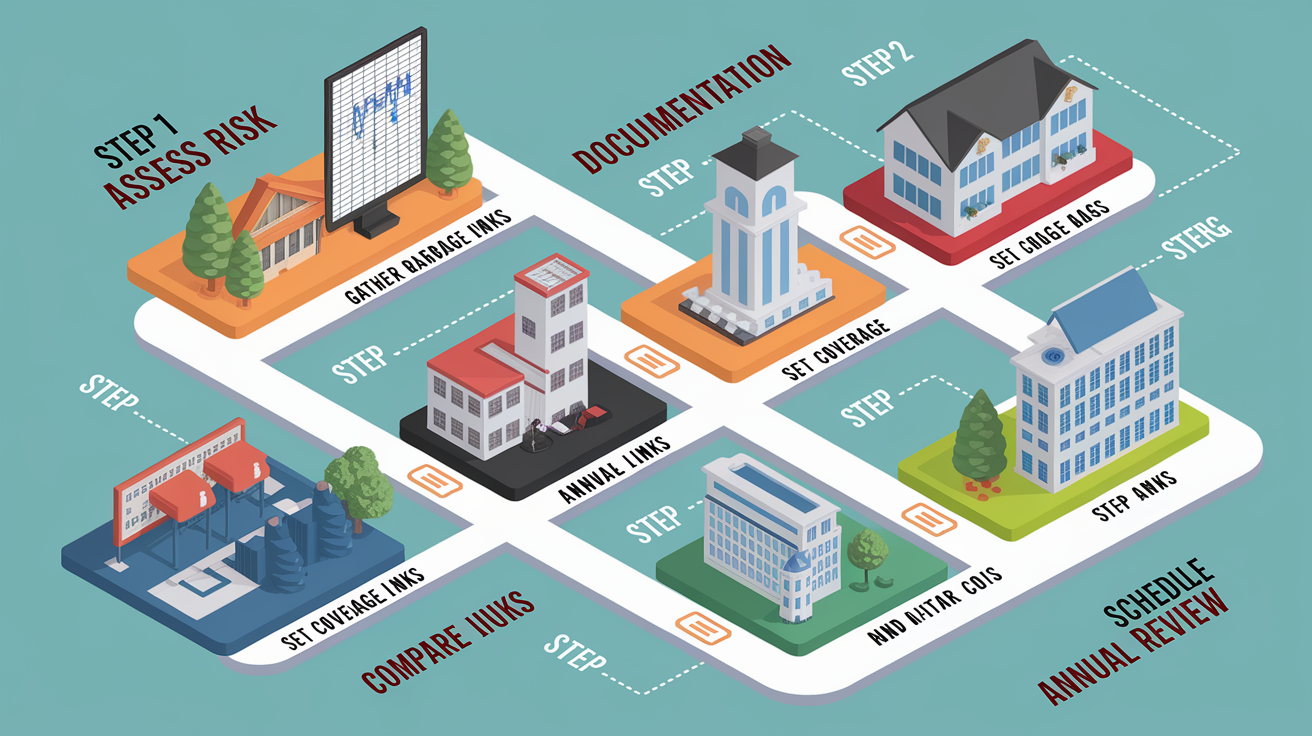
Buying business insurance can feel overwhelming. But breaking it into discrete steps makes the process manageable and ensures you don’t miss critical details.
Assess Your Risk. List all potential loss scenarios: customer injuries, property damage, data breaches, employee accidents, professional mistakes, vehicle accidents, and contract disputes. Rank them by likelihood and financial impact. This exercise reveals which policies are urgent and which can wait.
Gather Documentation. Collect your business formation documents, EIN, revenue projections, payroll records, asset inventory (equipment values, inventory counts, building details if owned), vehicle information, SIC or NAICS industry code, and any existing insurance certificates. Insurers use this data to quote accurately.
Compare Quotes from Multiple Carriers. Request quotes from at least three insurers or work with an independent broker who can shop multiple carriers for you. Compare not just premium cost but also coverage limits, deductibles, exclusions, and insurer financial strength (look for A.M. Best ratings of A- or better).
Select Appropriate Coverage Limits. Use the typical starting points as a baseline: $1,000,000 per occurrence for general liability, replacement cost for property, statutory minimums for workers’ comp. Adjust up if your contracts, landlord, or risk profile demand higher protection. When in doubt, higher limits cost more but prevent catastrophic out-of-pocket exposure.
Bind Your Coverage and Obtain Certificates. Once you choose a policy, complete the application truthfully, pay the first premium, and request certificates of insurance (COIs) for any party that requires proof (landlords, clients, lenders). Add them as “additional insureds” on your general liability policy if the contract requires it.
Set Up an Annual Review Schedule. Mark your renewal date on your calendar and plan a coverage review 60 days before. Re-evaluate your revenue, payroll, assets, and risk exposure each year, and update your policies to reflect growth. Many claims are denied or underpaid because limits haven’t kept pace with business expansion.
Following this sequence reduces the chance of coverage gaps, ensures you meet contractual and legal obligations, and gives you a clear roadmap from first quote to active policy.
When and How to Upgrade Coverage as Your Business Grows

Insurance limits that fit a brand-new startup rarely stay adequate as you hire employees, sign bigger contracts, or expand into new locations. Underinsurance becomes a real danger when your coverage hasn’t kept pace with your growth, leaving you personally exposed to losses that exceed your policy limits.
Common expansion milestones that trigger coverage upgrades include hiring your first employee (requiring workers’ comp), adding a commercial vehicle (requiring commercial auto), increasing revenue past $100,000 (often prompting higher general liability limits), signing contracts that demand $2,000,000 or $5,000,000 aggregate limits (requiring an umbrella policy), and acquiring expensive equipment or opening new storefronts (requiring higher property limits). Each of these events changes your risk profile, and outdated limits can result in denied claims or massive out-of-pocket costs.
Outdated limits create dangerous financial exposure because insurers only pay up to the policy maximum, even if your actual loss is larger. If you carry $500,000 in property coverage but now own $800,000 in inventory and equipment, a total loss leaves you $300,000 short. If a lawsuit results in a $2,000,000 judgment but your general liability tops out at $1,000,000, you’re personally liable for the remaining $1,000,000.
Insurers reassess risk during renewal by reviewing your updated revenue, payroll, and claims history. If your numbers have grown significantly, expect premium increases. Use that renewal conversation as a prompt to raise limits, add endorsements, or bundle new policies that now make sense for your stage of growth.
Final Words
You learned how business insurance protects a startup, which core policies to consider, typical costs, industry variations, how to buy coverage, and when to upgrade limits.
Use the simple steps here: assess risks, gather documents, compare quotes, choose limits that match your assets, and set an annual review. Avoid common mistakes like underinsuring or assuming one policy covers everything.
Start small if you must. With the right starter business insurance coverage, you’ll protect cash flow, reduce worry, and focus on growing the business.
FAQ
Q: What insurance does a startup business need?
A: A startup business needs core protections like general liability, commercial property, and workers’ compensation (if you hire). Add professional liability, business interruption, and cyber coverage based on your services and risks.
Q: How much does a $1,000,000 liability insurance policy cost?
A: A $1,000,000 liability insurance policy typically costs about $400–$1,200 per year for low‑risk small businesses; higher‑risk firms or professionals often pay $1,500–$5,000+. Costs depend on industry, revenue, and claims history.
Q: When should an LLC get business insurance?
A: An LLC should get business insurance before you start operating—especially before hiring staff, signing leases, or taking clients. Some coverages, like workers’ compensation, are required once you have employees.
Q: What kind of insurance coverage should a business have?
A: A business should have coverage matched to its risks: liability for third‑party harm, property for assets, workers’ comp for employees, plus industry‑specific policies like professional liability or cyber insurance as needed.