



What if your next paycheck stopped today, would you still be okay?
Starter disability insurance replaces part of your income when illness or injury keeps you from working, and it’s built for first-time buyers who need simple, lower-cost protection.
Think of it as a financial bridge that covers rent, utilities, and groceries until you recover.
This post lays out how starter plans work, the differences between short-term and long-term options, common exclusions to watch for, and simple steps to pick the benefit amount that actually keeps your household running.
Understanding the Basics of Starter Disability Insurance

Starter disability insurance is simplified income protection for first-time buyers who need affordable coverage while building emergency savings or adding to basic employer benefits. If you can’t work because of illness, injury, surgery recovery, or pregnancy, a disability policy replaces part of your paycheck so you can still cover rent, utilities, and groceries. These entry-level plans focus on straightforward terms, lower premiums, and faster approval than comprehensive policies built for high earners.
Most first-time buyers run into disability coverage through an employer’s benefits package. The employer might pay the full premium, split the cost through payroll deductions, or offer the option at group rates that are way lower than what you’d pay alone. If your employer doesn’t offer any disability coverage, you can buy an individual policy directly from an insurance company or through a professional association. Individual policies need more paperwork and usually a health questionnaire, but they stick with you when you change jobs.
Starter disability coverage solves a specific problem. Most Americans live paycheck to paycheck and would face financial hardship within weeks of losing income. About 5% of working adults experience a short-term disability each year. That could be a broken bone from a car accident, complications during pregnancy, pneumonia requiring hospitalization, or mental health treatment that temporarily prevents you from doing your job. Disability insurance fills the income gap when paid sick leave and vacation time run out.
Income protection purpose: Replaces part of your paycheck when you can’t work due to a covered medical condition
Coverage portability: Employer plans typically end when you leave the company. Individual plans follow you from job to job as long as you pay the premium.
Typical uses: Illness (cancer, heart attack, stroke), accidental injury (fractures, head trauma), pregnancy and childbirth, surgery recovery, and some mental health conditions
Employer vs. individual availability: Employer group policies are easier to qualify for and often partly subsidized. Individual policies offer customization and portability but require medical underwriting.
Why beginners choose this coverage: Lower premiums than comprehensive plans, straightforward terms, and protection during the years when emergency savings are still small
Key Features Found in Entry-Level Disability Insurance Plans

Entry-level disability policies share a core set of mechanical features that determine when benefits start, how long they last, and what situations aren’t covered. The benefit amount is usually expressed as a percentage of your base salary (commonly 40% to 70%) and paid weekly or monthly while you remain unable to work. The elimination period is the waiting time after you become disabled before the first check arrives. Short-term disability policies often use a 1 to 14 day wait, while long-term policies typically impose a 90 day elimination period.
Benefit periods define how long the policy will keep paying once the elimination period ends. Short-term disability might pay for nine weeks to six months. Long-term disability can continue for several years or until you reach retirement age, depending on the policy. Most starter plans include a list of exclusions, conditions or circumstances that automatically disqualify a claim. Work-related injuries, intentional self-harm, injuries during criminal activity, and pre-existing conditions subject to policy-specific limits are common exclusions.
Elimination periods: The waiting time before benefits begin. Short-term policies average about 14 days, long-term policies commonly 90 days. Some policies let you choose a longer wait (30, 60, or 180 days) to lower your premium.
Benefit lengths: Short-term disability typically pays for three to six months. Long-term disability benefit periods can range from two years to age 65, with trade or manual labor occupations often capped at five years.
Exclusions: Work-related injuries are covered by workers’ compensation, not standard disability insurance. Most policies also exclude suicide attempts, drug abuse during the injury, and injuries while committing a crime.
Partial disability benefits: Some policies pay a reduced benefit if you return to work part-time while still recovering, offsetting the income you lose by working fewer hours.
Comparing Short-Term and Long-Term Starter Disability Coverage
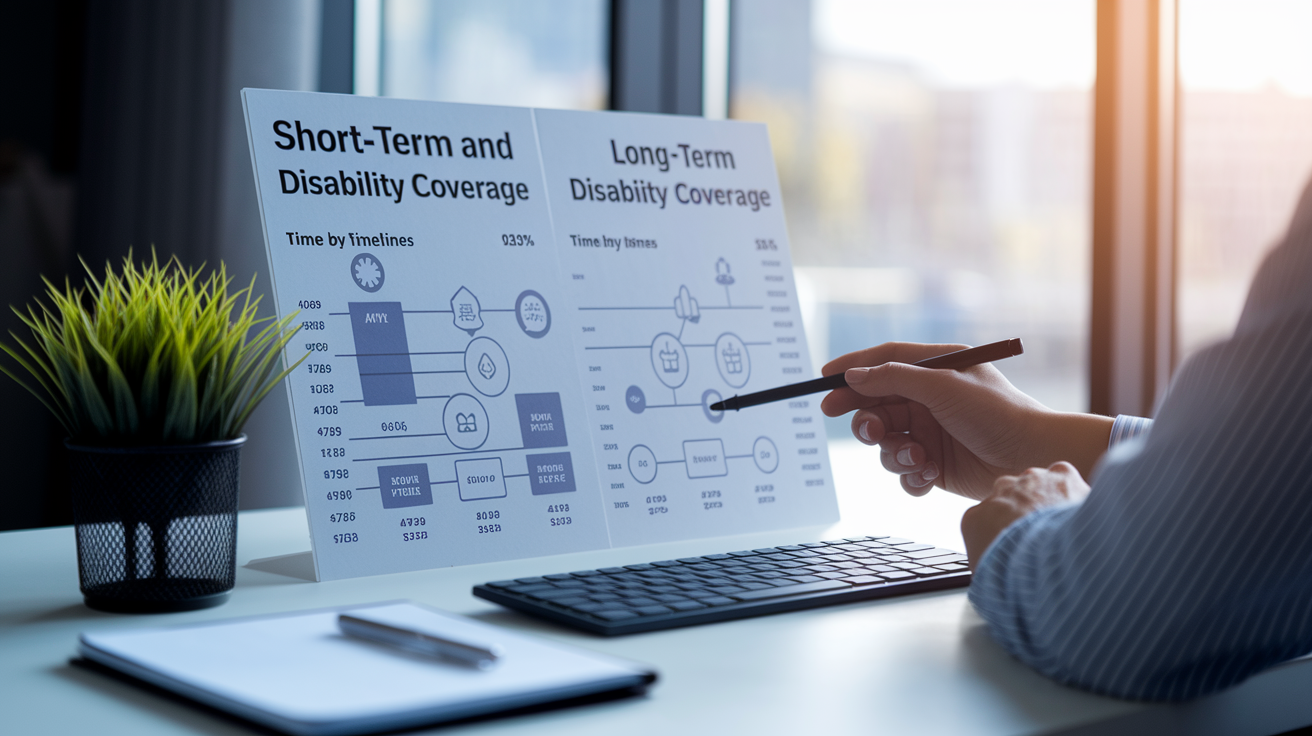
Short-term and long-term disability policies serve different phases of recovery. Short-term disability acts as a bridge for temporary conditions (pregnancy leave, broken bones, minor surgeries, or illnesses that resolve within weeks or months). Long-term disability picks up where short-term ends, covering extended recoveries or permanent impairments that prevent you from earning income for years.
| Type | Benefit Duration | Waiting Period | Income Replacement |
|---|---|---|---|
| Short-Term Disability | 3–6 months (up to 1 year in some policies) | 1–14 days (average ~14 days) | 40%–70% of base salary |
| Long-Term Disability | 2–10 years or to age 65 (varies by policy and occupation) | 90 days or when STD ends (some policies offer 30-, 60-, or 180-day options) | 50%–70% of base salary |
Short-term disability makes sense when you need quick income replacement after your employer’s paid sick leave runs out. Because the benefit period is short, the total payout is limited, and the premium is relatively low. Long-term disability is what you need for serious conditions (cancer treatment, major back surgery, stroke rehabilitation, or chronic mental health disorders) that can keep you out of work for months or years. If you can only afford one policy, prioritize long-term disability. A six month recovery might deplete your savings, but a two year disability can force you into bankruptcy. Many people carry both: short-term disability covers the first few months at a higher replacement rate, then long-term disability steps in after the waiting period ends.
Eligibility Requirements and What Qualifies as a Covered Disability

Filing a disability claim requires medical documentation signed by your treating doctor, nurse practitioner, or specialist confirming that you cannot perform the duties of your job. The insurance company reviews your medical records, treatment plan, and prognosis to decide whether your condition meets the policy’s definition of “disabled.” Employer-sponsored group plans typically approve claims faster and with less scrutiny than individual policies because the underwriting happened at the group level, not on each person.
The definition of disability varies by policy and has a big impact on whether your claim is approved. “Own-occupation” policies pay benefits if you cannot perform the specific duties of your current job. A surgeon with hand tremors, for example, would qualify even if they could work in a different medical role. “Any-occupation” policies only pay if you’re unable to work in any job for which you’re reasonably qualified by education, training, or experience. Own-occupation definitions cost more but offer stronger protection for professionals and specialists who have invested years in training.
Common qualifying conditions include severe illnesses such as cancer, heart attack, stroke, or arthritis. Accidental injuries including fractures, head trauma, torn ligaments, or musculoskeletal damage. Pregnancy and childbirth, both routine and complicated. Surgery and the rehabilitation period afterward. Temporary mental health conditions like depression, anxiety, or work-related stress that make it unsafe or impossible to perform your duties. Pre-existing conditions may be excluded or subject to a waiting period (typically 12 months) before the policy will cover a relapse or new episode. Work-related injuries are almost always excluded because they fall under workers’ compensation, a separate mandatory insurance system.
How to Calculate Starter Disability Insurance Benefit Amounts

Choosing the right benefit amount starts with listing your essential monthly expenses: mortgage or rent, utilities, groceries, car payments, insurance premiums, minimum debt payments, and dependent care costs. Add up those obligations and you have a baseline income target. Disability insurance doesn’t replace 100% of your earnings. Insurers cap total replacement at about 70% from all sources combined to preserve an incentive to return to work when medically cleared.
If your employer provides a group disability policy, check the benefit statement to see what percentage of your salary it replaces and whether it includes only base pay or also commissions and bonuses. Many employer plans replace 40% to 60% of gross base salary and cap the monthly payout, often around $10,000 per month for high earners. If that amount falls short of your essential expenses, you can purchase a supplemental individual policy to fill the gap, as long as the combined benefit doesn’t exceed about 70% of your total income.
Assess monthly expenses: Write down rent or mortgage, utilities, food, debt payments, insurance, childcare, and any other non-negotiable costs. This is the minimum amount you need to keep your household running.
Compare employer coverage: Review your employer’s disability benefit summary to see what percentage of your income is replaced and whether bonuses or commissions are included. Subtract that monthly benefit from your essential expenses to find the gap.
Add supplemental coverage if needed: Purchase an individual policy that pays enough to cover the shortfall, keeping in mind that insurers typically limit total replacement to about 70% of pre-disability income across all policies combined.
Starter Disability Insurance Costs and Premium Factors

Long-term disability insurance premiums generally range from 1% to 3% of your gross annual income, while short-term disability premiums are lower because the benefit period is shorter. A 30 year old office worker earning $50,000 per year might pay $500 to $1,500 annually for a long-term disability policy with a 90 day elimination period and benefits to age 65. That same person could add short-term disability for a few hundred dollars more per year, or obtain it at little to no cost through an employer-sponsored plan.
Several factors push premiums up or down. Age is the biggest driver. Coverage purchased at 25 costs significantly less than the same policy bought at 45 because younger buyers are statistically healthier and less likely to file a claim soon. Women often pay higher premiums than men for the same coverage because actuarial data show longer average claim durations, particularly related to pregnancy and certain chronic conditions. Smokers pay more, and people in high-risk occupations (construction workers, firefighters, warehouse staff) face steeper premiums than office workers or software developers.
Age and health: Younger, healthier applicants receive the lowest rates. Pre-existing conditions or elevated health markers (high blood pressure, diabetes, obesity) can increase premiums or result in coverage exclusions.
Occupation risk: Manual labor, jobs requiring physical strength, or roles with higher injury rates cost more to insure than desk-based professions.
Policy definition: Own-occupation policies cost more than any-occupation because the threshold for qualifying is lower. Partial disability riders add cost but provide income if you return to work part-time.
Elimination and benefit periods: Choosing a longer waiting period (180 days instead of 90) or a shorter benefit period (5 years instead of to age 65) reduces your premium.
You can lower your premium by increasing the elimination period. Waiting 180 days instead of 90 cuts the cost because you’re self-funding more of the early recovery period with savings or other resources. Shortening the benefit period also reduces cost, but be cautious. Disabilities that last five years or longer aren’t rare, and ending coverage at year five leaves you exposed if a serious condition prevents you from ever returning to work. Reducing the monthly benefit amount is the least attractive cost-saving option because it defeats the purpose of income protection, but it may be necessary if budget constraints are severe.
Starter Disability Policy Riders Worth Considering

Riders are optional add-ons that modify or expand your policy’s coverage, and they come with additional premium charges. For first-time buyers, a few riders offer meaningful protection without overwhelming your budget. The cost-of-living adjustment (COLA) rider increases your monthly benefit each year by a fixed percentage (often tied to inflation) so your purchasing power doesn’t erode during a long-term claim. Without COLA, a $3,000 monthly benefit might cover your expenses in year one but fall short by year five as rent, utilities, and groceries rise.
A future purchase option (also called a guaranteed insurability rider) lets you increase your coverage at specific intervals (typically every few years or after major life events like marriage, a new baby, or a salary increase) without answering new health questions. This rider is especially valuable for young professionals who expect their income to grow. You lock in insurability today and scale up coverage later even if you develop a health condition in the meantime. The catastrophic disability rider pays an additional lump sum or higher monthly benefit if you suffer a severe impairment (loss of two limbs, total blindness, or complete paralysis) that requires costly home modifications or full-time care.
Cost-of-living adjustment (COLA): Increases your benefit annually to keep pace with inflation. Especially important for long-term disabilities that may last years or decades.
Future purchase option: Allows you to buy more coverage later without a medical exam, protecting your ability to increase benefits as your salary grows or family needs change.
Catastrophic disability rider: Provides extra money if you suffer a severe, life-altering disability such as loss of limbs, sight, speech, or mobility.
Partial or residual disability rider: Pays a pro-rated benefit if you return to work part-time or at reduced capacity, filling the income gap while you recover gradually.
Where Beginners Can Get Starter Disability Coverage

Most first-time buyers begin with employer-sponsored disability insurance because it’s the easiest and least expensive entry point. Many employers offer short-term disability as a standard benefit or provide long-term disability at no cost to employees. Others make coverage available on a voluntary basis, letting you purchase the policy at group rates through payroll deduction. Employer plans typically replace 40% to 60% of your base salary and don’t require a medical exam, though they may ask basic health questions during open enrollment.
Professional associations and trade groups sometimes offer disability insurance to members at group rates. If you work in healthcare, education, engineering, or a licensed trade, check whether your association has partnered with an insurer to provide coverage. These group policies fall between employer plans and individual policies in terms of cost and customization. They’re more portable than employer coverage because membership can continue across jobs, but they still use standardized terms that may not fit every individual’s needs.
Individual disability insurance is purchased directly from an insurance company or through an independent broker. The application process includes detailed health questions, income verification, and sometimes a medical exam or review of your doctor’s records. Approval and pricing depend on your age, occupation, health history, and the specific features you choose (elimination period, benefit period, definition of disability, and optional riders).
Employer-sponsored plans: Offered during benefits enrollment. Often partially or fully subsidized by the employer. Provide basic income replacement (40% to 60% of salary) with minimal underwriting. Coverage typically ends when you leave the company.
Association or affinity group plans: Available through professional organizations, alumni groups, or trade associations. Purchased at group rates but may require membership fees. More portable than employer plans because you can maintain membership across jobs. Benefit levels and definitions are standardized.
Individual policies: Bought directly from insurers or brokers. Require full medical underwriting and income documentation. Offer the most customization (choice of elimination period, benefit period, riders, and definition of disability). Remain in force as long as you pay premiums, regardless of employment changes.
Claim Filing Steps for First-Time Disability Insurance Users

When you become unable to work due to illness or injury, notify your insurance company or employer’s benefits administrator as soon as possible. Many policies require you to file a claim within a specific time window, such as 30 or 60 days after the disability begins. The insurer will send you a claim packet that includes forms for you, your employer, and your treating physician. Your portion asks for details about your condition, when symptoms started, and how the disability prevents you from performing your job duties.
Notify the insurer promptly: Contact your insurance company or HR department within the timeframe specified in your policy (often 30 days) to begin the claim process.
Complete the claimant statement: Provide your personal information, employment details, description of your condition, and an account of how it affects your ability to work.
Obtain employer verification: Your employer must confirm your job title, duties, work schedule, salary, and last day worked. Some policies also require proof of exhausted sick leave or vacation time.
Submit medical documentation: Your doctor must complete an attending physician statement describing your diagnosis, treatment plan, prognosis, and functional limitations. The insurer may request medical records or test results.
Provide income proof: Submit recent pay stubs, tax returns, or other documentation showing your pre-disability earnings. Especially important if you receive commissions, bonuses, or self-employment income.
Short-term disability claims typically begin paying benefits within about two weeks after the elimination period ends, assuming all paperwork is complete and the condition is clearly documented. Long-term disability claims take longer to process because the elimination period is usually 90 days or more, and the insurer conducts a more detailed review of medical records and may require an independent medical examination. If your claim is approved, benefits are paid directly to you, usually on a monthly schedule, and continue as long as you remain disabled under the policy’s definition and within the benefit period.
Final Words
Protecting your income matters now; starter disability insurance is the step that fills the gap if illness, injury, pregnancy, or recovery keeps you from working.
This guide walked you through what starter policies cover, key features, short vs long choices, how benefits are calculated, common costs and riders, where to buy, and filing tips.
Use the checklist here to compare waiting periods, benefit amounts, exclusions, and riders, and pick the policy that fits your budget and job. Starter disability insurance coverage gives a simple, affordable safety net and more confidence when life changes.
FAQ
Q: How much disability will I get if I make $60,000 a year?
A: If you make $60,000 a year, disability benefits typically replace about 40–70% of income, so expect roughly $2,000–$3,500 per month, depending on plan limits and employer coverage.
Q: Does osteoporosis qualify for disability?
A: Osteoporosis can qualify for disability when it causes severe, documented functional limits that prevent your job duties; mild cases often don’t meet criteria, so provide detailed medical records and functional testing.
Q: Does Parkinson’s qualify for long-term disability?
A: Parkinson’s can qualify for long-term disability when symptoms significantly reduce your ability to work; submit neurologist notes, medication history, and functional test results—early-stage cases may not meet the threshold.
Q: Does lymphedema qualify for disability?
A: Lymphedema can qualify for disability if it causes persistent, well-documented functional impairment that prevents essential job tasks; mild or intermittent swelling usually won’t qualify.