


Think a starter home is too small to cause big losses? Think again.
A single fire, storm, or liability claim can cost tens of thousands and wipe out months of savings.
Home insurance is the safety net that protects your house, your belongings, and your wallet.
This post lays out the essential starter-home insurance coverages, what each one actually pays for, the common gaps new owners miss, and easy steps to choose sensible limits for your budget and risk.
What Starter Home Insurance Covers
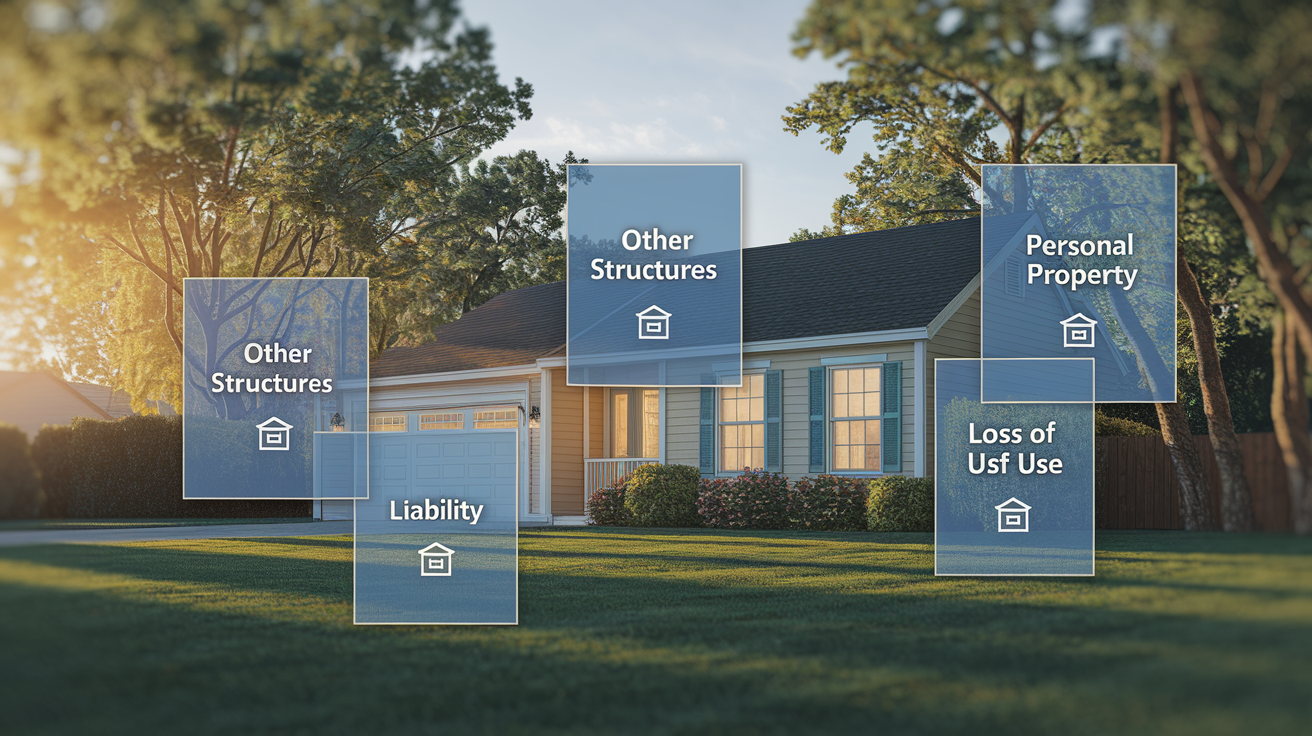
Homeowners insurance protects the financial investment you just made. A single disaster can wipe out years of savings if you’re not covered right.
Dwelling coverage pays to rebuild or repair your home’s physical structure. That’s the roof, walls, floors, built-in appliances, attached deck. The number that matters here is replacement cost, not what you paid for the house. If your home costs $200,000 to rebuild but you’re only carrying $150,000 in dwelling coverage, you’re on the hook for that $50,000 gap after a total loss.
Other structures coverage protects detached buildings on your property. A standalone garage, shed, fence, gazebo. Most policies automatically set this at 10% of your dwelling coverage. So if your dwelling limit is $180,000, you get $18,000 for other structures. Built an expensive detached workshop? Long privacy fence? Raise this limit.
Personal property coverage pays to replace your stuff. Furniture, clothes, electronics, dishes. Insurers usually set this at 50% to 70% of your dwelling coverage by default. A home with $200,000 dwelling coverage typically includes $100,000 to $140,000 in personal property protection. You can adjust this based on what you actually own.
Replacement cost vs. actual cash value matters. Replacement cost pays what it costs to buy a new item of similar quality today. Actual cash value subtracts depreciation, so a five-year-old laptop might only be worth a fraction of what you originally paid. Replacement cost coverage costs more but gives you enough money to actually replace what you lost.
Liability coverage protects you if someone gets injured on your property or if you’re held responsible for damage to someone else’s property. Policies often start at $100,000, but that’s usually too low. If a guest falls down your stairs and sues, legal fees and a settlement can blow past $100,000 fast. Most experts say $300,000 to $500,000 in liability coverage for starter-home buyers.
Medical payments coverage is a small add-on, usually $1,000 to $5,000, that pays minor medical bills for guests injured on your property regardless of who was at fault. Twisted ankle or a cut that needs stitches without triggering a liability claim.
Loss of use or additional living expenses (ALE) pays for temporary housing, meals, and extra costs if your home becomes unlivable after a covered event. Kitchen fire forces you out for two months? This coverage pays for a hotel, restaurant meals, the extra commute to work. Policies commonly set this at 10% to 20% of dwelling coverage or cap it at a fixed time period like 12 or 24 months. A $200,000 dwelling policy with a 20% ALE limit gives you $40,000 to cover temporary living costs.
Policy Forms: Which One Fits a Starter Home

Most first-time homebuyers choose an HO-3 policy, the standard homeowners form. HO-3 covers your dwelling on an “open perils” basis, meaning it protects against everything except what’s specifically excluded (common exclusions: flood, earthquake, normal wear and tear, intentional damage). Your personal property gets covered on a “named perils” basis. Only events listed in the policy, like fire, theft, vandalism, windstorm, lightning.
For most starter homes, HO-3 offers the right balance.
HO-5 is the broadest form. It covers both your dwelling and your personal property on an open-perils basis, so your stuff is protected against a much wider range of risks. Television stops working due to an electrical surge? HO-5 is more likely to cover it than HO-3. The trade-off is a higher premium, often 10% to 30% more than HO-3. HO-5 makes sense if you own expensive electronics, collectibles, or custom furniture and want the widest safety net.
HO-6 is the condo-owner policy. Bought a condo as your starter home? You need HO-6, not HO-3. HO-6 covers your unit’s interior, your belongings, liability, and a share of the building’s common areas. The condo association’s master policy covers the building structure and shared spaces, but it won’t replace your personal property or protect you from liability claims.
HO-4 is renters insurance. Renting while you save for a down payment? HO-4 covers your belongings and liability but not the building itself. Not homeowners insurance, but worth mentioning because many first-time buyers transition from renting and mistakenly assume their landlord’s policy protects their stuff. It doesn’t.
| Policy Form | Who It’s For | Dwelling Coverage | Personal Property Coverage |
|---|---|---|---|
| HO-3 | Single-family homeowners | Open perils (all risk) | Named perils |
| HO-5 | Homeowners wanting broadest protection | Open perils (all risk) | Open perils (all risk) |
| HO-6 | Condo owners | Interior walls and improvements | Named perils |
| HO-4 | Renters | None | Named perils |
Typical Costs and What Drives Your Premium

The national average annual homeowners insurance premium is around $1,500, but your actual cost depends on dozens of factors. Starter homes often fall in the $800 to $2,000 per year range, depending on size, location, and what you choose to cover.
Simple rule of thumb: expect to pay roughly 0.3% to 0.6% of your dwelling replacement cost per year. A $150,000 dwelling at 0.4% would cost about $600 annually. A $250,000 dwelling at 0.5% runs about $1,250 per year.
Here are three sample calculations for typical starter-home sizes:
800 sq ft, $100/sq ft replacement cost:
Dwelling coverage = $80,000
Estimated annual premium at 0.4% = $320
1,000 sq ft, $125/sq ft replacement cost:
Dwelling coverage = $125,000
Estimated annual premium at 0.5% = $625
1,400 sq ft, $150/sq ft replacement cost:
Dwelling coverage = $210,000
Estimated annual premium at 0.5% = $1,050
Your actual premium will vary based on where you live, the age and condition of the home, and what you select.
Location is one of the biggest drivers. Homes in coastal areas prone to hurricanes, regions with high wildfire risk, or neighborhoods with higher crime rates cost more to insure. Proximity to a fire station or fire hydrant can lower your premium. Insurers know firefighters will arrive faster and limit damage.
Home age and condition matter. Older roofs, outdated electrical wiring, aging plumbing increase risk. A roof over 15 years old often triggers a surcharge or a requirement to replace it before coverage starts. Some insurers offer discounts of 10% to 30% for roofs under 10 years old or homes with updated systems.
Claims history follows you and the property. If the previous owner filed multiple claims, the home may be flagged as high-risk, and you’ll pay more even though you weren’t the one filing. Your personal claims history from prior homes or rentals also affects your rate.
Credit score influences premiums in most states. Insurers use credit-based insurance scores to predict the likelihood of future claims. Higher score typically means a lower premium.
Construction and materials impact cost. Brick homes often cost less to insure than wood-frame homes because brick is more fire-resistant. Homes with shake-shingle roofs or aluminum wiring may be surcharged or declined by some insurers.
Deductible choice has a direct effect on premium. Common deductible options are $500, $1,000, and $2,500. Raising your deductible from $500 to $1,000 typically cuts your premium by 10% to 25%. Jumping to a $2,500 deductible can save 25% to 40%, but you’ll need to cover that amount out of pocket before insurance pays a dime on a claim.
How Much Coverage You Actually Need

Start with dwelling coverage. Set the limit high enough to rebuild your home from the ground up if it’s destroyed. Replacement cost isn’t the same as market value or the price you paid.
A home that sells for $220,000 might only cost $180,000 to rebuild because land value is included in the sale price but not in the rebuild. On the other hand, a custom-built home with high-end finishes might cost more to rebuild than its market value.
Use a replacement-cost estimator. Most insurers provide calculators that factor in your home’s square footage, number of stories, construction type, and local labor costs. A rough starting point is to multiply your home’s square footage by the local replacement cost per square foot, which commonly ranges from $75 to $250 depending on region and quality of materials.
Replacement-cost formula:
Dwelling coverage = Square footage × Replacement cost per sq ft
Example: 1,200 sq ft × $140/sq ft = $168,000 dwelling coverage.
Tell your agent about any renovations, additions, or upgrades. Finished basement, updated kitchen, new HVAC system increases replacement cost.
Other structures coverage is typically set at 10% of dwelling coverage by default. If your dwelling limit is $150,000, you get $15,000 for other structures. Raise this if you have an expensive detached garage, workshop, or large deck.
Personal property is commonly set at 50% to 70% of dwelling coverage. A $150,000 dwelling policy might include $75,000 to $105,000 in personal property protection. Walk through your home and estimate what it would cost to replace everything. Furniture, clothes, dishes, linens, electronics, tools, sports equipment. Own high-value items like musical instruments, cameras, or collectibles? Consider raising the limit or scheduling those items separately.
Use this simple calculator:
Personal property limit = Dwelling limit × 0.5 (or 0.6 or 0.7, depending on how much you own)
Example: $150,000 dwelling × 0.6 = $90,000 personal property limit.
Liability coverage should reflect your assets and risk exposure. Policies often start at $100,000, but that’s rarely enough. Legal defense costs alone can hit $50,000 to $100,000 even if you win. Recommended minimums are $300,000 to $500,000 for most homeowners. Pool? Trampoline? Dog? Frequently host gatherings? Consider $500,000 or a $1 million umbrella policy that sits on top of your home and auto liability limits.
Loss of use is often set as a percentage of dwelling coverage, typically 10% to 20%, or capped at a fixed time period like 12 months. Check your local rental market. If a two-bedroom apartment costs $1,800 per month and restaurants add another $600, you’d need at least $2,400 per month. Six-month displacement would require $14,400. A dwelling limit of $150,000 with 20% loss-of-use coverage gives you $30,000, which would cover that scenario comfortably.
Extended replacement cost and guaranteed replacement cost endorsements can protect you if rebuilding costs spike after a major disaster. Extended replacement cost adds a buffer, commonly 25% or 50%, above your dwelling limit. Guaranteed replacement cost pays whatever it takes to rebuild, even if costs exceed your limit. These endorsements cost more but can save you from a massive out-of-pocket bill if lumber prices double after a regional catastrophe.
The 80% Rule and What Your Lender Requires

Most policies include an “80% rule” clause, also called a coinsurance penalty. If you insure your home for less than 80% of its replacement cost, the insurer can reduce your claim payout, even for partial losses.
Here’s how it works. Suppose your home’s replacement cost is $200,000. You carry $120,000 in dwelling coverage, only 60% of replacement cost. A kitchen fire causes $40,000 in damage. Instead of paying the full $40,000, the insurer applies the coinsurance penalty:
Payout = (Coverage carried ÷ 80% of replacement cost) × Loss
Payout = ($120,000 ÷ $160,000) × $40,000 = $30,000
You’re left with a $10,000 gap.
To avoid this, insure your home for at least 80% of its replacement cost. Many insurers and lenders prefer 100%.
Lender requirements vary but are usually strict. Most mortgage lenders require you to carry enough dwelling coverage to rebuild the home completely. That’s 100% of replacement cost. Some lenders also require a minimum liability limit, often $100,000, though this is less common. Your lender will ask for proof of insurance before closing and will verify coverage annually as long as you have a mortgage.
Let your policy lapse or drop coverage below the required amount? The lender can force-place insurance, which is expensive and covers only the structure, not your belongings or liability.
Common Coverage Gaps and Endorsements to Consider

Standard homeowners policies exclude several major risks. Live in a high-risk area or own expensive items? You’ll need to add endorsements or buy separate policies to fill the gaps.
Flood insurance isn’t included in standard policies. Home in a flood zone? Your lender will require flood coverage. Even if you’re not in a mapped flood zone, flooding can happen anywhere. Heavy rain, snowmelt, or a nearby river overflow can cause damage. Flood insurance is available through the National Flood Insurance Program (NFIP) or private insurers. Premiums vary widely based on flood risk, elevation, and coverage limits, but many policies cost a few hundred to a few thousand dollars per year.
Earthquake insurance is also excluded. Live in California, the Pacific Northwest, or another seismically active region? Consider adding earthquake coverage. Deductibles are typically high, 10% to 25% of the dwelling limit, so a $200,000 home might carry a $20,000 to $50,000 earthquake deductible.
Water backup and sump pump overflow coverage is often excluded or capped at a low limit like $5,000. Sewer line backs up into your basement or your sump pump fails during a storm? You could face tens of thousands in cleanup and repair costs. Adding water backup coverage is inexpensive, usually $40 to $100 per year, and raises the limit to $10,000 or more.
Ordinance and law coverage pays for the extra cost of rebuilding to current building codes. Your 1970s home is destroyed and local codes now require fire-resistant materials, upgraded electrical systems, or seismic reinforcements? Standard coverage may not pay the difference. Ordinance and law endorsements typically add 25% to 50% to your dwelling limit and cost an extra $50 to $150 per year.
Scheduled personal property or blanket coverage raises limits for high-value items. Standard policies cap coverage for certain categories:
- Jewelry theft: often $1,500 or $2,500
- Firearms: $2,500
- Electronics: may have sub-limits
- Cash: $200 to $500
- Art and collectibles: varies
Own an engagement ring worth $8,000? You’ll only receive $1,500 from a standard policy after a theft. Scheduling the ring on your policy, providing an appraisal and paying a small additional premium, ensures full coverage.
Identity theft coverage reimburses costs related to restoring your identity after fraud. Legal fees, lost wages, credit monitoring. Coverage limits are usually $10,000 to $25,000 and cost $25 to $50 per year.
Smart Ways to Save on Starter Home Insurance

You can lower your premium without sacrificing essential protection.
Bundle home and auto insurance with the same company. Most insurers offer discounts of 10% to 25% when you combine policies. For a $1,200 annual home premium, bundling could save $120 to $300.
Raise your deductible. Moving from a $500 deductible to $1,000 typically cuts your premium by 10% to 25%. A $2,500 deductible can save 25% to 40%. Just make sure you have enough savings to cover the deductible if you file a claim.
Install safety and security features. Monitored burglar alarms, smoke detectors, fire extinguishers, deadbolt locks can earn discounts of 5% to 15%. Some insurers offer credits for water leak detectors or smart-home systems that alert you to problems.
Upgrade your roof. A roof replacement can lower your premium by 10% to 30%, depending on materials and age. Impact-resistant shingles or metal roofs may qualify for additional discounts in hail-prone areas.
Update electrical, plumbing, and HVAC systems. Replacing old wiring, copper pipes, or a 30-year-old furnace reduces risk and can cut premiums. Some insurers require these updates before they’ll offer coverage on older homes.
Shop at least three quotes. Premiums for identical coverage can vary by hundreds of dollars. Compare coverage details, not just price. A cheaper policy may have lower limits, higher deductibles, or more exclusions.
Ask about discounts. Insurers offer credits for:
- First-time homebuyers
- Military service or veterans
- Autopay or paperless billing
- Loyalty (staying with the same insurer for several years)
- Early shopping (quoting 30+ days before your current policy expires)
- Claims-free history
- Home age (newer homes often cost less to insure)
Review your policy annually. Life changes affect your coverage needs. Paying off your mortgage, finishing a basement, adding a home office may lower or raise your premium. Call your agent before your renewal date and update your information.
Don’t over-insure. Carrying $200,000 in personal property coverage but your belongings are only worth $80,000? You’re paying for coverage you don’t need. Create a home inventory and adjust limits accordingly.
Common Mistakes First-Time Homebuyers Make

Underinsuring the dwelling. Using the purchase price or tax-assessed value instead of replacement cost is the most common error. A $180,000 home might cost $220,000 to rebuild if it has custom features or sits in an area with high labor costs. Insure for $180,000 and a fire destroys the house? You’ll be $40,000 short.
Ignoring sub-limits on valuables. Many buyers assume their $3,000 camera or $5,000 engagement ring is fully covered, then discover the policy caps jewelry theft at $1,500 after a break-in. Review sub-limits and schedule valuable items.
Skipping flood or earthquake coverage. “I’m not in a flood zone” is a risky assumption. FEMA flood maps don’t capture every risk, and climate change is increasing flood frequency in areas previously considered safe. Earthquake coverage is expensive, but one event can destroy a home and leave you with no payout if you skipped the endorsement.
Choosing the cheapest quote without comparing coverage. A $700 annual premium sounds great until you realize the policy has a $5,000 deductible, excludes water backup, caps personal property at 40% of dwelling coverage, and only offers actual cash value for belongings. Always compare limits, deductibles, exclusions, and endorsements.
Failing to update coverage after renovations. Finished the basement and added $30,000 in value to the home? If you don’t notify your insurer and increase your dwelling limit, you won’t be paid for that space after a loss.
Accepting default limits without reviewing them. The insurer’s automatic calculations may not match your actual needs. Check every coverage line and adjust as needed.
Buying too much coverage you don’t need. Own minimal personal property? You don’t need $150,000 in contents coverage. Lower the limit and save money.
Not documenting belongings. After a total loss, you’ll need to prove what you owned. Take photos or videos of each room, capture serial numbers on electronics, appliances, and tools, save receipts for big-ticket items, and store the records off-site or in the cloud.
Step-by-Step: Selecting the Right Coverage

Step 1: Calculate dwelling replacement cost. Use your insurer’s estimator or multiply your home’s square footage by local replacement cost per square foot. Add 10% to 25% if your home has custom features, high-end finishes, or sits in an area with expensive labor.
Step 2: Set other structures coverage. Start with 10% of dwelling coverage. Raise it if you have a detached garage, large shed, or expensive fencing.
Step 3: Inventory your belongings and set personal property limits. Walk through your home and estimate replacement cost for everything you own. Use the 50% to 70% rule as a starting point, then adjust. Choose replacement-cost coverage if you want full payout. Accept actual cash value only if you’re comfortable receiving depreciated amounts.
Step 4: Choose liability coverage. Start at $300,000 minimum. Go higher if you have significant assets, own a pool, have a dog, or host frequent gatherings. Consider a $1 million umbrella policy if your net worth exceeds $500,000.
Step 5: Set loss-of-use limits. Estimate local rental costs and multiply by the number of months you’d need temporary housing. Use 10% to 20% of dwelling coverage as a baseline and raise it if rentals are expensive in your area.
Step 6: Add endorsements for gaps. Review exclusions. Add flood coverage if you’re in a flood zone or near water. Add earthquake coverage if you’re in a seismically active region. Add water backup, ordinance and law, and scheduled personal property coverage as needed.
Step 7: Choose your deductible. Pick the highest amount you can afford to pay out of pocket in an emergency. Common choices for starter homes are $1,000 or $2,500.
Step 8: Get at least three quotes. Compare coverage limits, deductibles, exclusions, and endorsements, not just the annual premium.
Step 9: Ask about discounts. Confirm whether you qualify for bundling, safety features, new roof, claims-free history, or other credits.
Step 10: Review the policy documents before signing. Read the declarations page and the exclusions section. Make sure the limits match what you requested. Confirm the deductible, coverage types, and endorsements are correct.
Step 11: Set an annual review reminder. Policy needs change as your home value increases, you finish renovations, or you acquire new belongings. Review coverage every year before renewal and after major life events.
Quick Calculators for Starter Homes

Dwelling replacement cost:
Square footage × Replacement cost per sq ft = Dwelling coverage
Example: 1,100 sq ft × $130/sq ft = $143,000
Other structures:
Dwelling coverage × 0.10 = Other structures limit
Example: $143,000 × 0.10 = $14,300
Personal property:
Dwelling coverage × 0.50 to 0.70 = Personal property limit
Example: $143,000 × 0.60 = $85,800
Loss of use:
Dwelling coverage × 0.10 to 0.20 = ALE limit
Example: $143,000 × 0.15 = $21,450
Sample calculations for three starter-home sizes:
| Home Size | Replacement Cost/Sq Ft | Dwelling Coverage | Other Structures (10%) | Personal Property (60%) | Loss of Use (15%) | Estimated Annual Premium (0.4%–0.6%) |
|---|---|---|---|---|---|---|
| 800 sq ft | $100 | $80,000 | $8,000 | $48,000 | $12,000 | $320–$480 |
| 1,000 sq ft | $125 | $125,000 | $12,500 | $75,000 | $18,750 | $500–$750 |
| 1,400 sq ft | $150 | $210,000 | $21,000 | $126,000 | $31,500 | $840–$1,260 |
What to Bring When You Shop for Coverage
Gather the following information before requesting quotes:
- Home square footage (above-grade living space)
- Year built
- Roof age and material (asphalt shingle, metal, tile)
- Heating and cooling system age
- Electrical system type (copper, aluminum, updated panel)
- Plumbing material (copper, PEX, galvanized)
- Foundation type (slab, crawl space, basement)
- Number of stories
- Garage type (attached, detached, carport, none)
- Renovations and upgrades (kitchen remodel, finished basement, new windows)
- Distance to nearest fire hydrant and fire station
- Home security features (monitored alarm, smoke detectors, deadbolts, cameras)
- Prior claims on the property (ask the seller or check a CLUE report)
- Your personal claims history (past five years)
- Serial numbers and photos of high-value items (electronics, jewelry, firearms, collectibles)
- Mortgage balance (if applicable)
Having this information ready speeds up the quoting process and ensures accurate pricing.
Managing Your Policy and Staying Protected
Buy a binder or set up a digital folder to store all insurance documents. The policy, declarations page, endorsements, payment receipts, and claim records.
Take photos or video of every room in your home. Capture serial numbers on electronics, appliances, and tools. Store receipts for furniture, jewelry, and other valuable items. Keep a copy of this inventory off-site or in cloud storage.
Set a calendar reminder 60 days before your renewal date. Review your coverage limits, confirm your contact information is current, and ask your agent whether any discounts or updates apply.
Update your policy immediately after:
- Finishing a renovation or addition
- Buying expensive items (jewelry, art, furniture, electronics)
- Installing a new roof or upgrading systems
- Paying off your mortgage (you may be able to lower coverage slightly or remove lender-required endorsements)
- Adding a pool, trampoline, or other high-risk feature
File a claim? Document everything. Take photos of the damage before making temporary repairs. Keep all receipts for emergency repairs, temporary housing, and replacement items. Submit your claim promptly and follow up with your adjuster regularly.
Review your policy’s fine print at least once. Read the exclusions section so you know what’s not covered. Check sub-limits for personal property categories. Confirm your deductible and liability limits match what you expected.
Ask your agent questions whenever something is unclear. Good agents expect first-time homebuyers to need guidance and will walk you through each coverage line.
Final Words
We jumped straight into the essentials: what a starter home policy typically covers, common exclusions, how deductibles and coverage limits affect out-of-pocket costs, and useful add-ons like replacement cost and liability.
You also got a simple shopping checklist: compare quotes, verify limits, ask about riders, and understand the claims steps. Common mistakes were flagged so you can avoid underinsuring or skipping important riders.
Armed with these steps, choosing starter home insurance coverage is a lot less confusing. Review your options at renewal or after big changes, and you’ll feel confident about protecting your new home.
FAQ
Q: What is the most basic home insurance coverage?
A: The most basic home insurance coverage is a standard dwelling policy that covers your house structure, personal belongings, liability for injuries, and additional living expenses if you must live elsewhere after a covered loss.
Q: How much is home insurance on a $400,000 house?
A: Home insurance on a $400,000 house typically runs about $1,200–$3,000 per year, depending on location, roof age, coverage limits, deductible, and claims history. Get local quotes for accuracy.
Q: Does homeowners insurance cover termites?
A: Homeowners insurance generally does not cover termite damage because it’s considered preventable maintenance. Coverage might apply only if damage results from a covered peril. Inspect your policy and consider pest control or a rider.
Q: Who has the cheapest homeowners insurance?
A: No single company is always cheapest; rates vary by state, home value, credit, and discounts. Compare quotes from multiple insurers, work with independent agents, and check local reviews to find the best rate.