


Think you can wait until you’re bigger to buy workers comp?
Most states require it when you hire your first employee, and fines can be thousands per employee if you don’t comply.
Starter workers comp insurance guarantees medical care and wage support for injured employees and shields your new business from costly claims.
This post walks new business owners through when you need coverage, what it pays for, how premiums work, and affordable ways to get started so you can hire with confidence.
Getting Started With Your First Workers Comp Policy

Workers comp is a state-mandated safety net that covers medical bills, rehab, and part of lost wages when your employees get hurt at work. If you’re a new or small business owner, it’s not optional in most states. It’s the law the second you hire your first employee, or whenever you cross your state’s employee threshold. The policy does two things: it guarantees care and income support for injured workers, and it shields your business from employee lawsuits.
Most states require coverage once you hit a minimum headcount, usually one, three, four, or five employees depending on where you operate. Skip the insurance and the penalties hit hard and fast. Minnesota can fine you up to $1,000 per employee per week for every week you’re uninsured. Nevada goes up to $15,000 plus retroactive premiums. Illinois starts at $10,000 and adds up to $500 a day until you comply. These numbers stack up quickly and can kill a startup before it gets going.
The December 24, 2024 guidance for startups and small businesses calls out three core benefits for employers: legal compliance, financial protection from surprise medical and rehab costs, and better odds at keeping and attracting employees. Meeting your legal obligation wipes out the risk of crushing fines, while the financial cushion keeps one bad injury from triggering a cash crisis or bankruptcy.
First-time buyers need to know:
- Most states require workers comp by the time you hire your first or third employee.
- Penalties for skipping coverage can go over $1,000 per employee per week in some states.
- Coverage pays medical care and roughly two-thirds of lost wages while the worker recovers.
- The policy usually stops employees from suing you for on-the-job injuries. It’s your exclusive legal remedy.
- You’ve got to check your state’s specific rules before hiring to avoid retroactive fines and coverage gaps.
Workers Comp Legal Requirements for New Employers

State law decides when coverage becomes mandatory, and no two states have the same rules. Most require you to buy workers comp as soon as you hire your first employee, but some set higher thresholds like three, four, or five before the mandate kicks in. Texas is the only state where workers comp is truly optional, though federal contractors and high-risk employers often buy it anyway to meet contract terms and limit liability.
Six jurisdictions run monopolistic state funds where private workers comp isn’t available: North Dakota, Ohio, Washington, Wyoming, Puerto Rico, and the U.S. Virgin Islands. In these places you buy your policy through the state fund. Period. Other states let state funds and private insurers compete, while the rest allow private carriers only. If you operate in multiple states, each state’s rules apply independently. Coverage purchased in one state won’t automatically extend to work done in another unless you explicitly add that state to your declarations or secure an “Other States” endorsement.
Penalties for missing required coverage vary widely but they always get worse the longer you wait. Even a short gap can trigger retroactive premium bills, statutory fines, and potential criminal charges in extreme cases. Your state workers comp board or department of labor website will publish the current thresholds, exemptions, and approved carriers.
Where to verify your state’s rules:
- Your state’s workers comp board or commission website. Search “[Your State] workers comp requirements.”
- State department of labor or insurance regulator. Most publish new employer guides and FAQs.
- National Academy of Social Insurance (NASI) state-by-state resource directories.
- Local insurance brokers who specialize in commercial lines and small business policies.
What Starter Workers Comp Insurance Covers

Workers comp is a no-fault system. Your employees get benefits no matter who caused the accident, and in exchange they usually give up the right to sue you for workplace injuries. The policy pays all medically necessary treatment: emergency care, surgery, physical therapy, prescriptions, and any follow-up visits needed to restore function. Most states use utilization management guidelines to control costs, but the core promise is that an injured worker gets the care they need to recover.
Wage replacement is the second major benefit. When an injury stops someone from working, the policy pays temporary total disability (TTD) benefits, usually about two-thirds of the employee’s average weekly wage, subject to state minimum and maximum caps. If the injury results in permanent impairment, permanent partial disability (PPD) or permanent total disability (PTD) benefits keep going for a set number of weeks or for the worker’s lifetime, depending on severity and state law. The policy also covers occupational diseases like asbestosis, carpal tunnel, or hearing loss that develop over time, plus death benefits and funeral expenses for dependents when an employee is killed on the job.
Coverage goes beyond accidents on your physical property. Work-related vehicle trips are the leading cause of workers comp death claims, and incidents during work travel like driving to a client site, picking up supplies, or running errands for the business are covered. Workplace violence, terrorist attacks, and natural disasters that happen during work hours also trigger benefits. The policy doesn’t cover ordinary commuting to and from your workplace, off-the-clock activities, injuries while intoxicated or using illegal drugs, intentional self-harm, or voluntary participation in employer-sponsored recreational or wellness activities.
Core benefits covered:
- Emergency medical care, surgery, hospital stays, and all medically necessary treatment.
- Rehab and physical therapy to restore pre-injury function.
- Temporary and permanent disability wage replacement, typically two-thirds of weekly wages.
- Occupational disease treatment for conditions that develop over months or years.
- Survivor benefits and funeral expenses when a worker is killed on the job.
- Legal defense and limited monetary coverage under Part Two (Employers’ Liability) for suits outside the statutory system.
Cost Factors for Starter Workers Comp Insurance

Workers comp premiums follow a straightforward formula: your total annual payroll multiplied by a rate assigned to each job classification, divided by 100. The rate reflects how risky the work is. Trash haulers and loggers pay far higher rates per $100 of payroll than accountants or graphic designers. Your state assigns every job a classification code, and even within a single business you might have employees in multiple classes. An office manager and a warehouse loader get rated differently.
Location risk became a bigger factor after September 11, 2001. Insurers now look closely at where your employees work. Downtown high-rise offices in major metro areas might carry higher premiums than suburban or rural locations because of catastrophe exposure. Your claims history enters the equation once your annual premium crosses a state-specific threshold, often $5,000 to $10,000. At that point you become eligible for experience rating, which adjusts your premium up or down based on your company’s past claims frequency and severity. A single lost-time injury can raise your experience modifier (EMR) and increase premiums for three years.
Average workers comp claim costs provide context for why premiums exist. Industry analysis of 2022–2023 data found the average claim runs about $47,000. Slip-and-fall injuries average $54,500, burns $65,000, and auto accidents involving work vehicles $91,000. Medical expenses typically make up half the total claim cost, with wage replacement and administrative overhead accounting for the rest. For small businesses with clean claim histories and annual premiums under $5,000, many states offer merit rating credits of 5 percent to 15 percent as a reward for safe operations.
Policy limits also influence cost. Part One of the policy (Workers Compensation) carries no dollar ceiling. The insurer accepts your full statutory obligation. Part Two (Employers’ Liability) sets monetary limits for lawsuits not covered by statutory benefits. Common limits are $100,000 per accident, $100,000 per employee for disease, and $500,000 aggregate per policy. Federal contractors and employers in high-risk industries often buy higher Part Two limits, which increases the premium.
| Factor | Impact on Premium |
|---|---|
| Industry classification code | High-risk trades (construction, logging) pay 5× to 10× more per $100 payroll than low-risk office work. |
| Total payroll | Premium scales directly with payroll. Double your headcount or wages, roughly double your premium. |
| Location and catastrophe exposure | Urban high-rises and disaster-prone regions may see 10–30% surcharges compared to low-risk suburban sites. |
| Experience modifier (EMR) | A 1.0 modifier is average; 0.8 = 20% discount, 1.3 = 30% surcharge. Claims history adjusts this for 3 years. |
| Chosen policy limits and deductibles | Raising Part Two limits by $100k can add $100–$500 annually; optional medical deductibles ($500–$5,000) can cut premiums 5–15%. |
Affordable Starter Workers Comp Options for Small Businesses

You’ve got two primary routes to buy coverage: state funds or private insurance carriers. In monopolistic states (North Dakota, Ohio, Washington, Wyoming, Puerto Rico, U.S. Virgin Islands), the state fund is your only option. In competitive-fund states you can choose between the state fund and private insurers. In purely private markets you request quotes from licensed carriers or work with an independent broker who represents multiple companies.
Private carriers vary widely in how they serve small businesses. Some focus on financial strength and low complaint ratios, making them stable long-term partners. Others offer online policy management, mobile apps for certificates of insurance, and fast quote turnarounds. Features that matter when you need a certificate by Monday to start a new contract. Specialty insurers focus on high-risk trades or hard-to-place industries, while large national carriers might bundle workers comp with general liability and commercial auto for premium discounts and simplified administration.
Carrier types and marketplace options:
- State funds. Guaranteed coverage in monopolistic states; available as a safety net in competitive states when private carriers decline.
- National multi-line insurers. Offer bundling discounts, strong financial ratings, and multi-state service; may require higher minimum premiums.
- Regional and specialty carriers. Focus on specific industries (construction, healthcare, hospitality); often provide loss-control consulting and return-to-work planning.
- Online platforms and pay-as-you-go providers. Allow monthly premium payments tied to real-time payroll data; reduce upfront cost and eliminate year-end audit surprises.
- Independent brokers. Shop multiple carriers on your behalf; especially useful if you’re in a high-risk class or assigned-risk territory.
Step-by-Step Guide to Buying Your First Workers Comp Policy
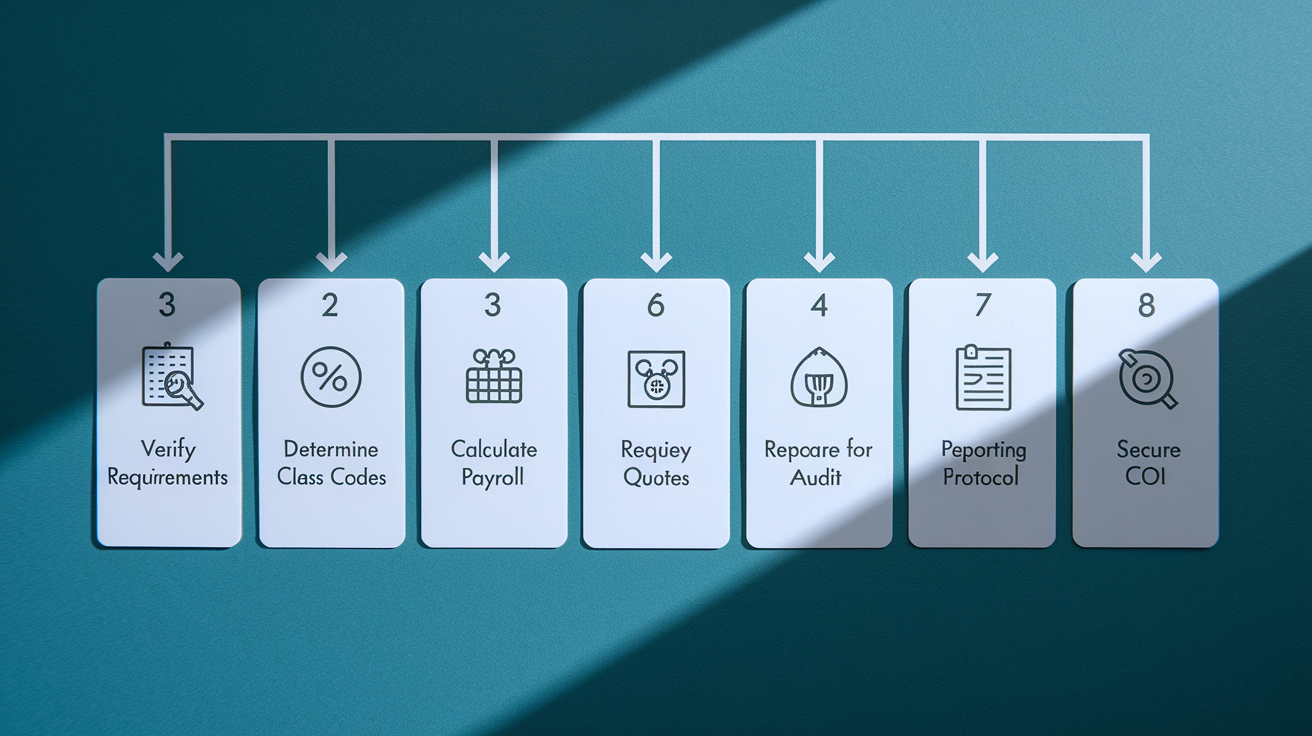
Buying workers comp for the first time is less complicated than it feels once you break it into discrete steps. The whole process, from verifying legal requirements to binding coverage, can take as little as a few days if you’ve got your payroll and employee data organized. Expect two to four weeks if you’re shopping multiple quotes, negotiating terms, or waiting for underwriting approval in a high-risk classification.
How to buy your first policy:
-
Verify your state’s requirements. Check your state workers comp board website or call your department of labor to confirm the employee threshold, mandatory vs. optional coverage, and whether you must use a state fund or can buy from private carriers.
-
Determine your industry classification codes. Your insurer will assign each job role a classification code (class code) based on the National Council on Compensation Insurance (NCCI) system or your state’s proprietary schedule. Accurate codes matter. Misclassification inflates premiums or leaves you underinsured.
-
Calculate your projected annual payroll. Include wages, salaries, bonuses, and overtime for all employees you plan to hire in the next 12 months. Exclude payments to independent contractors (unless state law reclassifies them as employees). Your premium is based on this payroll estimate and adjusted during the year-end audit.
-
Request at least three quotes. Contact private insurers, brokers, or your state fund. Provide the same payroll, class codes, and coverage details to each so you can compare apples to apples. Ask about payment plans: annual upfront, quarterly installments, or pay-as-you-go tied to real-time payroll.
-
Review policy limits, exclusions, and endorsements. Confirm Part Two (Employers’ Liability) limits meet any contract requirements. Federal contractors typically need $100,000 minimums. Check for “Other States” coverage if you occasionally work outside your home state. Note any exclusions for subcontractors, off-premises work, or voluntary activities.
-
Prepare for the premium audit. Insurers will audit your actual payroll and employee classifications at the end of the policy year. Gather tax forms (1099s, W-2s), payroll reports, contractor payment records, and job descriptions now so you’re not scrambling later. Audits adjust your final premium. Underpayment triggers a bill, overpayment earns a refund or credit.
-
Implement an injury reporting protocol. Set up a written procedure for employees to report injuries immediately and for management to file claims with your insurer within the state-mandated timeframe (often 24 to 72 hours). Delayed reporting can jeopardize benefits and inflate claim costs.
-
Secure your certificate of insurance (COI). Most clients, landlords, and contract partners require proof of workers comp before you start work. Your insurer or broker can issue a COI within hours of binding coverage. Keep digital and paper copies handy and request updated COIs whenever you renew or change carriers.
These steps apply whether you’re a sole proprietor hiring your first part-time helper or a startup scaling from five to fifty employees. The documentation and class-code details get more complex as you grow, but the core sequence stays the same.
Workers Comp Exemptions and Owner/Contractor Rules

Many states exempt sole proprietors and business partners from mandatory workers comp coverage unless they hire non-owner employees. The logic is simple: you can’t sue yourself, and workers comp exists to replace the employee’s right to sue the employer. Once you hire even one employee, the exemption typically disappears and coverage becomes mandatory. Some states let owners opt in to coverage voluntarily. Useful if you want the income protection and medical benefits for yourself or if you need to meet a client’s contract requirement.
Family members sometimes get special treatment. A handful of states exclude parents, spouses, or children from the employee count that triggers mandatory coverage, especially in family-owned farms or small retail businesses. These exclusions are narrow and vary widely, so check your state’s statute before assuming your spouse or adult child working in the business is exempt.
Independent contractors are the most common source of misclassification disputes. If you hire a contractor who doesn’t carry their own workers comp policy, many states will treat that contractor (and any employees of an uninsured subcontractor) as your employee for liability purposes. The reclassification happens automatically during a premium audit or after an injury. To protect yourself, require proof of current workers comp coverage (a certificate of insurance) from every contractor and subcontractor before they start work. Keep those certificates on file; your auditor will request them.
Commission-only workers may be excluded in some states, but the rules are inconsistent. Real estate agents paid purely on commission might not count toward your employee threshold in one state and count fully in another. When in doubt, disclose the arrangement to your insurer and ask for a written confirmation of coverage status.
Common exemptions:
- Sole proprietors and business partners. Usually exempt unless they hire employees; can often opt in voluntarily for self-coverage.
- Immediate family members. Parents, spouses, and sometimes children may be excluded from employee counts in certain states and industries (check statute).
- Commission-only workers. May be exempt in some states; highly variable, so verify with your insurer.
- Independent contractors with proof of their own coverage. Not counted as your employees if they provide a valid certificate of insurance; uninsured contractors are typically reclassified as employees during audit.
Starter Workers Comp Claims Process and Employer Responsibilities

When an employee gets injured, the claims process follows a predictable sequence that starts with immediate medical care and ends with the insurer approving or denying benefits. Your role as the employer is to make fast reporting happen, provide accurate information, and stay in regular contact with the injured worker to support a smooth return to work.
Step one happens at the moment of injury. If the injury is serious, the employee seeks emergency medical care. The provider will ask if the injury is work-related and flag it for workers comp billing. For less urgent injuries, direct the employee to an approved medical provider or occupational health clinic if your state allows employer-directed care. Prompt medical attention speeds recovery and documents the injury while details are fresh.
Step two is employee reporting. The injured worker must report the injury to you, typically within 24 to 72 hours depending on state law. In California, waiting more than 30 days to report an injury can jeopardize benefits if the delay prevents a proper investigation. Provide a simple, written injury-report form and make it clear that reporting is required and won’t result in retaliation. Fear of discipline is the most common reason workers delay reporting.
Step three is employer filing. You must complete a first report of injury form (the name and format vary by state) and submit it to your insurer and your state workers comp board within the timeframe specified by law, usually one to seven days. Late filing can trigger fines, delay benefits, and complicate the claim. Your insurer will open a claim file and assign an adjuster.
Step four is the insurer’s investigation. The adjuster reviews medical records, interviews the employee and any witnesses, and decides whether the injury is compensable under state law. Common reasons for denial include injuries that occurred off the clock, during voluntary recreational activities, while the employee was intoxicated, or through intentional self-harm. If approved, the insurer begins paying medical bills and wage-replacement benefits according to the state statutory schedule.
Step five is ongoing benefits and return-to-work planning. Temporary total disability benefits continue as long as the employee can’t work. Once the doctor clears the employee for modified or light duty, coordinate with your insurer and the employee to bring them back as soon as medically safe. Early return-to-work programs reduce the total claim cost, lower your experience modifier, and help the employee avoid long-term unemployment.
Claims process steps:
- Injury occurs during work or in the course and scope of employment.
- Employee seeks immediate medical care and informs the provider the injury is work-related.
- Employee reports injury to employer within state-mandated timeframe (usually 24–72 hours).
- Employer completes first report of injury and files with insurer and state board within required window (1–7 days).
- Insurer investigates, approves or denies the claim, and begins paying medical and wage-replacement benefits if approved.
Reducing Premiums for First-Time Workers Comp Buyers

New employers often think premiums are fixed and non-negotiable, but you’ve got more control than you realize. The most effective cost-reduction tactic is accurate job classification and payroll allocation. If your office manager is mistakenly coded as a warehouse worker, you’ll pay several times the correct rate. During your initial quote and again at the year-end audit, confirm that each employee’s duties match the assigned class code and that payroll dollars are split correctly when someone performs multiple roles.
Safety programs deliver measurable savings. One widely cited study found that workplace safety committees reduced lost-time injuries by 59 percent. Even informal safety practices like regular toolbox talks, written injury and illness prevention plans, and incident investigation protocols signal to underwriters that you take risk management seriously. Some insurers offer premium discounts of 5 to 10 percent for documented safety programs, and many states grant merit rating credits for small businesses with clean claims histories.
Deductible options are available in most states and can cut premiums by 5 to 15 percent. A medical-only deductible of $500 to $5,000 means you pay the first portion of each claim’s medical costs, and the insurer covers the rest plus all wage-replacement benefits. Deductibles work best when you’ve got strong cash reserves and a low tolerance for premium volatility. One or two claims can wipe out your deductible savings, so weigh the trade-off carefully.
Bundling policies with a single carrier often unlocks package discounts. If you need general liability, commercial auto, or a business owner’s policy (BOP) in addition to workers comp, placing all coverage with one insurer can reduce your combined premium by 10 to 20 percent. Paying your annual premium upfront instead of in installments may earn an additional 2 to 5 percent discount and eliminates monthly billing fees.
Coordination of disability programs can prevent double benefits and streamline claims. If your state or company offers short-term disability (STD) or you participate in state disability insurance (SDI) programs, make sure your workers comp policy is structured to offset those benefits rather than pay duplicates. This reduces your total risk exposure and can lower the insurer’s loss projection.
Loss-control services provided by your insurer are often free and directly reduce claims. Insurers may conduct on-site safety inspections, provide written recommendations, offer online training modules, and help you design return-to-work programs. Use these services. Underwriters track participation and reward proactive employers with better rates at renewal.
Savings tactics for new employers:
- Make sure every employee is assigned the correct industry classification code. Misclassification inflates premiums.
- Put a written safety program in place and document all training, toolbox talks, and incident investigations.
- Raise your medical deductible to $500–$5,000 if you’ve got cash reserves to cover small claims.
- Bundle workers comp with general liability and commercial auto for package discounts of 10–20%.
- Pay your annual premium upfront to earn 2–5% payment discounts and avoid installment fees.
- Participate in your insurer’s free loss-control services. On-site inspections, safety training, and return-to-work planning reduce claims and improve renewal pricing.
Audits, Recordkeeping, and Compliance for New Employers

Every workers comp policy includes a year-end premium audit. The initial premium you pay is an estimate based on your projected payroll and employee classifications. At the end of the policy term, the insurer audits your actual payroll, job classifications, and payments to contractors to calculate the final premium. If you underpaid, you’ll get a bill for the difference. If you overpaid, you’ll get a refund or a credit applied to your renewal policy.
Refusing or ignoring the audit isn’t an option. Insurers can cancel your policy, charge you the maximum estimated premium with no refund, and report noncompliance to your state workers comp board. Most audits are conducted remotely. The auditor requests documents by email, reviews them, and issues a final audit statement within a few weeks. High-risk industries or businesses with payroll discrepancies may trigger an on-site audit where the auditor visits your office to inspect records in person.
You need four categories of documents ready for every audit. Tax forms (W-2s for employees, 1099s for contractors) verify total wages and contractor payments. Payroll reports from your payroll service or accounting software break down wages by employee and pay period. Records of all payments to contractors and subcontractors (invoices, canceled checks, proof of payment) prove you didn’t misclassify employees as contractors. Job descriptions or duty summaries for each employee confirm the correct classification code was applied throughout the year.
Multi-state operations add complexity. The standard policy covers only the states listed on your declarations page. If you occasionally send employees to work in another state, you must add an “Other States” endorsement to extend coverage. If you establish permanent operations in a new state, notify your insurer immediately to add that state to your declarations. In monopolistic states (North Dakota, Ohio, Washington, Wyoming) you can’t use an endorsement. You must buy a separate policy from that state’s fund.
State and federal agencies require you to post workers comp notices in a visible location where employees can read them. The poster explains how to report an injury, what benefits are available, and how to contact the state board if a claim is denied. Penalties for failing to post the notice range from nominal fines to more serious sanctions if an employee claims they didn’t know how to file a claim.
Required audit documents:
- W-2 forms for all employees and 1099 forms for all independent contractors and subcontractors.
- Detailed payroll reports showing gross wages by employee and pay period.
- Invoices, contracts, and proof of payment for all contractor and subcontractor work.
- Job descriptions or duty summaries for each employee to verify correct classification codes.
Final Words
You now know the essentials: what starter workers comp insurance covers, why most states require it, how premiums are set, and the steps to buy a policy.
We also walked through legal requirements, exemptions, the claims process, audits, and practical ways to lower costs, plus a simple checklist for first-time buyers.
Use this to check your state rules, gather payroll and class codes, and compare quotes. With starter workers comp insurance in place, you’ll protect employees and reduce financial risk. That’s a solid step forward.
FAQ
Q: What is starter workers comp insurance and why do I need it immediately?
A: Starter workers comp insurance is basic employer coverage that pays medical bills and partial wage replacement for job injuries, and you need it immediately for legal compliance, financial protection, and employee retention.
Q: Is workers comp required for new or small businesses?
A: Workers comp is required in most states for new and small businesses; some states set employee thresholds or exceptions, and failing to carry it can lead to large fines and penalties.
Q: How do state rules affect whether I must carry workers comp?
A: State rules affect coverage by setting employee-count triggers, allowing optional status in some states, and designating monopolistic state funds; always check your specific state law and thresholds first.
Q: What does starter workers comp typically cover and what is excluded?
A: Starter workers comp typically covers medically necessary treatment, about two-thirds wage replacement, occupational disease, workplace violence, and work vehicle incidents; exclusions often include intoxication, off‑the‑clock events, and commuting.
Q: How are premiums for starter workers comp calculated?
A: Premiums are calculated from payroll, classification codes, location risk, claims history, and chosen limits; experience modifiers and merit credits can lower rates for clean histories, especially with small annual premiums.
Q: Where can small businesses buy affordable starter workers comp?
A: Small businesses can buy coverage from private carriers, state funds, online platforms, brokers, or direct insurers; each option offers different buying ease, loss‑control services, and pricing structures.
Q: What are the key steps to buy my first workers comp policy?
A: To buy your first policy, verify state rules, determine class codes, calculate payroll, request multiple quotes, compare exclusions and limits, prepare for audits, and secure a certificate of insurance.
Q: Do owners, partners, or independent contractors need workers comp?
A: Owners and partners are often exempt unless they hire employees or opt in; independent contractors may be reclassified as employees, so verify state rules and require certificates of insurance when appropriate.
Q: What should an employer do after a workplace injury?
A: After a workplace injury, provide medical care, ensure the employee reports the incident, file the claim with your insurer, document details promptly, and follow return‑to‑work and reporting deadlines.
Q: How can a first-time buyer reduce workers comp premiums?
A: First‑time buyers can reduce premiums by improving safety programs, using accurate class codes and payroll allocation, choosing appropriate deductibles, bundling policies, and seeking upfront payment or merit discounts.
Q: What records and documents do I need for audits and compliance?
A: For audits and compliance, keep payroll reports, 1099s, duty descriptions, contractor payment records, proof of state filings, and required workplace posters and notices.