


Most travelers buy the wrong travel insurance without realizing it.
Travel insurance breaks into three main plan types, comprehensive, travel medical, and annual multi-trip, and each covers very different losses.
Comprehensive plans made up about 65% of policies in 2025, but that doesn’t mean they’re right for every trip.
This post shows which coverage you actually need based on how much you’ve prepaid, your medical risk abroad, and how often you travel.
You’ll get clear checklists so you can pick the protection that fits, not the one that costs the most.
Overview of Core Travel Insurance Coverage Categories

Travel insurance breaks down into three main plan structures, each built around different protection needs. Comprehensive plans dominated the 2025 market, pulling in about 65% of all policies sold. They cost around $400 on average, usually running 4 to 10% of your insured trip cost. These plans bundle trip cancellation, medical emergencies, evacuation, and baggage protection into one package. Travel medical plans zero in on healthcare abroad, averaging around $90 and delivering medical coverage that often hits hundreds of thousands of dollars, plus emergency evacuation. Annual multi-trip plans cost about $300 and cover multiple journeys over 12 months, mostly emphasizing medical and evacuation benefits while a lot of them skip trip cancellation altogether.
Only comprehensive plans include standard trip cancellation benefits. If you’ve prepaid a nonrefundable vacation and want money back if you can’t travel, a comprehensive policy is your only path. Travel medical plans exist for travelers who need solid international healthcare coverage without the trip-cost reimbursement piece. Annual plans make sense when you travel a lot. Three or more international trips per year usually tips the math toward a year-long policy instead of stacking single-trip purchases.
Across all plan types, six foundational coverage pieces show up in different combinations:
- Trip cancellation – Money back for prepaid, nonrefundable costs when you cancel for a covered reason.
- Trip interruption – Reimbursement if you have to cut a trip short and head home early.
- Emergency medical – Payment for doctor visits, hospital stays, and urgent care while traveling.
- Evacuation and repatriation – Transport to an appropriate medical facility or return of remains.
- Baggage loss and delay – Reimbursement for lost, stolen, damaged, or delayed luggage and essential purchases during delays.
- Accidental death and dismemberment (AD&D) – Lump sum benefits for accidental injury or death while traveling.
Trip Cancellation Coverage Explained

Trip cancellation insurance reimburses prepaid, nonrefundable trip costs (flights, hotels, tours, cruises) when you cancel for a covered reason before departure. This coverage appears only in comprehensive plans, which cost around $400 on average and represent the only product category that protects your financial investment if the trip falls apart. If you’ve locked in a $5,000 vacation package months in advance, cancellation coverage makes sure you don’t lose that money when life forces a change of plans.
Standard covered reasons typically include:
- Sudden illness or injury to you, a traveling companion, or an immediate family member.
- Severe weather that prevents safe travel or makes the destination inaccessible.
- Family emergency such as the death of a close relative.
- Supplier bankruptcy when your airline, hotel, or tour operator goes out of business before your trip.
- Jury duty, court subpoena, or job termination that legally or practically prevents travel.
Exclusions matter just as much as coverage. Policies won’t reimburse cancellations for reasons outside the covered list. Changing your mind, work obligations that don’t meet the termination standard, or deciding the destination no longer appeals all fall outside. Pre-existing medical conditions often land in a gray zone. Many insurers exclude them entirely unless you purchase a pre-existing condition waiver within a short window after your initial trip deposit. Even then the insurer may apply a look-back period (commonly 60 to 180 days) to determine eligibility. Always confirm your coverage limits match or exceed the total prepaid, nonrefundable amount at risk. A $3,000 trip requires at least $3,000 in cancellation coverage, or you’ll absorb the difference yourself.
Travel Medical Coverage and Emergency Care Abroad

Travel medical insurance pays for unexpected healthcare expenses when you’re away from home. Doctor visits, emergency room treatment, prescription drugs, and sometimes emergency dental care. Domestic health plans rarely extend full coverage outside your home country, leaving international travelers exposed to bills that can reach tens of thousands of dollars for a single hospital stay. Travel medical plans cost about $90 on average and often deliver medical coverage limits measured in the hundreds of thousands, plus emergency medical evacuation bundled into the same policy.
These plans exist for one purpose: to keep you financially whole when illness or injury strikes abroad. They don’t reimburse prepaid trip costs if you cancel. They offer limited or no coverage for baggage, travel delays, or other comprehensive-plan benefits. The trade-off is a lower premium focused entirely on healthcare and evacuation, which makes them a natural fit for long-term travelers, expats, students studying abroad, or business travelers who already have trip-cost protection through other means.
| Medical Coverage | Typical Limits | What’s Included | Common Exclusions |
|---|---|---|---|
| Emergency Medical | $50,000 – $500,000+ | Hospital stays, physician fees, diagnostic tests, prescription drugs, emergency dental | Routine checkups, elective procedures, care for pre-existing conditions (unless waived), mental health (often limited) |
| Emergency Evacuation | $100,000 – $1,000,000+ | Air ambulance or ground transport to nearest appropriate facility, return home when medically necessary | Non-emergency transport, evacuation for convenience, elective repatriation |
| Repatriation of Remains | $25,000 – $100,000 | Return of remains to home country, preparation costs | Funeral or memorial service expenses beyond transport |
| Emergency Dental | $300 – $1,000 per incident | Treatment for acute pain or injury to sound natural teeth | Routine cleanings, orthodontics, cosmetic work |
Pre-existing conditions create the biggest confusion in medical coverage. Most policies exclude them outright, meaning a flare-up of a chronic illness won’t be covered. Some insurers offer a pre-existing condition waiver if you meet strict criteria: purchase the policy within a certain number of days after your initial trip deposit (often 14 to 21 days), insure the full nonrefundable trip cost, and be medically able to travel when you buy. Even with a waiver, the insurer will examine your medical history during a look-back period (60, 90, or 180 days before the effective date) to determine whether a condition was stable. If your blood pressure medication changed doses 70 days before the trip and your policy has a 90-day look-back, that condition may still be excluded. Read the waiver terms line by line before assuming full protection.
Medical Evacuation and Repatriation Coverage Types

Emergency medical evacuation covers the cost of transporting you to the nearest appropriate hospital when local facilities can’t provide the care you need, or flying you home when continued treatment requires resources unavailable at your current location. An air ambulance from a remote island to a major city hospital can easily exceed $20,000. Repatriation from Asia or Africa to North America can climb above $50,000 depending on medical staff requirements and aircraft type. Comprehensive plans, travel medical plans, and annual multi-trip policies all include evacuation as a core benefit, though limits and conditions vary.
Evacuation insurance typically splits into two scenarios: moving you to better care nearby, or moving you all the way home. In the first case, imagine a hiking injury in a rural area where the local clinic lacks orthopedic surgery. Evacuation coverage pays for helicopter or fixed-wing transport to the nearest hospital equipped to handle your injury. In the second case, you might suffer a stroke in Southeast Asia, stabilize enough to travel, and require ongoing rehabilitation that your insurer determines is better managed at home. The policy then covers medically supervised transport back to your home country.
Four types of evacuation and repatriation benefits commonly appear:
- Medical evacuation to nearest facility – Transport to the closest hospital or clinic capable of treating your condition.
- Medical repatriation to home – Supervised return to your home country when local care is insufficient or you’ve stabilized enough to travel.
- Repatriation of remains – Return of your body to your home country and preparation for transport if you die abroad.
- Search and rescue reimbursement – Costs to locate and extract you from a remote or dangerous location before medical transport begins. Limits are often lower (a few thousand dollars) and may require a specific rider.
Evacuation decisions rest with the insurer’s medical team, not your personal preference. If local care is adequate, the policy won’t pay to fly you home simply because you’d rather recover at a familiar hospital. The coverage exists to address genuine medical necessity, not convenience. Check your evacuation limit. Many policies cap it at $100,000 to $250,000, which sounds high but can be consumed quickly by international air ambulance and medical staff costs. Higher limits ($500,000 to $1,000,000) appear in premium plans and are worth considering for remote or high-risk destinations where extraction logistics become complicated.
Baggage Loss, Theft, and Delay Coverage Options

Baggage coverage reimburses you when luggage is lost, stolen, damaged, or delayed, helping replace essential items and personal belongings. Most comprehensive plans include baggage benefits as part of the bundle, with per-item limits (often $250 to $500 per article) and aggregate limits (commonly $1,000 to $2,500 total). Delayed-baggage coverage kicks in after a waiting period, typically 12 to 24 hours, and reimburses essential purchases like toiletries, clothing, and medication while you wait for your bag to arrive. Usually capping reimbursement at $50 to $200 depending on the policy.
Baggage protection splits into two categories: permanent loss or damage, and temporary delay. Permanent loss means the airline, hotel, or carrier can’t locate your bag after a reasonable search period (usually 5 to 21 days), at which point the insurer treats it as lost and pays the claim based on itemized receipts or proof of ownership. Damage claims apply when your suitcase returns crushed, torn, or with contents broken. Theft claims require a police report and documentation of the incident. Delayed-baggage benefits operate separately and focus on immediate relief. Buying a toothbrush, a change of clothes, and necessary prescriptions when your bag misses a connection and won’t arrive for two days.
Five common baggage scenarios:
- Lost baggage – Airline or carrier permanently loses your checked luggage. You file a claim with receipts and the insurer reimburses up to policy limits.
- Damaged baggage – Your suitcase arrives with a broken zipper, cracked hard shell, or crushed contents. Coverage pays repair or replacement costs within per-item limits.
- Theft – Someone steals your bag from a hotel room, rental car, or public space. You provide a police report and itemized list for reimbursement.
- Delayed baggage purchases – Your bag doesn’t arrive with you. After the waiting period, you buy essentials and submit receipts for reimbursement up to the delay limit.
- Special equipment – Cameras, laptops, sports gear, and musical instruments often face lower sub-limits or require scheduled declarations and additional premiums for full protection.
Read the fine print on exclusions and sub-limits. High-value items (jewelry, electronics, collectibles) typically carry per-item caps well below their actual value unless you declare them in advance and pay extra. Unattended baggage, items left in unlocked vehicles, and damage from normal wear-and-tear are commonly excluded. If you’re traveling with $3,000 in photography equipment, a standard $500 per-item limit won’t come close. Consider purchasing a separate valuable-articles rider or a specialty travel gear policy to close the gap.
Travel Delay, Missed Connections, and Alternate Transport Coverage

Travel delay coverage reimburses additional expenses (meals, accommodations, local transportation) when your trip is delayed by a covered cause such as severe weather, mechanical breakdown, or air traffic control issues. Policies typically require a minimum delay threshold, often 6 to 12 hours, before benefits activate. If your flight sits on the tarmac for 10 hours due to a snowstorm, delay coverage pays for a hotel room, dinner, and a taxi once you exceed the waiting period and can no longer reach your original destination that day.
Missed connection benefits apply when a delay causes you to miss the start of a cruise, tour, or other time-sensitive reservation. Imagine a flight delay that makes you miss your cruise departure by four hours. The cruise has already left port, and you now need to fly to the next port of call to board. Missed-connection coverage reimburses the cost of that extra flight, ground transport to the new port, and any meals or overnight accommodation required to catch up. These benefits protect nonrefundable reservations that won’t wait for late arrivals.
Alternate transportation reimbursement covers the cost of rebooking travel when your original carrier cancels or delays you beyond the policy threshold. If your airline cancels a flight and can’t rebook you for 24 hours, the policy may pay for a ticket on a different airline or alternate transport mode (train, rental car) so you can reach your destination without losing an entire day of vacation. The insurer typically caps reimbursement at a set dollar amount or requires you to choose the most economical reasonable alternative.
Four typical reimbursable delay expenses:
- Meals – Restaurant or delivered food purchased during the delay period, often with per-meal or per-day caps.
- Accommodations – Hotel room costs when an overnight delay prevents you from reaching your destination or continuing your journey.
- Ground transportation – Taxi, rideshare, or public transit to and from the airport, hotel, or alternate departure point.
- Communication costs – Phone calls or internet fees to notify family, employers, or travel suppliers of the delay and arrange new plans.
Coverage only applies to delays caused by reasons listed in the policy. Weather, mechanical failure, labor strikes, or carrier bankruptcy. Delays due to your own late arrival, missing documentation, or voluntary decisions (deciding to wait for a better flight) are excluded. Check your policy’s delay threshold and per-day reimbursement limits. A 6-hour threshold activates faster than a 12-hour one, and a $200-per-day cap may fall short if you’re stuck overnight in an expensive city. Some plans also include coverage for delays on the return leg, ensuring protection both ways.
Rental Car Damage and Collision Coverage Types

Rental car insurance covers physical damage to a rental vehicle from collision, rollover, theft, or vandalism. It may include liability protection for injury or property damage you cause to others. Many credit cards offer secondary rental car coverage as a cardholder benefit, meaning the card pays after your personal auto insurance settles its portion. Dedicated travel insurance rental car coverage can provide primary protection, stepping in first without involving your personal policy and avoiding potential rate increases from a claim.
Primary coverage pays rental damage claims directly and immediately, with no need to file through your personal auto insurer. Secondary coverage only pays what your primary insurance doesn’t cover (deductibles, amounts exceeding your personal limits, or gaps if you don’t carry comprehensive and collision on your own car). If you don’t own a car and have no personal auto insurance, secondary coverage becomes effectively primary by default, but you still face the administrative burden of proving the absence of other coverage before the insurer pays.
Three key rental car coverage points:
- Primary vs. secondary – Primary coverage pays first and protects your personal insurance record. Secondary coverage pays after your personal policy, which may trigger a claim and rate review on your own auto insurance.
- Collision and comprehensive – Covers damage to the rental car from accidents, theft, vandalism, fire, and weather. Does not cover liability to third parties.
- Liability add-on – Optional coverage for bodily injury or property damage you cause to others while driving the rental. Personal auto policies often extend liability abroad, but international rentals may exceed your domestic limits or fall outside your policy’s territory.
Rental car coverage in travel insurance policies typically mirrors the collision damage waiver (CDW) or loss damage waiver (LDW) offered by rental agencies but costs less when bundled into a comprehensive plan. Check geographic restrictions. Some policies exclude coverage in certain countries (Ireland, Israel, and Italy are common exclusions due to high fraud rates). Verify whether the policy covers rentals longer than 31 days, whether it extends to vans, trucks, or luxury vehicles, and whether off-road driving or unpaved-road use voids the coverage. If you’re planning a monthlong European road trip in a 4×4, confirm every detail before assuming full protection.
Accidental Death, Dismemberment, and Travel Accident Policies

Accidental death and dismemberment (AD&D) insurance pays a lump sum if you die or suffer a severe injury (loss of a limb, loss of sight, loss of hearing, paralysis) as the direct result of an accident while traveling. AD&D appears as a supplemental benefit in many comprehensive and annual plans, or as a standalone travel accident policy for travelers who want higher coverage amounts. Benefits are calculated as a percentage of the policy’s “principal sum” (the maximum payout for accidental death), with partial percentages paid for specific injuries.
AD&D is not life insurance. It only covers death or dismemberment caused by an accident, not illness, disease, or natural causes. If you have a heart attack on a flight, AD&D pays nothing. If you fall down stairs in a hotel and suffer a traumatic brain injury that results in death, AD&D pays the full principal sum to your beneficiary. If the same fall results in the loss of one hand, you’d receive a partial benefit, typically 50% of the principal sum for the loss of a single limb.
| Incident | Benefit Type | Notes |
|---|---|---|
| Accidental death during trip | 100% of principal sum | Death must occur within a set period (often 90 to 365 days) from the date of the accident and be the direct result of the accident, not an illness or pre-existing condition. |
| Loss of one limb or sight in one eye | 50% of principal sum | Partial benefit paid for single-limb loss. Policies define “loss” as complete severance or total permanent loss of use. |
| Loss of both limbs or sight in both eyes | 100% of principal sum | Treated as equivalent to accidental death for benefit purposes. Full principal sum paid. |
Travel accident policies bundle AD&D with additional accident-related benefits: emergency medical evacuation, accidental medical expense reimbursement, and sometimes a small daily hospital indemnity. These policies are sold separately or as upgrades to comprehensive plans, with principal sums ranging from $25,000 to $500,000 or more. They’re most relevant for travelers engaging in higher-risk activities (adventure sports, remote expeditions) or those who want to supplement employer-provided life insurance during business travel. Review the policy’s covered activities and exclusions carefully. Many AD&D policies exclude injuries sustained while under the influence of alcohol or drugs, participating in professional sports, or engaging in acts of war or terrorism.
Adventure and High-Risk Activity Coverage Types

Standard travel insurance policies exclude coverage for injuries, accidents, or losses arising from high-risk activities. Skiing, snowboarding, scuba diving deeper than recreational limits, mountaineering, bungee jumping, skydiving, and similar pursuits. Insurers classify these activities as materially increasing the risk of injury or death. They either exclude them outright or require you to purchase an adventure sports rider (also called a hazardous sports or high-risk activity endorsement) that adds coverage for a higher premium.
Adventure coverage transforms an exclusion into a covered benefit by extending medical, evacuation, and sometimes AD&D protection to injuries sustained during listed activities. Without the rider, a broken leg from a ski fall would be excluded under the policy’s “hazardous activity” clause, leaving you responsible for all medical bills, evacuation costs, and trip interruption expenses. With the rider, the same injury triggers full benefits under the terms of the policy, subject to the rider’s specific limits and conditions.
High-risk activities commonly requiring specialized coverage:
- Skiing and snowboarding – Downhill, cross-country, heli-skiing, and backcountry skiing. Some policies exclude off-piste or out-of-bounds skiing unless the rider explicitly includes it.
- Scuba diving – Recreational diving (typically defined as depths up to 130 feet with proper certification) is often covered. Technical diving, cave diving, or deeper dives require a rider.
- Mountaineering and rock climbing – Climbing above a certain altitude (often 4,000 to 6,000 meters) or using ropes and technical gear. Policies may distinguish between trekking (covered) and climbing (excluded).
- Adventure sports – Bungee jumping, skydiving, paragliding, hang gliding, BASE jumping, and similar aerial activities.
- Motor sports – ATV riding, snowmobiling, jet skiing, motorcycle touring. Some policies exclude motorized sports entirely unless a specific rider is purchased.
Review your policy’s “prohibited activities” list before you travel. Each insurer defines high-risk differently. One may cover recreational scuba diving up to 100 feet without a rider, while another excludes all diving unless you add the endorsement. Altitude thresholds for mountaineering vary widely. Trekking to Everest Base Camp (about 5,300 meters) might be covered under one policy’s standard terms and excluded under another’s. If your trip revolves around an adventure activity, confirm explicit coverage in writing before you book. Adventure riders typically cost an additional 10 to 50% of the base premium depending on the activity and destination. They may impose their own limits: lower medical maximums, shorter evacuation distances, or exclusions for solo activities without guides.
Specialty Travel Coverage Types: CFAR, Pandemic, Natural Disaster, Terrorism
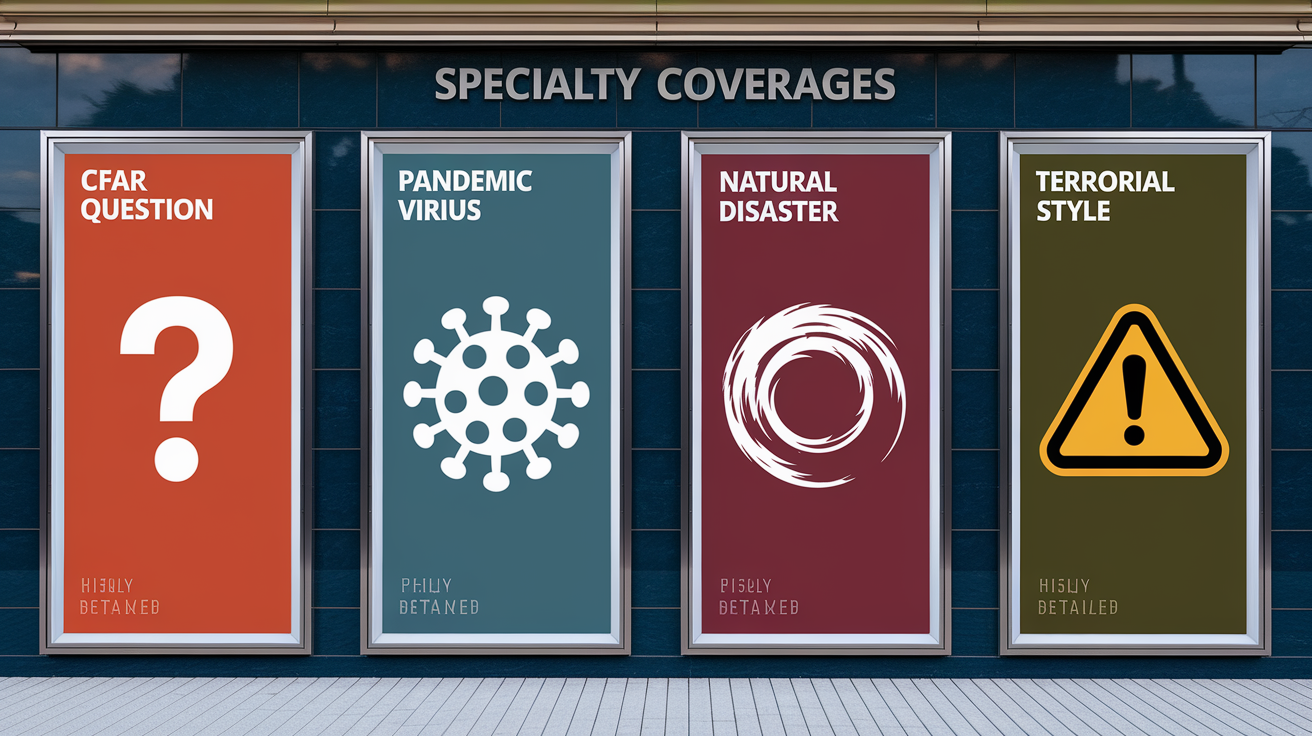
Specialty coverages address gaps in standard policies by extending protection to scenarios that fall outside typical covered reasons. These add-ons cost more and carry stricter rules, but they deliver peace of mind when standard trip cancellation, medical, or delay benefits don’t go far enough. Four specialty coverages dominate the 2025 market: Cancel For Any Reason (CFAR), pandemic and COVID-19 coverage, natural disaster and severe weather benefits, and terrorism-related protection.
Cancel For Any Reason
Cancel For Any Reason (CFAR) coverage reimburses a portion of your prepaid, nonrefundable trip costs, typically 50 to 75%, when you cancel for a reason not listed in the standard trip cancellation policy. Standard cancellation covers illness, injury, severe weather, family emergencies, and supplier bankruptcy. CFAR covers everything else, including changing your mind, work stress, fear of travel, or any other personal reason. The trade-off is cost and conditions: CFAR increases your premium by 40 to 60% over the base comprehensive plan, and you must purchase it within a short window after your initial trip deposit (often 14 to 21 days). You also must cancel at least 48 to 72 hours before departure to qualify for reimbursement. Last-minute cancellations are excluded.
CFAR is not full reimbursement. If you cancel a $5,000 trip under a 75% CFAR policy, you receive $3,750 and forfeit the remaining $1,250. The partial payout reflects the higher flexibility the coverage provides. CFAR makes sense when you’re booking a trip far in advance, when personal or work circumstances are uncertain, or when your trip involves destinations or activities that standard policies might exclude. It doesn’t make sense if you’re certain you’ll travel or if the added premium cost exceeds your comfort level for the partial reimbursement benefit.
Pandemic & COVID Coverage
Pandemic and COVID-19 coverage varies widely by insurer and policy. Some comprehensive plans now include COVID-19 as a covered reason for trip cancellation, trip interruption, and emergency medical, treating it like any other illness. Others exclude pandemic-related claims entirely or limit coverage to specific scenarios (you test positive within 48 hours of departure, you’re hospitalized, or your destination issues a government-mandated travel ban). Annual and travel medical plans often extend emergency medical benefits to COVID treatment abroad, but cancellation protection remains inconsistent.
Check three pandemic-related details before buying: whether COVID-19 is a covered reason for trip cancellation, whether emergency medical benefits apply to COVID treatment (hospital, doctor, prescriptions), and whether quarantine expenses (hotel, meals, extended stay) are reimbursed if you’re required to isolate at your destination. Some policies cap quarantine reimbursement at a daily limit (for instance, $200 per day for up to 14 days). Others exclude it entirely. If pandemic flexibility is a priority, confirm explicit coverage language in the policy wording, not just in marketing materials.
Natural Disaster & Severe Weather Benefits
Natural disaster and severe weather coverage reimburses trip cancellation, interruption, and delay expenses when hurricanes, earthquakes, floods, wildfires, volcanic eruptions, or other natural events make your destination uninhabitable or inaccessible. Standard comprehensive plans include natural disasters in their covered-reason lists, but the devil lives in the details. Coverage often hinges on the timing of the event, the official status of warnings or evacuation orders, and whether your specific accommodations were directly affected.
Hurricane coverage is the most common natural disaster benefit and the most scrutinized. Policies typically cover trip cancellation if a hurricane makes landfall at your destination within 24 to 72 hours of your scheduled departure, or if a mandatory evacuation order is issued for your resort or hotel. If the storm changes course, weakens to a tropical storm, or hits a neighboring area without affecting your lodging, coverage may not apply. Policies also exclude cancellations made out of fear or caution before an official warning is issued. If you’re traveling to a hurricane-prone region during storm season, verify the policy’s named-storm language and the timing requirements for coverage.
Terrorism-Related Coverage
Terrorism coverage reimburses trip cancellation, interruption, or delay when a terrorist attack occurs at your destination within a defined window before your departure, commonly 30 days. Coverage applies only to attacks officially classified as terrorism by the policy’s terms (often requiring a government or international agency designation) and only if the attack happens at your specific destination city or within a certain radius of your accommodations. Attacks in a different part of the country or region typically don’t trigger benefits.
Some policies include terrorism coverage as standard in comprehensive plans. Others exclude it or require a rider. Business travel insurance and high-end plans sometimes add kidnap, ransom, and extortion coverage for travelers visiting high-risk regions, though these benefits are rare in consumer policies. Terrorism coverage doesn’t extend to travel cancellations based on general safety concerns, State Department warnings, or personal fear unless an actual attack meets the policy’s criteria. If you’re traveling to a region with active conflict or elevated terrorism risk, confirm both the coverage language and the definition of “terrorism” in the policy wording.
Single-Trip vs Annual Multi-Trip Travel Insurance Types
Single-trip policies cover one defined trip from departure to return, protecting you for the specific dates, destinations, and travelers named in the policy. Annual multi-trip plans cover an unlimited number of trips over a 12-month policy period, subject to per-trip duration limits, commonly 30, 45, or 60 days per journey. Single-trip insurance costs vary by trip length, destination, traveler age, and coverage limits, while annual plans charge a flat premium (averaging around $300) and deliver the same benefits on every trip you take during the year.
Annual plans make financial sense when you travel frequently. If you take three or more international trips per year, the cost of three separate single-trip comprehensive policies (averaging $400 each, totaling $1,200) exceeds the cost of one annual plan at $300. Frequent business travelers, retirees who split time between multiple locations, academics attending conferences, and anyone with a pattern of short international trips all benefit from the convenience and savings of annual coverage.
| Policy Type | Best For | Average Cost | Trip Cancellation | Medical & Evacuation |
|---|---|---|---|---|
| Single-Trip Comprehensive | One vacation, family trip, or event | ~$400 (4–10% of trip cost) | Included for full prepaid nonrefundable costs | Included, with limits matching single-trip exposure |
| Single-Trip Travel Medical | One international trip needing medical protection only | ~$90 | Not included | Primary focus; often hundreds of thousands in medical limits plus evacuation |
| Annual Multi-Trip | Frequent travelers (3+ trips/year) | ~$300 per year | Often excluded or very limited; check policy terms | Included on all trips, with consistent medical and evacuation limits per trip |
| Annual Multi-Trip with Cancellation Add-On | Frequent travelers needing cancellation protection | ~$400–$500 per year | Included for each trip, subject to per-trip limits | Included on all trips |
| Business/Corporate Annual | Business travelers with employer-sponsored plans | Varies; often employer-paid | Depends on plan; many exclude or limit | Included, often with higher limits and global assistance services |
The biggest limitation in most annual plans is trip cancellation. Many exclude it entirely or cap reimbursement at a low per-trip limit (for instance, $1,000 to $2,500). If you routinely book expensive vacations with substantial nonrefundable deposits, an annual plan without cancellation coverage leaves you exposed. Some insurers offer annual plans with full trip cancellation as an add-on, raising the premium to $400 to $500 but delivering comprehensive protection on every trip. Another workaround: buy an annual medical plan for continuous medical and evacuation coverage, then add a single-trip cancellation policy or rely on credit card trip cancellation benefits when you book a high-cost vacation.
Family, Elderly Traveler, Business, and Student Travel Insurance Variants
Different traveler profiles face unique risks and coverage needs. Family travel insurance plans bundle coverage for multiple travelers under one policy, often at a lower per-person cost than buying individual policies for each family member. Elderly traveler plans address age-related underwriting, higher premiums, and medical screening requirements. Business travel insurance prioritizes trip interruption, equipment coverage, and global assistance services. Student international insurance focuses on long-term medical coverage abroad, repatriation, and benefits for study-related risks like tuition reimbursement if a program is canceled.
Family plans typically cover two adults and all dependent children under a single premium, with one set of coverage limits shared across the group or individual limits per person depending on the policy structure. This approach saves money compared to individual policies and simplifies claims. One policy number, one set of documents, one point of contact. Family plans also allow coordination of trip cancellation and interruption. If one family member gets sick and the whole trip is canceled, the entire family’s prepaid costs are reimbursed under the shared limits.
Elderly travelers face higher premiums due to age-based risk and may encounter coverage restrictions or exclusions. Many insurers cap coverage at age 70, 75, or 80, or require medical questionnaires and pre-approval for travelers above a certain age. Some policies exclude or limit coverage for pre-existing conditions in older travelers, even with a waiver. Seniors should compare policies designed specifically for older travelers, which offer higher age limits, more flexible pre-existing condition rules, and coverage tailored to longer trips or snowbird travel (extended stays in warmer climates during winter months). Expect premiums to increase significantly after age 65, sometimes doubling or tripling compared to younger travelers on the same trip.
Business travel insurance emphasizes trip interruption over cancellation, because business travelers often book on short notice and have less advance planning. Policies include coverage for missed meetings, equipment (laptops, presentation materials, samples), and global assistance services like emergency translation, legal referrals, and 24/7 concierge support. Corporate plans purchased by employers often bundle coverage for all employees under a master policy, with higher limits for frequent travelers and executives. Business policies may also include kidnap, ransom, and extortion coverage for high-risk regions, plus evacuation for political unrest or natural disasters.
Student international insurance is built for long-term coverage abroad (semester or year-long programs) and includes benefits standard travel insurance excludes. These policies cover:
- Extended medical coverage for the full program length, often with higher limits and lower deductibles than short-term travel medical plans.
- Repatriation and emergency reunion benefits that pay to bring parents or family to the student’s side during a medical emergency, or to return the student home if medically necessary.
- Tuition reimbursement if the study program is canceled, interrupted, or if the student must withdraw due to a covered medical reason.
- Mental health and counseling benefits, recognizing the stress and isolation students may face abroad.
Comparing Travel Insurance Coverage Types Side by Side
Choosing between comprehensive, travel medical, and annual plans requires understanding what each delivers and where gaps appear. The table below maps the three primary plan types against major benefits, highlighting coverage availability, typical limits, and key exclusions to guide your decision.
| Benefit / Feature | Comprehensive (Single-Trip) | Travel Medical (Single-Trip) | Annual Multi-Trip |
|---|