



Think your homeowners policy will pay to rebuild your house after a major loss?
Many policies won’t cover the full bill, and that shortfall can leave you with tens of thousands to pay.
Dwelling coverage limits are the maximum your insurer will pay to repair or rebuild your home’s structure (not the land or your stuff).
This post explains how insurers set those limits, why underinsuring is one of the most expensive mistakes homeowners make, and how to choose a limit that actually protects your rebuild budget.
Core Explanation of Dwelling Coverage Limits

Dwelling coverage limits are the maximum dollar amount your homeowners insurance will actually pay to repair or rebuild your home’s physical structure after something like a fire, windstorm, or lightning strike. This limit covers the dwelling itself (that’s Coverage A in most policies) and doesn’t touch your land, your stuff inside, or liability protection. So if a fire takes out your kitchen and living room, your insurer covers the restoration costs up to your dwelling limit, minus whatever deductible you’re carrying.
Most policies anchor these limits to replacement cost. That’s the amount it would take to rebuild your home using similar materials and methods at today’s prices. Market value and purchase price don’t factor in because they include the land and bounce around with real estate trends, while replacement cost zeroes in on actual construction expenses. A home you bought for $350,000 might need $425,000 to rebuild if local labor and materials run high, which makes the replacement cost estimate the smarter number to lean on.
Getting your dwelling limit right prevents ugly financial surprises after a total loss. If your home needs $300,000 to rebuild but your limit sits at $250,000, you’re covering that $50,000 gap yourself or settling for a smaller, cheaper rebuild. Setting limits too low is one of the most common and expensive mistakes in homeowners insurance, especially in areas where construction costs have jumped after disasters or supply chain chaos.
How Insurers Determine Dwelling Coverage Limits

Insurance companies rely on replacement cost estimating tools that pull from national construction databases, local labor rates, and current material prices. These tools factor in your home’s size, age, quality of finishes, and regional cost differences. A 2,000 square foot home in rural Nebraska will have a lower per square foot rebuild cost than the same home in coastal California, where labor, permits, and materials cost more.
Your insurer will also dig into details you provide about your home’s features. Type of roofing, number of bathrooms, custom cabinetry, finished basements, attached structures like covered patios. Older homes might need upgrades to meet current building codes during a rebuild, which can push replacement costs higher than the original construction. Many carriers now require periodic checkups or use automatic inflation adjustments to keep limits aligned with rising construction expenses.
A few key things that shape your dwelling coverage limit:
Square footage and layout complexity. Larger homes and those with multiple stories, vaulted ceilings, or custom floor plans cost more to rebuild.
Quality of materials and finishes. Granite countertops, hardwood floors, high end fixtures bump up replacement cost compared to builder grade alternatives.
Local construction labor rates. Metropolitan areas and regions with labor shortages typically see higher per square foot costs.
Building code and ordinance requirements. Newer codes may demand updated electrical, plumbing, or structural elements that weren’t there when the home was first built.
Special features and upgrades. Pools, outdoor kitchens, custom tile work, finished attics or basements all add to the total rebuild estimate.
Replacement Cost vs Actual Cash Value
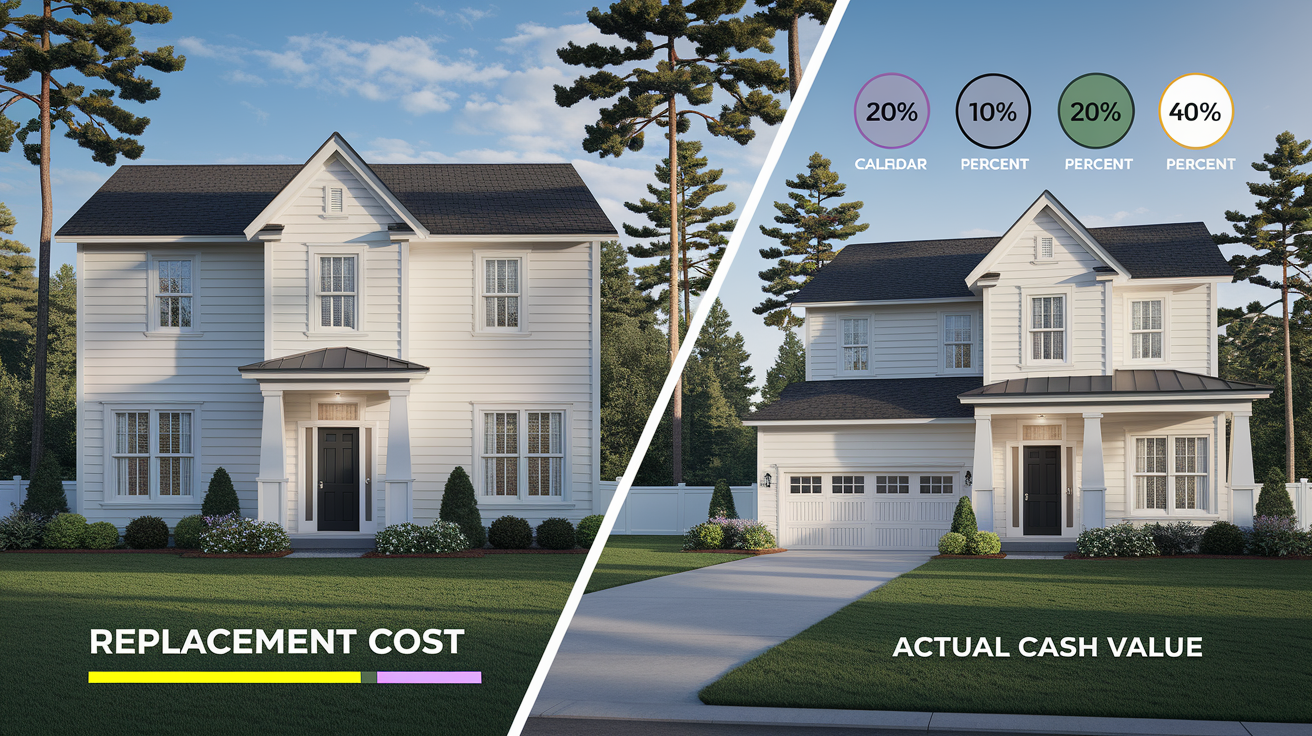
| Valuation Method | What It Covers | Impact on Payout |
|---|---|---|
| Replacement Cost | Full cost to rebuild or replace with new materials at current prices, no depreciation | Higher payout; covers entire rebuild cost up to policy limit |
| Actual Cash Value (ACV) | Replacement cost minus depreciation for age and wear | Lower payout; leaves homeowner to cover depreciation gap |
Replacement cost coverage pays to rebuild your home using new materials and current labor rates without deducting for the age or condition of the damaged parts. If your ten year old roof gets destroyed by hail and replacement cost is $20,000, the insurer pays close to that full amount (minus your deductible) regardless of the roof’s depreciation. This approach protects you from big out of pocket expenses when older parts of your home need replacing.
Actual cash value coverage subtracts depreciation from the replacement cost, which cuts the claim payout significantly. Same roof example: a $20,000 replacement cost minus ten years of depreciation on a 25 year lifespan roof equals about 40 percent depreciation, leaving an ACV payout of roughly $12,000. You’d need to come up with the remaining $8,000 yourself. ACV policies are less common for dwelling coverage but may show up in older or high risk properties, and they always cost less in premiums because the insurer’s exposure is lower.
Some insurers offer extended replacement cost or guaranteed replacement cost endorsements that go beyond your base dwelling limit. Extended replacement cost typically adds 20 to 25 percent above your limit (so a $250,000 limit becomes $312,500 in available funds), while guaranteed replacement cost can cover the full rebuild expense even if it exceeds the limit. Availability is increasingly limited and often comes with strict underwriting rules.
Consequences of Underinsuring Your Dwelling

When your dwelling limit falls short of actual replacement cost, the insurer may invoke a coinsurance clause. Common in policies requiring you to insure to at least 80 percent of the home’s full replacement value. If you don’t meet that threshold, the insurer reduces your claim payment proportionally. A $300,000 replacement cost home should carry at least $240,000 in dwelling coverage under an 80 percent coinsurance rule. If you only carry $200,000 and file a $150,000 claim, the payout formula becomes (Policy Limit ÷ Required Limit) × Loss Amount. In this case, ($200,000 ÷ $240,000) × $150,000 equals $125,000, leaving you to cover the remaining $25,000 plus your deductible.
Even partial losses can trigger significant out of pocket costs if you’re underinsured. A kitchen fire causing $80,000 in damage might only yield a $66,667 payout under the same coinsurance penalty, forcing you to delay repairs, finance the shortfall, or accept lower quality replacements. The financial strain often extends beyond the immediate repair. Temporary housing, storage fees, and loan interest compound the burden.
Major consequences of inadequate dwelling coverage:
Reduced claim payouts due to coinsurance penalties or limits that simply don’t cover the full loss.
Large out of pocket expenses for materials, labor, permits, and code upgrade costs not covered by the shortfall.
Inability to rebuild to original quality, forcing compromises on materials, square footage, or finishes.
Potential mortgage default or lender disputes, since most mortgage agreements require sufficient insurance to protect the lender’s collateral. An underinsured total loss can leave you owing a mortgage on a destroyed property.
How to Choose the Right Dwelling Coverage Limit

Start with a professional replacement cost estimate rather than relying on your home’s purchase price or tax assessed value. Many insurers provide free calculators or appraisals as part of the quoting process, but you can also hire an independent appraiser or use third party cost estimating tools to cross check the insurer’s number. The goal is a realistic figure that reflects current local construction costs, not outdated or generic national averages.
Review your coverage annually and immediately after any major renovation, addition, or improvement. A remodeled kitchen, finished basement, new roof, or added bathroom changes your home’s replacement cost, and your limit should rise accordingly. Inflation and supply chain volatility can also shift construction costs quickly. Builders in many markets reported cost increases of 20 to 30 percent between 2020 and 2023, so static limits from years ago may no longer be adequate.
Consider endorsements that provide extra cushion for unexpected expense spikes. An inflation guard automatically increases your dwelling limit by a small percentage each year, typically 1 to 3 percent, to keep pace with rising costs. Extended or guaranteed replacement cost coverage adds a buffer for situations where final rebuild expenses exceed initial estimates due to permit delays, labor shortages, or updated code requirements. While these endorsements raise your premium slightly, they can prevent devastating shortfalls after a major loss.
Practical steps to make sure your dwelling limit is sufficient:
Obtain a detailed replacement cost estimate from your insurer or a certified appraiser, factoring in square footage, finishes, and local building costs.
Update your limit after renovations or additions, providing receipts and project details to your insurer so the new value is reflected.
Ask about inflation guard endorsements that automatically adjust your limit each year to match construction cost trends.
Add extended or guaranteed replacement cost coverage if available, especially in high cost or high risk markets where rebuilding expenses can surge unexpectedly.
Include allowances for code upgrades, debris removal, and permit costs. Many insurers offer ordinance and law coverage as a separate endorsement. Budget 5 to 20 percent above base rebuild cost for these items.
Review your policy annually and compare your limit to current local builder estimates, adjusting if construction costs in your area have risen or if you’ve made improvements.
Final Words
You learned that dwelling coverage limits set the maximum your insurer will pay to repair or rebuild, and that those limits are usually based on replacement cost rather than market value.
We also covered how insurers calculate limits, the difference between replacement cost and actual cash value, and the real risks of underinsuring so you don’t face a surprise shortfall after a loss.
If you’re wondering what are dwelling coverage limits for your home, check your replacement-cost estimate, update it after renovations, and ask your agent. Do this and you’ll sleep easier knowing your coverage fits your home.
FAQ
Q: What does dwelling coverage limit mean?
A: The dwelling coverage limit means the maximum your insurer will pay to repair or rebuild your home after a covered loss, usually based on replacement cost rather than the home’s market value.
Q: What does it mean if the coverage limits are $50,000 / $100,000?
A: If the coverage limits are $50,000 / $100,000, it usually means $50,000 per injured person and $100,000 total per accident for bodily injury liability; check your policy since formats can vary.
Q: What does $500,000 building coverage on flood policy mean?
A: The $500,000 building coverage on a flood policy means the insurer will pay up to $500,000 to repair or replace the insured structure after covered flood damage, minus your deductible and any exclusions.
Q: What is an example of dwelling coverage?
A: An example of dwelling coverage is payment to rebuild damaged walls, roof, floors, built-in cabinets, and attached structures like a garage after a covered peril such as fire or windstorm.