



What does personal property coverage include: furniture, electronics, clothing and belongings?
You might think it covers every item in your home.
It usually covers furniture, clothes, TVs, laptops, and things you take with you.
But there are sub-limits, exclusions, and different valuation methods that change what you actually get after a loss.
This article walks through what’s typically covered on- and off-premises, common dollar caps for high-value items, how claims are valued (actual cash value vs replacement cost), and simple steps to make sure your stuff is properly protected.
Core Elements of Personal Property Coverage

Personal property coverage (usually called Coverage C in homeowners policies or the main protection in renters insurance) is what protects your stuff instead of the building. It covers things you own and use every day. Furniture, clothes, electronics, and everything else that would come with you if you moved. Whether you own or rent, this coverage kicks in when those belongings get damaged, destroyed, or stolen.
The coverage isn’t just for what’s bolted down. It usually applies to items inside your home, belongings stored in attached or detached garages and sheds, and often things you take with you when you leave. So a laptop stolen from your car or luggage lost on a trip might still fall under your policy’s personal property protection, depending on the limits and conditions in your specific contract.
Here’s what’s typically covered:
Living room and bedroom furniture (sofas, beds, tables, dressers), clothing and shoes, TVs and laptops and tablets and phones, small kitchen appliances, tools and lawn equipment, sports gear, linens and towels, books and DVDs.
On-premises coverage protects belongings inside your home and on your property. Off-premises coverage extends protection to items you carry outside the home. Your laptop at a coffee shop, your bike locked downtown, your suitcase in a hotel room. Many policies cap off-premises claims at a percentage of your total personal property limit (usually 10% to 50%), so check your declarations page to see how much protection travels with you. Off-premises coverage won’t replace specialized policies for things like motor vehicles, but it fills gaps for everyday stuff away from home.
Coverage Limits and How They Work
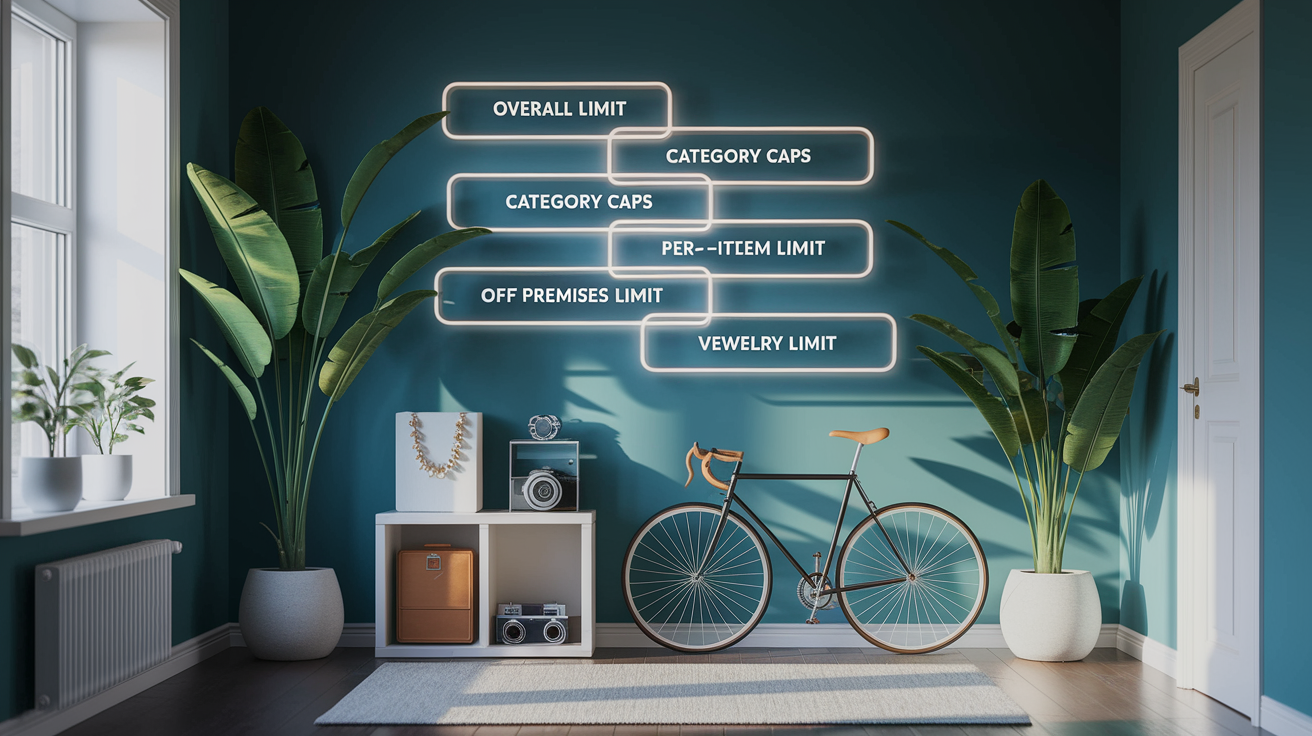
Your policy’s personal property limit is the maximum dollar amount the insurer will pay for all covered belongings combined. For homeowners, this limit is usually a percentage of your dwelling coverage, commonly 50% to 70%. If your home is insured for $300,000, your personal property limit might be $150,000 to $210,000. Renters policies set a fixed personal property limit since there’s no dwelling to anchor the percentage.
But the overall limit isn’t the only cap you’ll run into. Policies layer in sub-limits and category-specific caps that restrict payouts for certain types of items, even if your total personal property limit is high. These nested limits exist because some belongings are more likely to be stolen or harder to verify, so insurers reduce their risk by capping what they’ll pay per item or per category.
When you file a claim, the insurer applies every relevant limit. If your policy caps jewelry at $2,000 and you lose a $6,000 ring, you’ll get up to $2,000 unless you bought extra coverage. Your deductible also matters. Common amounts are $500, $1,000, or $2,500, and it gets subtracted from the claim payout before you receive anything.
Limits you’ll see in most policies:
Overall personal property limit is the total coverage available for all belongings combined. Category limits cap groups like jewelry, firearms, or collectibles. Per-item limits set a maximum payout for a single item within a limited category. Off-premises limit is often a percentage of your total personal property limit for items away from home.
Exclusions and Special Limits for High-Value Items

Not everything in your home gets full protection under a standard policy. Certain categories are excluded completely, while others face strict dollar caps. Common exclusions include flood and earthquake damage (which need separate policies), normal wear and tear, motor vehicles and their parts, business inventory or equipment used for work, and losses you caused on purpose. These exclusions exist because the risks are either uninsurable under a homeowners contract, better suited to specialty coverage, or outside the scope of accidental loss.
Beyond exclusions, many policies put special limits on high-value or easily portable items. These sub-limits cap payouts well below your overall personal property limit, even if the item is covered for the named peril. The goal is to control the insurer’s exposure to theft and fraud while still offering baseline protection.
Categories that commonly face special limits:
Jewelry and watches get typical limits ranging from $1,000 to $5,000 total, sometimes as low as $1,000 to $2,000 per item. Furs are often capped at $1,000 to $2,500. Firearms usually get limited to $2,000 to $5,000 total. Collectibles, coins, and stamps often fall between $1,000 and $2,000. Fine art and antiques may have per-item or per-category caps. Cash and precious metals get extremely low limits, often just a few hundred dollars.
Always read your policy’s declarations page and special limits section. The exact dollar amounts vary by insurer and state. What one company caps at $1,500 another might cap at $5,000. If your belongings in any of these categories exceed the printed limits, you’ll need an endorsement to close the gap.
Endorsements and Riders to Expand Coverage

When standard policy limits fall short, you can buy an endorsement (also called a rider or floater) to increase or customize your coverage. A scheduled personal property endorsement is the most common fix for high-value items. It lists specific belongings by description and agreed value, then removes the standard sub-limits so each item is covered up to its scheduled amount. This approach works well for engagement rings, collectible watches, musical instruments, camera equipment, or anything worth more than your policy’s category cap.
To schedule an item, you’ll typically need proof of value. A recent receipt, a professional appraisal, or documentation from the seller. The insurer uses that proof to set the coverage amount and calculate the additional premium. Scheduled coverage often includes broader protection than the base policy, sometimes covering accidental loss or mysterious disappearance that wouldn’t qualify under standard named-peril coverage. The trade-off is higher cost, but the premium increase is usually modest relative to the item’s value.
Endorsements aren’t just for jewelry and art. You can also buy riders to increase aggregate limits for categories like tools, sports equipment, or electronics if you own more than the standard cap allows. Some insurers offer blanket increases (raising the jewelry limit from $2,000 to $10,000, for example) without itemizing every piece, though this option may still require an appraisal or inventory. Review your belongings annually and update scheduled items whenever you acquire something valuable or when appraised values change.
Actual Cash Value vs. Replacement Cost
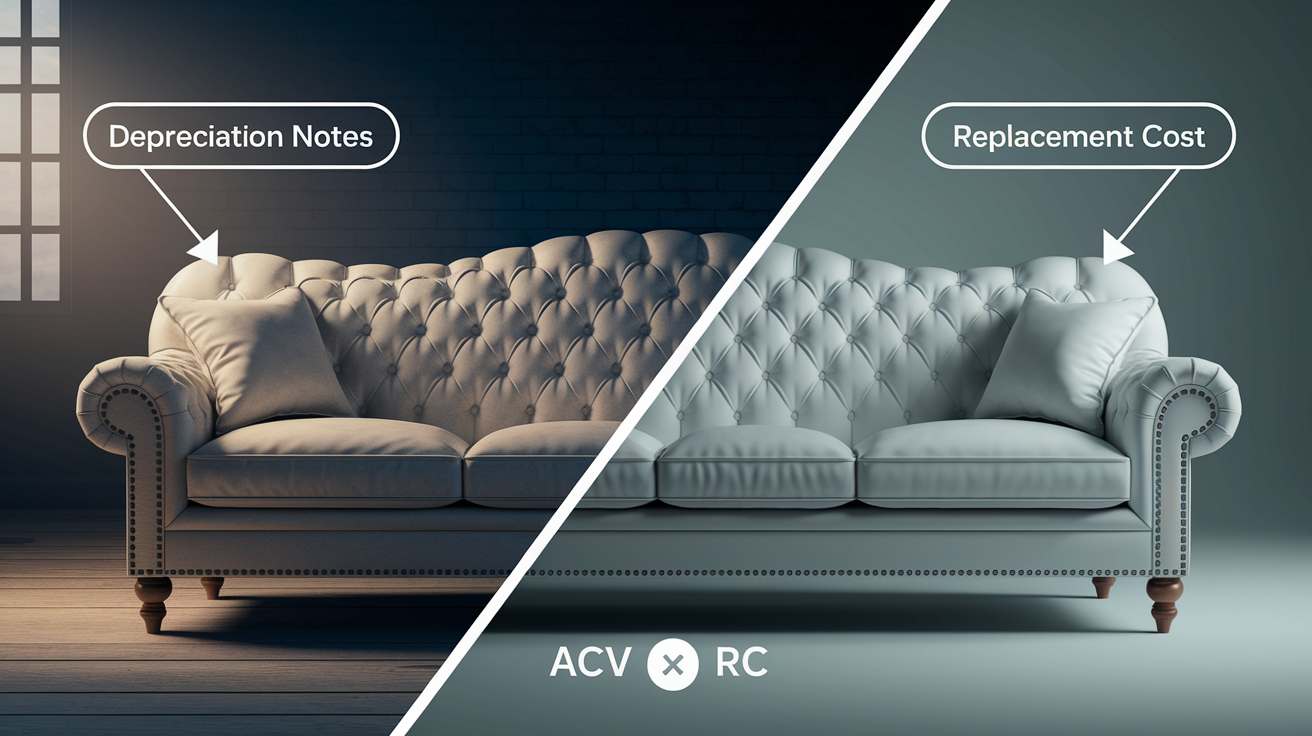
How your policy values belongings determines what you’ll receive after a covered loss. The two primary methods are Actual Cash Value (ACV) and Replacement Cost (RC), and the difference can be thousands of dollars on a large claim.
Actual Cash Value pays what the item was worth at the time of loss, accounting for age, condition, and depreciation. If a five year old sofa originally cost $1,200 and the insurer estimates it depreciated 60%, you might receive around $480. Replacement Cost Coverage reimburses the amount needed to buy a new item of similar kind and quality, with no depreciation deduction. The same sofa might cost $1,300 to replace today, and RC coverage would pay close to that amount (subject to your policy limit and deductible).
Most insurers offer personal property coverage on an ACV basis by default, with an option to upgrade to replacement cost for an additional premium, often around 10% more than the base rate. That extra cost usually pays for itself in a claim, especially for furniture, electronics, and appliances that lose value quickly but cost a lot to replace.
| Actual Cash Value (ACV) | Replacement Cost (RC) |
|---|---|
| Depreciation is deducted from the payout | No depreciation; pays the cost of a new equivalent item |
| Lower claim payouts, especially for older items | Higher payouts that reflect current retail prices |
| Standard on many policies; no added premium | Optional upgrade; typically adds about 10% to premium |
| May leave you with out-of-pocket costs to replace belongings | Covers full replacement, reducing or eliminating your out-of-pocket expense |
When choosing between ACV and RC, consider the age and condition of your belongings. If most of your furniture and electronics are new or recently purchased, the gap between methods may be small. If you’ve lived in your home for years and haven’t updated major items, replacement cost coverage can make a real difference in your ability to rebuild after a loss.
Documenting Belongings and Filing a Claim

Insurers ask for proof of ownership and value when you file a claim, and the quality of your documentation directly affects how quickly and fully you’re reimbursed. A home inventory is the single most useful tool you can create. It’s a detailed record of what you own, where you bought it, and what it would cost to replace. You don’t need specialized software. A simple spreadsheet, a note-taking app, or even a handwritten list can work as long as it’s complete and stored somewhere safe.
Start by walking through your home room by room and listing major items. For each, note the brand, model, serial number (if applicable), purchase date, purchase price, and current replacement cost. High-value items should have receipts or appraisals attached. Take photos or short videos of each room, focusing on electronics, furniture, and anything valuable or unique. Store the inventory and all digital files in cloud storage or email them to yourself so they survive if your home is destroyed.
Steps to create and maintain a home inventory:
List every room and record furniture, electronics, appliances, and other belongings in each space. Capture serial numbers and model names for anything with a manufacturer label, especially electronics and appliances. Photograph or video each item and each room. Include close-ups of high-value possessions. Attach receipts and appraisals for items over $500 or anything scheduled under an endorsement. Update the inventory annually or after major purchases, remodeling, or life changes like a move or inheritance. Store a copy off-site in cloud storage, a safe deposit box, or with a trusted contact so you can access it after a loss.
When you file a claim, the insurer will ask for the inventory, photos, receipts, and sometimes a police report for theft. The faster you can provide detailed documentation, the faster the claim moves. If you don’t have receipts for older items, the insurer may accept photos, credit card statements, or even testimony from witnesses who saw the item in your home. But incomplete records often lead to lower payouts because the adjuster has to estimate value conservatively. Treat your inventory as part of your insurance policy. It’s only useful if you keep it current and accessible.
Final Words
You now know what personal property coverage protects: furniture, clothing, electronics, and many items you take off‑premises.
We also covered how limits and special sub‑limits control payouts, when endorsements or scheduled coverage help, and the difference between actual cash value and replacement cost.
Finally, keeping a home inventory helps speed claims and get fair reimbursement.
If you’re asking what does personal property coverage include, check your policy’s limits, exclusions for valuables, and whether you need riders—then update your inventory and review at renewal. You’ll be better protected and less stressed when something goes wrong.
FAQ
Q: What is covered in personal property insurance?
A: Personal property insurance covers your belongings like furniture, clothing, electronics, and appliances, usually on- and off-premises. Check for special limits on jewelry, art, collectibles, and firearms.
Q: Is VPP insurance worth it?
A: VPP insurance is worth it when you own high-value items that exceed standard limits. It removes sub-limits but usually needs appraisals, receipts, and raises premiums slightly.
Q: What is the average personal property coverage?
A: Average personal property coverage is typically set at 50% of your dwelling coverage on standard homeowners policies. You may need higher limits or endorsements for valuables.
Q: How is personal property coverage paid out?
A: Personal property coverage is paid out either as Actual Cash Value (depreciated) or Replacement Cost, minus your deductible, after you file a claim and provide receipts, photos, or repair estimates.