


Is a starter liability policy a smart bargain or a false sense of security?
It’s the cheap, basic coverage that pays for injuries or property damage you cause to other people.
It moves big financial risk off your shoulders without a big premium, but it has low limits and clear gaps — no cover for your own car, professional mistakes, workers’ injuries, or cyber losses unless you add more.
This post explains what a starter policy really covers, the common exclusions and limits to watch, and when you should upgrade or add protection.
Clear Definition of a Starter Liability Policy and Its Core Purpose

A starter liability policy is entry-level insurance that covers bodily injury and property damage you cause to other people, at the cheapest premium available. It won’t protect your own stuff, your professional screwups, or employee injuries unless you add those through endorsements or buy separate policies. These policies meet minimum legal requirements in most states and satisfy basic demands from landlords or lenders, but they come with low limits that can leave you exposed when claims blow past those thresholds.
The whole point of starter liability is moving catastrophic financial risk off your shoulders without dropping a ton of cash upfront. For a new driver with an old beater and no car loan, a liability-only auto policy keeps costs down while still covering damages if you hurt someone or wreck their car. For a micro-business with no employees and barely any client contact, a basic general liability policy gives you a defense budget and settlement fund if a customer sues, so you’re not paying legal bills out of pocket.
Starter liability works as a first line of defense, not full protection. It’s most useful when your exposure is low: limited assets, minimal revenue, or you’re legally required to carry coverage but can’t afford higher limits yet. Once your net worth climbs, you hire people, or client contracts demand specific coverages, these policies usually need replacing or supplementing.
Common types include:
- Auto liability-only – covers bodily injury and property damage you cause in an accident, with nothing for your own car’s repair or theft
- Homeowners or renters personal liability – covers injuries or property damage you cause to visitors or neighbors, typically starting at $100,000
- Small-business general liability – covers customer injuries at your office or accidental property damage during service calls, often sold with $100,000 to $1,000,000 per-occurrence limits
- Product liability for retail sellers – covers third-party injury or damage claims from defective products you sold, made, or distributed
Starter Liability Coverage Components and What They Include

Bodily injury coverage pays medical bills, rehab costs, lost wages, and pain-and-suffering awards when you or your business are found legally responsible for injuring someone. In an auto context, this applies when you cause a collision that lands the other driver in the hospital. In a business setting, bodily injury covers a customer who trips on a loose floor mat in your office and breaks a wrist.
Property damage coverage reimburses the cost of fixing or replacing someone else’s property that you damaged. For drivers, this means paying to repair the other vehicle after a fender bender. For a plumber working in a client’s home, property damage would cover replacing a bathroom vanity accidentally cracked during a pipe repair. Coverage extends to legal liability, not your own assets.
Legal defense coverage gets bundled into most starter liability policies and pays attorney fees, court costs, expert witnesses, and settlement negotiations up to the policy limit. The insurer has a “duty to defend,” meaning they’ll assign lawyers and manage the lawsuit even if the claim is garbage or totally without merit. Defense costs typically count against your total limit rather than being provided on top of it, so a $50,000 claim that costs $20,000 to defend leaves only $30,000 available for settlement or judgment.
The three pillars:
- Third-party bodily injury protection for medical bills and legal damages when you injure someone
- Third-party property damage protection for repair or replacement costs when you damage someone else’s belongings
- Legal defense and settlement funding up to your policy limit, with the insurer controlling the claim and lawsuit process
Common Exclusions in Starter Liability Policies and Why They Matter

Collision and comprehensive coverage for your own vehicle aren’t included in auto liability-only policies. If you total your car in an accident you caused, your insurer will pay to fix the other driver’s vehicle but won’t replace yours. This exclusion is manageable if you drive a cheap car with no loan, but it becomes a serious financial exposure if your vehicle is worth $15,000 and you lack savings to replace it.
Professional liability, also called errors and omissions insurance, is excluded from general liability policies. If you provide consulting advice, write software code, or offer any service where a mistake could cause a client financial harm, general liability won’t cover that claim. A web developer whose buggy code crashes a client’s e-commerce site during a major sale would need E&O coverage to handle the resulting loss-of-revenue lawsuit.
Workers’ compensation, cyber liability, and business property coverage are separate policies that starter general liability doesn’t include. If an employee gets injured on the job, you need workers’ comp to cover medical bills and lost wages. General liability doesn’t apply to employee injuries. If your business suffers a data breach exposing customer payment info, cyber insurance pays for breach notification, credit monitoring, and legal defense, but general liability excludes digital and privacy claims. Office equipment, inventory, and computers damaged by fire or stolen during a break-in require business property insurance, which isn’t part of a liability-only policy.
Top exclusions:
- Collision and comprehensive coverage for your own vehicle damage or theft
- Errors and omissions (professional liability) for mistakes in advice, consulting, or service delivery
- Cyber and data breach liability for hacking, ransomware, or privacy violations
- Workers’ compensation for employee injuries or occupational illnesses
- Business property coverage for office equipment, inventory, and physical assets
Starter Liability Policy Limits and State Minimum Requirements
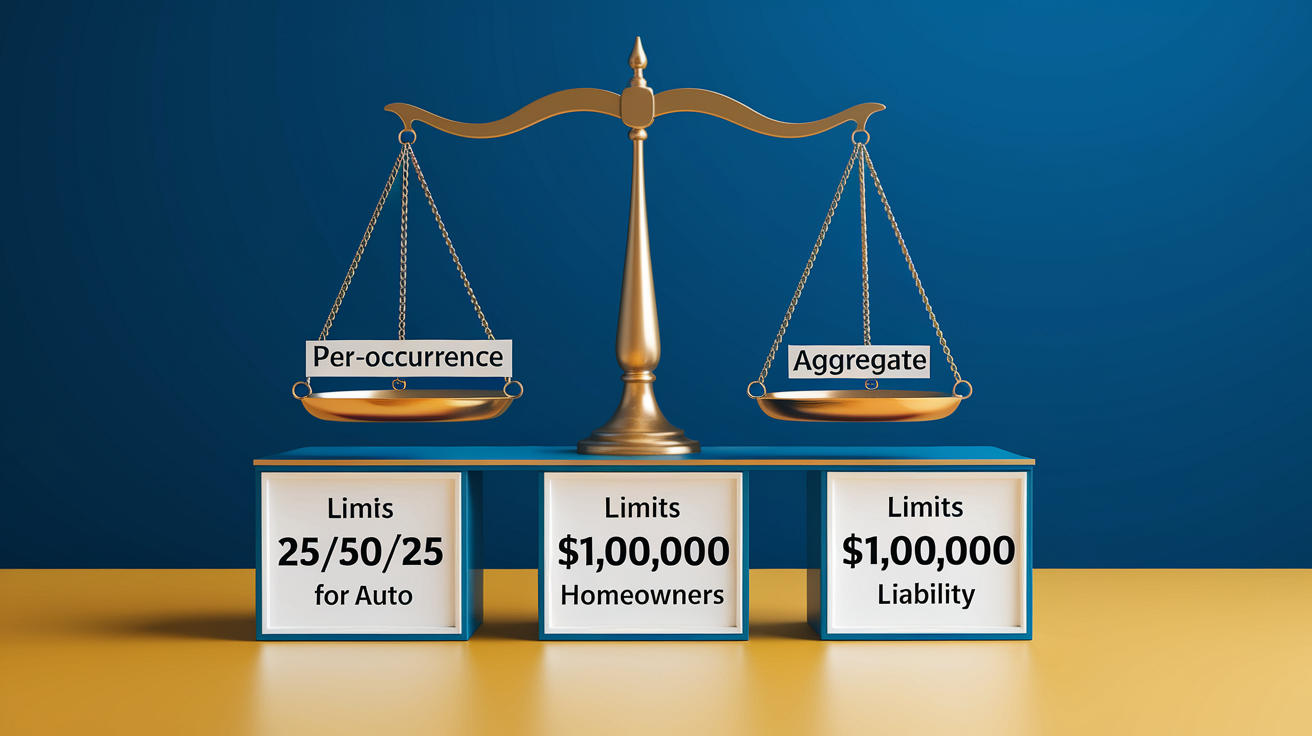
Liability limits get expressed as either a single combined limit or split limits. Auto policies often use split limits formatted as three numbers: the first is the maximum paid per person for bodily injury, the second is the maximum paid per accident for all injured parties combined, and the third is the maximum paid for property damage per accident. A common minimum is 25/50/25, meaning $25,000 per person, $50,000 per accident for injuries, and $25,000 for property damage. Some states require higher minimums, such as 30/60/25 or even 50/100/50, while a few allow lower thresholds like 15/30/5.
Homeowners and renters policies typically include personal liability with a single combined limit, often starting at $100,000. This limit applies to all bodily injury and property damage claims combined during the policy period. Many insurers offer upgrades to $300,000, $500,000, or $1,000,000 for a modest bump in premium, and those higher limits are often required before you can buy an umbrella policy.
Business general liability policies use per-occurrence and aggregate limits. The per-occurrence limit is the maximum the insurer will pay for a single claim or event, while the aggregate is the total amount the insurer will pay for all claims during the policy year. A starter GL policy might carry $100,000 per occurrence and $300,000 aggregate, but a more common industry standard is $1,000,000 per occurrence and $2,000,000 aggregate. Once the aggregate is exhausted, the policy provides no further coverage until renewal.
| Policy Type | Common Minimum Limits | Notes |
|---|---|---|
| Auto Liability | 25/50/25, 30/60/25, 15/30/5 | Minimum varies by state; higher limits recommended to protect assets |
| Homeowners/Renters Personal Liability | $100,000 single limit | Upgrade to $300,000–$1,000,000 common; required for umbrella eligibility |
| Small-Business General Liability | $100,000–$1,000,000 per occurrence; $300,000–$2,000,000 aggregate | Industry standard often $1M/$2M; contracts may require higher limits |
| Product Liability (Retail) | Varies; often $1,000,000 per occurrence minimum | Retailer contracts typically mandate coverage before shelving products |
Cost of a Starter Liability Policy and Factors That Drive Your Premium

Auto liability-only policies for low-risk drivers in states with moderate insurance costs typically range from $200 to $800 per year. High-risk drivers with recent accidents, DUI convictions, or poor credit scores can see premiums double or triple that range, and residents of expensive insurance states such as Michigan or Florida may pay well over $1,000 annually even for minimum coverage. Age and driving experience also play a major role. A 19-year-old driver will pay significantly more than a 45-year-old with a clean record, even for identical coverage.
Small-business general liability starter policies generally cost between $300 and $1,200 per year for low-exposure operations such as freelance consulting, home-based graphic design, or bookkeeping services. Premiums climb quickly for businesses with physical storefronts, in-person client interaction, or higher revenue. A coffee shop with foot traffic and hot equipment might pay $1,500 to $3,000 annually for the same $1,000,000 per-occurrence limit that a remote software consultant buys for $400. Product liability adds another layer of cost. Food products and simple consumer goods are typically less expensive to insure than custom medical devices, supplements with health claims, or electronics with fire risk.
Insurers evaluate multiple underwriting factors when calculating your premium. Your claims history is the single strongest predictor: one prior claim can raise your rate by 20 to 40 percent, and multiple claims may make you uninsurable in the standard market. For businesses, industry classification codes determine baseline risk. A landscaping company with power tools and ladders will always pay more than a virtual assistant with no equipment or client visits. Location matters because lawsuit frequency, jury awards, and medical costs vary by state and even by county. Higher coverage limits increase premiums proportionally, but the jump from $100,000 to $300,000 in liability is often smaller than the added protection justifies.
Top premium drivers:
- Industry or activity risk – high-exposure businesses or drivers with accident-prone vehicles pay more
- Claims history – prior liability claims raise premiums; multiple claims may trigger non-renewal
- Location – high-litigation states, urban areas, and regions with costly medical care see higher rates
- Coverage limits – choosing $500,000 instead of $100,000 increases premium but also expands financial protection
Practical Claim Scenarios That Reveal Gaps in Starter Liability Policies

A driver with 25/50/25 auto liability limits causes a two-car accident that sends three passengers in the other vehicle to the hospital. One passenger suffers a traumatic brain injury with medical bills, lost income, and pain-and-suffering damages totaling $250,000. The insurer will pay up to $50,000 for all bodily injury claims combined in this accident, leaving the driver personally responsible for the remaining $200,000. The injured passenger can sue the driver, place liens on assets, garnish wages, and force bankruptcy if the driver can’t pay. A policy with higher limits or an umbrella would have covered the full $250,000 and prevented personal financial ruin.
A renter hosts a dinner party and a guest trips on a loose rug, fracturing a hip and requiring surgery, physical therapy, and three months of missed work. The total claim is $120,000. The renter’s policy includes $100,000 in personal liability, so the insurer pays the full $100,000 limit and closes the claim. The injured guest is still owed $20,000 and can pursue the renter’s savings, future wages, or other assets to collect the balance. If the renter had upgraded to $300,000 in liability coverage for an additional $30 per year, the entire claim would have been paid without exposing personal funds.
These examples show how low limits create a false sense of security. The policy handles small claims efficiently, but a single serious accident or injury can exhaust starter coverage and leave you facing a judgment you can’t afford. Courts don’t forgive the shortfall just because you carried insurance. If your limit is too low, you remain personally liable for the difference. Reviewing your liability exposure against your net worth and upgrading limits accordingly is the only way to prevent a covered claim from becoming a personal financial disaster.
Who Should Consider a Starter Liability Policy and When It Makes Sense

New drivers who own inexpensive vehicles outright and carry minimal savings are good candidates for auto liability-only coverage. A 22-year-old driving a 15-year-old sedan worth $2,500 with no loan would waste money buying collision and comprehensive coverage because the insurer would only pay the car’s actual cash value minus the deductible if it were totaled or stolen. Liability-only meets the state requirement, keeps premiums affordable, and allows the driver to save money for a better vehicle or higher liability limits as income grows.
Renters and homeowners with limited assets and low personal risk exposure can start with basic personal liability coverage. A renter with $5,000 in savings, no dependents, and a low-risk lifestyle can manage on a $100,000 liability limit, especially if they rarely host guests or engage in activities that increase injury risk. As net worth climbs or life circumstances change (buying a home, starting a family, or hosting frequent gatherings) the same person should upgrade to $300,000 or $500,000 to match the increased exposure.
Micro-startups with no employees, minimal revenue, and no contractual insurance requirements can begin with a starter general liability policy to satisfy landlord or vendor demands without overbuying coverage. A solo freelance writer working from home with one or two clients and no office visitors faces almost no third-party injury or property damage risk. A $100,000 per-occurrence policy provides a legal defense budget and basic coverage at a low cost, allowing the business to allocate capital toward growth instead of insurance premiums.
Groups suited for starter liability:
- New or young drivers with low-value vehicles and no financing or lease requirements
- Renters or homeowners with limited net worth and low personal liability exposure
- Micro-businesses and sole proprietors with no employees, minimal client interaction, and low revenue
- Freelancers and gig workers whose services carry little risk of causing bodily injury or property damage to third parties
When to Upgrade Beyond a Starter Liability Policy

Your personal net worth exceeding your liability limit is the clearest signal to upgrade. If you have $150,000 in home equity, retirement savings, and liquid assets but only carry $100,000 in personal liability, a single serious claim will wipe out your policy limit and expose everything you own to a lawsuit. Financial advisors typically recommend carrying liability coverage equal to or greater than your net worth, with a common baseline of $300,000 to $500,000 for individuals and $1,000,000 for families with significant assets.
Financing or leasing a vehicle triggers a mandatory upgrade because lenders require collision and comprehensive coverage to protect their investment. You can’t legally drive off the lot with a liability-only policy if the bank holds the title. The added premium is unavoidable, but it also protects your ability to replace the vehicle if it’s totaled or stolen, which matters more when you owe $20,000 on a car loan.
Hiring employees creates an immediate need for workers’ compensation insurance, which is required by law in all 50 states as soon as you have at least one employee on payroll. General liability doesn’t cover employee injuries. Workers’ comp is a separate policy that pays medical bills, disability benefits, and lost wages when an employee gets hurt at work. Employment practices liability insurance also becomes important once you have employees, because wrongful termination, discrimination, and harassment claims are common, and nearly 40 percent of US companies face an employment-related lawsuit over a five-year period.
Launching a product or scaling revenue introduces new liability exposures that starter policies don’t address. If you sell physical goods direct to consumers, you need product liability insurance before those items reach retail shelves or ship to customers. Many retailers won’t accept your products without proof of coverage. If you provide software, consulting, or professional services, errors and omissions insurance should be purchased before product launch to cover claims that your service or advice caused a client financial loss.
Client contracts and investor requirements often mandate higher limits or additional coverages. A corporate client may refuse to sign a service agreement unless you carry $2,000,000 in general liability and $1,000,000 in E&O. Venture capital investors typically require directors and officers insurance, crime coverage, and cyber liability before they invest, especially if your startup handles customer data or operates in a regulated industry.
Five common upgrade triggers:
- Your net worth or liquid assets exceed your current liability limits. Upgrade personal liability to at least $300,000, ideally $500,000 or $1,000,000, and consider an umbrella policy.
- You finance or lease a vehicle. Lender will require collision and comprehensive; upgrade to full coverage immediately.
- You hire your first employee. Purchase workers’ compensation and employment practices liability insurance to comply with state law and protect against workplace injury and discrimination claims.
- You launch a product or scale revenue. Add product liability if selling physical goods; add E&O if providing professional services; increase general liability limits to match contract requirements.
- You handle customer data or enter a regulated industry. Purchase cyber liability and confirm your general liability and E&O policies cover regulatory fines and breach response costs.
Final Words
You can see the basics: a starter liability policy covers third-party bodily injury, third-party property damage, and defense costs at entry-level limits, but it often excludes collision, professional errors, cyber risks, and business property.
We reviewed limits and state minimums, typical costs, real claim examples that show gaps, who benefits from starter coverage, and clear triggers for upgrading.
If you’re still asking what is a starter liability policy, use this as a checklist, start small if risks are low, but plan to upgrade as assets, contracts, or operations grow. That’s good planning.
FAQ
Q: How much does a $1,000,000 liability insurance policy cost?
A: A $1,000,000 liability insurance policy typically costs between $150 and $1,500+ per year: personal umbrella policies often run $150–$400 if you have base coverage, while small-business $1M GL can be $400–$1,500+, depending on risk.
Q: What are two types of liability insurance?
A: Two types of liability insurance are general liability (covers third-party bodily injury and property damage) and professional liability or errors and omissions (covers claims from mistakes, bad advice, or service failures).
Q: What is the purpose of a liability policy?
A: The purpose of a liability policy is to pay for third-party bodily injury, property damage, and legal defense costs up to your limits, helping protect your savings and assets from lawsuits or claims.
Q: How much does it cost to start liability insurance?
A: The cost to start liability insurance varies: auto liability-only commonly runs $200–$800/year, small-business starter general liability about $300–$1,200/year, and renters/homeowner liability is often a low-cost add-on.