


Think your insurance will replace an old TV with a brand-new one?
Not usually.
Actual cash value (ACV) is what your damaged item is worth right now, after depreciation, and insurers use it to calculate payouts.
That means your check can be much smaller than a brand-new replacement, and you may have to cover the difference.
This post shows how ACV is calculated, why it matters, and what to check in your policy so you can avoid surprise bills.
Core Explanation of Actual Cash Value and How It’s Calculated
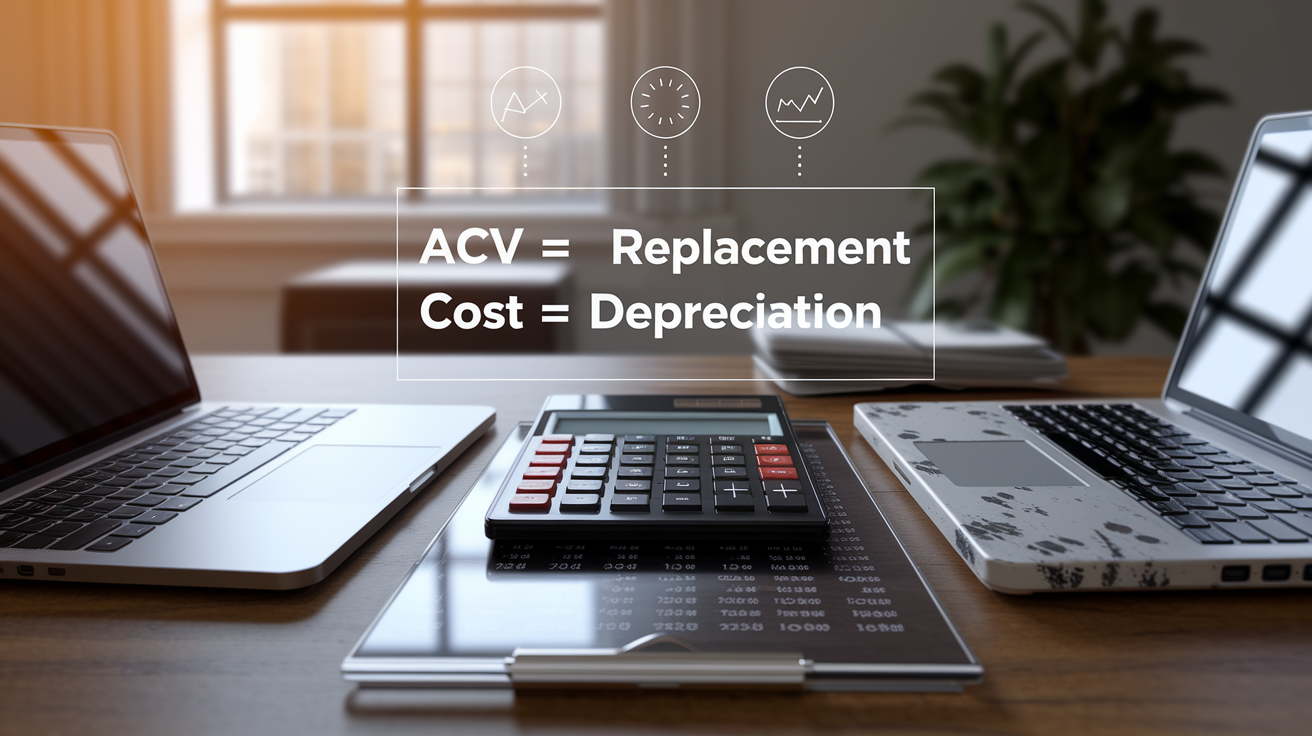
Actual cash value (ACV) is what your insured item is worth right now, at the moment of loss. It’s not what you paid for it years ago, and it’s not what you’d spend to buy it brand new today. It’s somewhere in between, and that difference matters when you file a claim.
The formula’s simple: replacement cost minus depreciation. Replacement cost is what you’d pay today to buy a new version of the same item. Depreciation is how much value the thing has lost since you bought it. Time, wear, and use all chip away at value. So if your damaged laptop would cost $1,000 to replace new, but it’s two years into a five year lifespan, the insurer might depreciate it by $400. Your ACV payout? $600.
Insurers use ACV because most stuff loses value as it ages. If they paid full replacement cost on every claim, premiums would be unaffordable for most people. The idea is to put you back where you were financially just before the loss, not to hand you an upgrade.
When you file a claim, the adjuster applies this formula to figure out what you actually lost in economic terms, not sentimental value or what you wish it was worth.
Depreciation comes down to three things:
- Age — the longer you’ve owned something, the less it’s worth.
- Condition — beat up, poorly maintained items lose value faster than well cared for ones.
- Expected useful life — a phone designed to last three years depreciates way faster per year than a roof built to last twenty.
Practical Examples of Actual Cash Value in Real Insurance Claims
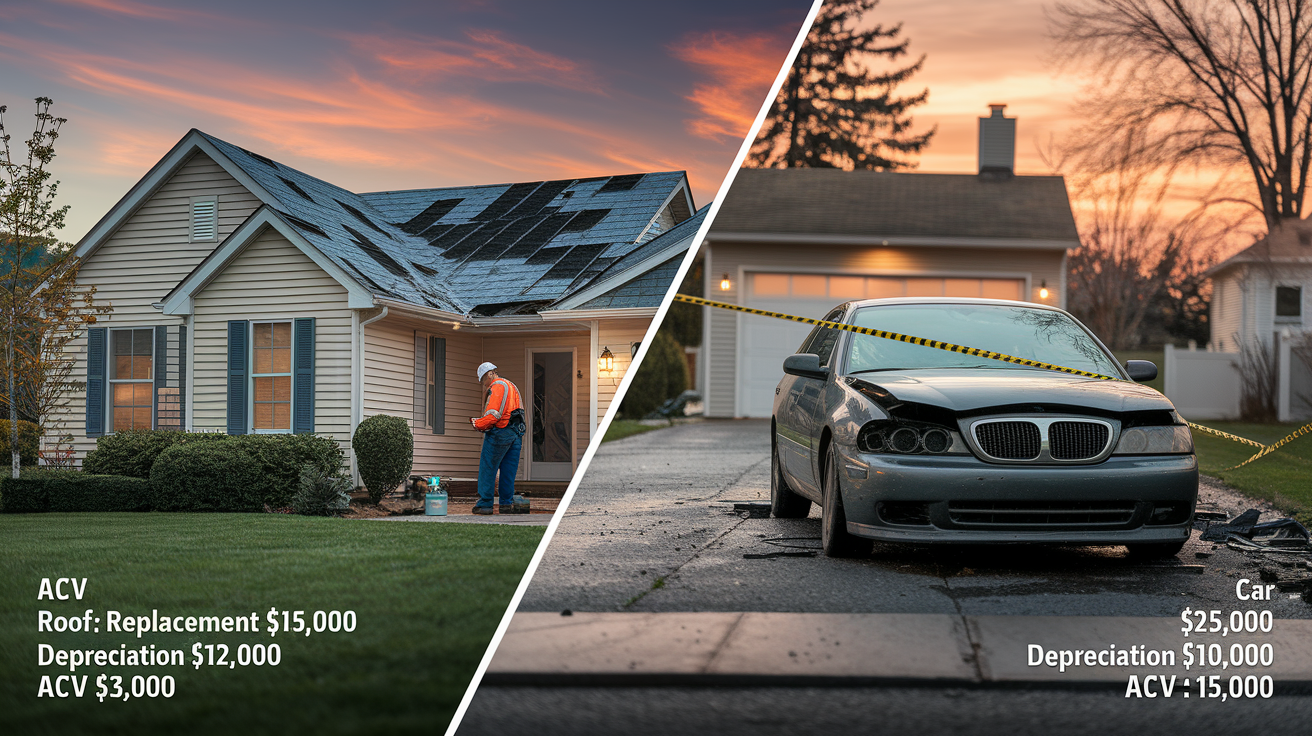
ACV gets easier to understand when you see it play out in real claims. Someone files after hail damages their twelve year old roof. Replacing it with new materials costs $15,000. The roof was supposed to last fifteen years, and it’s already been up there for twelve. Using straight line depreciation, the insurer calculates ACV as $15,000 × (15 − 12) / 15 = $3,000. After a $1,000 deductible, the homeowner gets a check for $2,000. They’re on the hook for the other $13,000 if they want a full replacement.
A driver totals their car. The adjuster figures a similar vehicle today would cost $25,000. The car’s four years old, and based on age, mileage, and condition, the insurer applies 40 percent depreciation. ACV comes out to $15,000. After the $1,000 collision deductible, the driver walks away with $14,000. If they keep the salvage (the wrecked car for parts or scrap), the insurer might deduct that salvage value, say $2,000, dropping the check to $12,000.
| Item | Replacement Cost | Depreciation | ACV Payout (before deductible) |
|---|---|---|---|
| Twelve year old roof | $15,000 | $12,000 (80% of useful life) | $3,000 |
| Four year old vehicle | $25,000 | $10,000 (40% depreciation) | $15,000 |
| Three year old television | $800 | $480 (60% depreciation) | $320 |
| Seven year old appliance | $1,200 | $840 (70% depreciation) | $360 |
Factors That Influence Depreciation in ACV Calculations

Age hits first and hardest. A one year old phone loses way less value than a five year old model, even if both still work fine. Insurers apply depreciation schedules that front load the loss. Electronics might drop 20 to 30 percent in year one, then slow down as they approach the end of expected life.
Condition matters too. An appliance that’s been serviced regularly and looks decent will hold value better than the same model that’s scratched up, stained, or making weird noises. Adjusters look at photos, receipts, service records. Items stored badly or left outside depreciate faster than those kept in climate controlled spaces.
Market value can override the usual tables. If a particular car model holds resale value better than most, the adjuster might lower the depreciation percentage. If a product line’s been discontinued or tech’s moved on, they’ll bump depreciation up to match what you’d actually get in the market. Expected useful life varies wildly. Roofs might be rated at fifteen to thirty years. Consumer electronics? Three to seven, tops.
Insurers look at several things when calculating depreciation:
- Original price and quality — higher end stuff may last longer, but starts from a bigger number.
- Type of property — roofs age differently than laptops.
- Usage patterns — daily drivers wear out faster than seasonal gear.
- Obsolescence and demand — outdated tech or styles tank faster than classics or hot items.
- Carrier specific schedules — insurers have internal tables that standardize rates by category, though they don’t always share these upfront.
Actual Cash Value vs. Replacement Cost Coverage

Replacement cost coverage pays what it actually costs to replace your stuff with new, similar items. No depreciation deduction. When you file a claim under replacement cost, the insurer cuts a check based on current retail prices, subject to your limits and deductible. ACV coverage knocks off depreciation first, leaving you with less cash and a bigger gap to cover on your own.
Replacement cost premiums run higher because the insurer’s committing to bigger payouts. The choice is clear: pay more now to avoid the depreciation gap later, or accept lower premiums and plan to cover the difference yourself if something happens. For new or expensive items, replacement cost usually makes sense. The depreciation hit on an ACV claim can be thousands of dollars.
Some insurers do a recoverable depreciation process with replacement cost policies. They pay ACV right away, then reimburse the depreciation once you actually replace the item and send in receipts. This protects them if you decide not to replace, but still gets you full replacement cost if you follow through.
| Feature | Actual Cash Value (ACV) | Replacement Cost Value (RCV) |
|---|---|---|
| Payout calculation | Replacement cost minus depreciation | Full cost to replace with new, no depreciation deduction |
| Premium cost | Lower | Higher |
| Out of pocket gap for older items | Larger (you cover depreciation) | Smaller or none (insurer covers depreciation) |
| Common application | Auto total loss, default for personal property in many policies | Homeowners/renters endorsements, newer vehicles with full coverage |
| Best fit | Budget conscious buyers, older belongings, lower replacement costs | New or high value items, homeowners wanting full replacement |
When Actual Cash Value Coverage Makes Sense

ACV works when your stuff’s already old and the gap between replacement cost and depreciated value isn’t huge. If you’ve got a ten year old couch that’d cost $800 new but has an ACV of $200, that $600 difference might be manageable out of pocket, especially if lower ACV premiums save you money over time. For items near the end of their useful life, paying extra for replacement cost can mean spending more in premiums than you’d ever see back in a claim.
Budget minded policyholders often go with ACV for personal property to keep costs down. If you’ve got an emergency fund and can absorb depreciation losses without strain, ACV lets you put the premium savings toward other things. Plenty of renters and homeowners who replace stuff gradually or buy used anyway find that ACV fits how they actually manage belongings.
Some policies default to ACV for personal property unless you specifically buy a replacement cost endorsement. In those cases, ACV is your starting point, and you have to actively upgrade if you want full replacement value. Check your policy’s Coverage C section to confirm whether you’re on ACV or replacement cost, and look at the endorsement cost before deciding. For DIYers comfortable sourcing materials and doing repairs, or for folks willing to replace items with used or refurbished versions, ACV can work well. The cash payout gives you flexibility without forcing you to buy new.
Final Words
You learned the simple ACV rule: replacement cost minus depreciation, how insurers calculate it, and why that usually means lower payouts.
We walked through roof and vehicle examples, highlighted the key depreciation factors, and compared ACV to replacement cost so you can see the trade-offs.
If you’re still asking what is actual cash value in insurance, it’s the current value of an item after depreciation — good for lower premiums but smaller claim checks. Review your policy at renewal and you’ll be ready to pick the coverage that fits your needs.
FAQ
Q: Which is better, replacement cost or actual cash value?
A: Replacement cost is better for fully replacing damaged items without depreciation, while actual cash value is better for lower premiums; pick replacement cost for new-item recovery, ACV to save on premium costs.
Q: What is an actual cash value in insurance?
A: An actual cash value in insurance is the current value of an item, calculated as replacement cost minus depreciation, so claim payouts reflect wear, age, and reduced market value.
Q: Can I negotiate actual cash value?
A: You can negotiate an actual cash value by submitting receipts, photos, repair estimates, and comparable sales; document condition, ask the adjuster to re-evaluate, or hire an independent appraiser if needed.
Q: What is the cash value of a $500,000 whole life insurance policy?
A: The cash value of a $500,000 whole life policy varies by insurer, policy age, and premiums paid; review your policy illustration or contact the insurer for the current surrender or loan value.